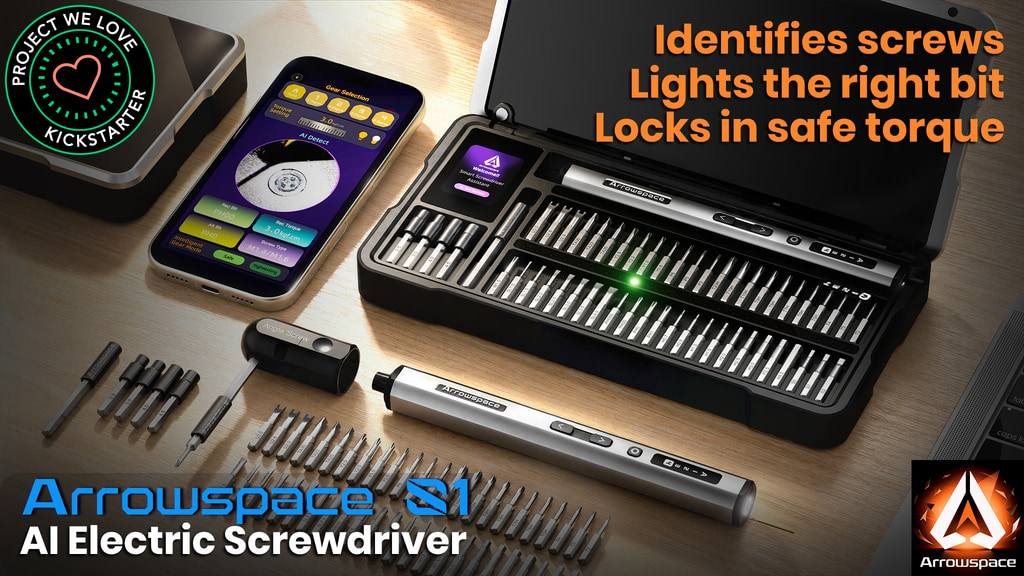
Choosing the wrong precision bit can turn a simple repair into a stripped-screw problem. Arrowmax’s new Arrowspace S1 tries to remove that guesswork with a rear camera, a phone-based recognition system and, in the full kit, a case that lights the slot containing the recommended bit.
The concept is unusually practical for an AI gadget, but the S1 is not a finished retail product. It is being funded through Kickstarter, with estimated deliveries beginning in April 2027. The lowest pledge is about $79 for the screwdriver alone, while the more complete early-bird kit is about $129 before shipping. Those are campaign rewards rather than ordinary store purchases, so delivery dates and final specifications are not guaranteed.
How the Arrowspace S1 identifies a screw
A small HD camera is built into the rear of the screwdriver. An extending contact probe rests on the surface around the fastener and holds the camera at a fixed distance, addressing a basic problem with photographing tiny screw heads: even a small focus error can make the profile hard to recognize.
The image is sent over a local connection to the companion phone app. Arrowmax says its recognition model was trained on tens of thousands of screw images collected and annotated by its engineering team. The current model covers 12 common screw-head profiles and returns a suggested drive type and size. The app also shows the captured image, giving the user a chance to check the recommendation rather than accepting a hidden result.
The smart case is what completes the workflow
The $79 standalone configuration can identify a screw and display the suggested bit in the app. The optional Smart Case makes the idea more tangible. It contains 52 S2-steel bits, a color display and individual lights for the storage slots. When the system recognizes a screw, the corresponding slot illuminates.
The campaign lists the bits at HRC60 hardness and includes longer bits for recessed fasteners. The full early-bird kit also includes a power-tip extension. This package is aimed at electronics, cameras, glasses, drones, game consoles and other work involving small fasteners, rather than automotive lug nuts or construction screws.
Automatic torque is useful—but not foolproof
The S1 can associate an identified fastener with a preset “safe” torque range. Arrowmax says the electric torque is adjustable from 1 to 10 kgf·cm, while the body can withstand up to 30 kgf·cm when used manually. An OLED screen shows the selected torque, rotation direction and battery status.
Importantly, the campaign itself warns that correct torque also depends on the fastener, material and application. A screw driven into plastic may need different treatment than the same head profile used in metal. The automatic setting should therefore be considered a conservative starting point, not a substitute for a manufacturer’s torque specification or careful hand control.
The AI works locally on the phone
Arrowmax says screw recognition takes place in the companion app without sending images to a cloud server. The phone and tool communicate locally, and an internet connection is not required for recognition. That design limits unnecessary uploads of workbench images and also makes the feature more useful in garages or repair areas with poor connectivity.
Only the recognition step depends on AI. Motor control, manual torque selection, charging and the display continue to work when the app is disconnected. In other words, a failed recognition or unsupported screw profile should not turn the S1 into an unusable tool; it becomes a conventional adjustable precision screwdriver.
Battery, charging and accessories
The company lists a 600mAh rechargeable battery and claims up to 90 minutes of operation or more than 900 screws per charge. Actual runtime will depend on torque, fastener resistance and how often the camera and wireless functions are used. USB-C charging is rated to take about 70 minutes with a compatible power source.
An optional right-angle attachment transfers up to 10 kgf·cm through a 90-degree gear train for tight spaces. Arrowmax is also offering a magnetic work pad and bit-converter sets as add-ons. These are separate purchases, so buyers should compare the complete pledge and later shipping charge rather than focusing only on the screwdriver’s headline price.
What the Kickstarter prices include
At the time of publication, the campaign lists a Kickstarter-exclusive standalone S1 pledge at HK$619, shown as about $79, plus an estimated $8 worldwide shipping charge collected later. That version includes only the electric screwdriver.
The early-bird full kit is HK$1,009, shown as about $129, plus an estimated $16 shipping charge. It includes the S1, illuminated Smart Case, 52 bits and power-tip extension. Limited reward quantities can sell out, currency conversion can change and taxes or import charges may apply depending on destination.
Crowdfunding risk matters more than the feature list
Kickstarter clearly states that rewards are not guaranteed. Arrowmax has delivered earlier crowdfunded screwdriver projects, including the SES Pro, SES Max and M1 Pro, which is more history than a first-time hardware creator can offer. That record still does not guarantee that the S1 will ship in April 2027 or arrive unchanged.
The campaign describes the pictured units as functional prototypes and acknowledges that production demand could delay fulfillment. Hardware backers also have fewer straightforward return and delivery protections than customers buying a stocked product from a conventional retailer. Anyone who needs a precision screwdriver for current repairs should buy an available tool instead of treating a pledge as a dependable order.
Who the S1 could help
The strongest use case is a hobbyist or repair technician who repeatedly handles many tiny fastener types. The illuminated case could save time, while the fixed-focus probe may help when screw heads are difficult to distinguish by eye. Beginners may also benefit from a cautious torque suggestion, provided they still verify the bit fit and material.
For occasional household repairs, the extra camera, app and smart case may add more complexity than value. A well-labeled manual bit set and a conventional electric precision driver cost less and do not depend on recognition software. The S1’s advantage grows with the number of small, mixed fasteners encountered in a typical job.
What remains unproven
No independent hands-on testing has yet established recognition accuracy across worn, dirty, painted or damaged screw heads. It is also unclear how reliably the model distinguishes very similar sizes under poor lighting and whether future app updates will expand profile support on schedule.
The design addresses a real repair problem, and local processing is a welcome privacy choice. The sensible decision, however, is to evaluate the S1 as crowdfunded prototype hardware: promising enough to watch, but not equivalent to a finished $79 retail product.