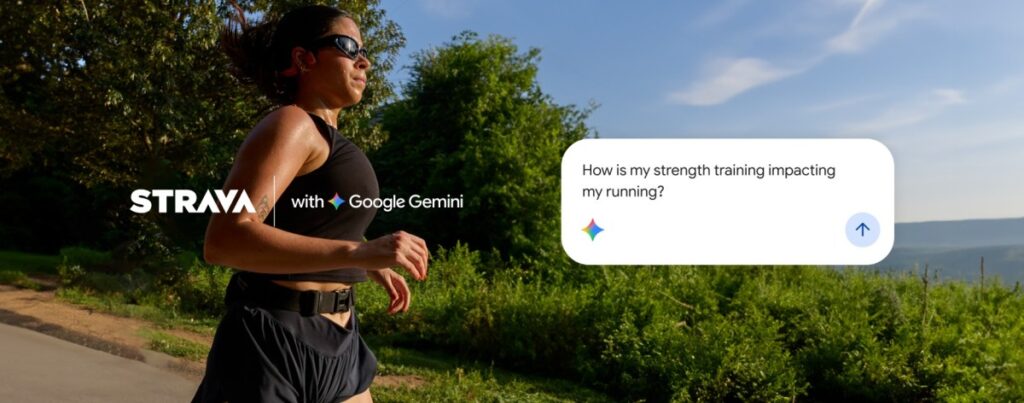
Strava subscribers in the United States can now connect their accounts directly to Google Gemini and ask questions about their workout history. The integration, announced October 28, gives Gemini access to a user’s authorized Strava data so it can compare activities, spot trends and answer questions that would otherwise require digging through months of training records.
This is not a new workout tracker or an automatic coaching plan. It is an optional, read-only connection. Gemini can analyze the information Strava makes available, but it cannot upload, edit or delete activities. That distinction is important for anyone deciding whether the convenience is worth sharing another layer of fitness context with an AI assistant.
What the Strava–Gemini connection does
Once connected, Gemini can use a subscriber’s activity history as context for a conversation. Strava’s examples include comparing pace at the same heart rate, reviewing a recent race, examining how strength training may relate to running, finding a fastest 10K and looking at how weather conditions affected performance.
The available context can include activities, fitness trends, best efforts, streaks, gear and recorded weather. Because Gemini reads live account data when a question is asked, the result can reflect newly uploaded activities rather than a one-time export that gradually becomes outdated.
That makes the feature most useful for questions that span many workouts. A runner could ask whether easy-run pace has changed over several months, while a cyclist could compare similar routes or identify the conditions associated with stronger rides. The answer is generated by Gemini, however, so it should be treated as an interpretation rather than a certified performance result.
Who can use it now
The launch is limited to the United States and requires an eligible Strava subscription. Google’s eligibility table also lists a personal Google Account, age 18 or older and English as the supported language at launch. Strava says the connection works across Google Gemini plans, so a separate Gemini upgrade is not listed as a requirement. Eligible Strava plans include the standard subscription, Strava plus Runna, Family and Student plans, along with qualifying discounted subscriptions.
Strava has not announced when the Gemini connection will expand beyond the US. It also has not introduced a separate price for the integration; it is presented as a subscriber feature. People using Strava’s free tier are not eligible at launch.
How to connect Strava to Gemini
Setup starts in Gemini’s Personal Intelligence settings. Choose Strava under connected apps, sign in to the Strava account and approve the requested access. After authorization, Gemini can answer Strava-related prompts in an ordinary conversation.
The connection is voluntary and can be removed later. Strava says disconnecting stops Gemini from accessing the account through this integration. Users should still review the privacy and activity controls in both services, especially if their workout history contains sensitive locations, routines or health-adjacent information.
The privacy guardrail: read-only access
The most meaningful limitation is also the clearest safeguard: Gemini cannot write back to Strava. It cannot record a workout, change a distance, alter a title or delete an activity. That reduces the risk of an AI response accidentally modifying a training log.
Strava says the connection uses its Model Context Protocol server with access controls and guardrails. Authorization remains tied to the user, and the integration can be disconnected. Those protections do not make every generated answer correct, and they do not remove the need to understand each service’s privacy settings. Users who hide home locations, restrict activity visibility or avoid recording certain workouts should keep those practices in place.
Important limits before relying on the answers
Strava’s support documentation notes that request limits apply per minute and per day, although it does not publish the exact limits. Heavy users may therefore encounter a cap. The company also warns that an AI assistant’s conclusions can differ from Strava’s Performance Predictions or a Runna training plan.
That is expected: a conversational model is summarizing and reasoning over data, not reproducing every calculation used by a dedicated training product. Missing heart-rate data, inconsistent device measurements, paused recordings and changes in terrain can all distort comparisons. A polished explanation is not evidence that the underlying comparison was scientifically controlled.
The feature should not be used as a medical diagnosis or as a replacement for a qualified coach or clinician. Questions about pain, recovery, heart-rate abnormalities or return-to-exercise decisions need appropriate professional advice.
Why this matters for fitness apps
Fitness platforms have long displayed charts, weekly totals and personal records. The Gemini connection changes the interface: instead of navigating dashboards, subscribers can ask a natural-language question that crosses sports, time periods and metrics.
That could make accumulated activity data more useful to ordinary athletes. It also places more responsibility on users to phrase questions carefully and verify surprising conclusions. The best prompts will be specific about the period, sport and metric—for example, asking for a pace comparison on similar-distance runs over the last twelve weeks rather than asking whether training is simply “better.”
How it compares with Strava’s Claude connection
Gemini is not Strava’s first AI-assistant connection. Strava introduced support for Anthropic’s Claude in June 2026. The October launch brings similar account-linked analysis to people who prefer Google’s assistant and its Personal Intelligence system.
The shared model is notable: Strava remains the source of the activity data, while the chosen assistant becomes the conversational analysis layer. Users can choose whether to connect at all, and the assistant receives read access rather than control of the training log.
What remains unknown
Strava has not provided a timeline for international availability, exact request quotas or a free-tier version. It also remains to be seen how consistently Gemini handles comparisons across different devices, sports and incomplete records.
For now, the integration is best viewed as a faster way for US subscribers to explore their own history. Its value will depend less on flashy summaries and more on whether it can produce transparent, repeatable answers from the data a user has already recorded.