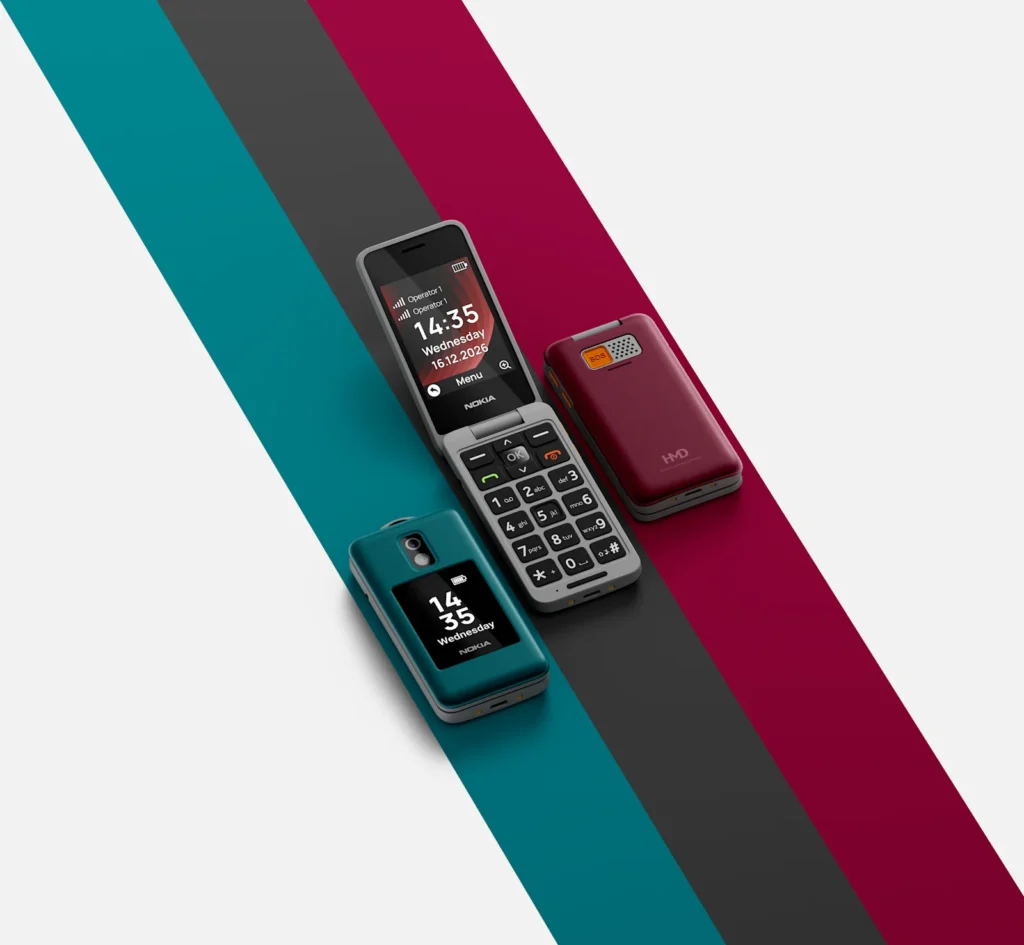
HMD has introduced the Nokia 2360 Flip, a deliberately simple phone for seniors, children and anyone who needs calling and texting without a modern smartphone. Its most interesting feature is not the clamshell design. A companion Family Assist app lets a relative remotely add contacts, set reminders, adjust volume and configure emergency settings.
The idea is practical, but the network specification is the catch. The Nokia 2360 Flip is a 2G-only phone, and HMD’s international specification page lists GSM 900/1800 support. That makes carrier compatibility the first question to answer, not an afterthought. HMD has also not announced pricing or broad market availability.
What HMD announced
The Nokia 2360 Flip was unveiled on October 30, 2026 as a basic dual-screen feature phone. It runs HMD’s S30+ software rather than Android, has a physical keypad and is intended to make essential functions easy to find. The main display measures 2.8 inches, while a 1.77-inch exterior screen shows information such as the caller before the phone is opened.
HMD offers the phone in charcoal, burgundy red and teal. It weighs 121 g and measures 111.85 by 55.56 by 18.95 mm when closed. There is no attempt to compete with smartphones on apps, cameras or processing power. The design is about clear menus, large buttons, a loud speaker and a battery that can be replaced.
Family Assist works through text messages
Family Assist is the feature that distinguishes this model from an ordinary low-cost flip phone. The managing relative installs the free Family Assist app on an Android phone or iPhone. From that app, they can add or update contacts, create reminders, adjust the Nokia’s volume and configure its SOS behavior.
Those commands are delivered to the Nokia 2360 Flip by SMS. The feature phone therefore does not need a mobile data plan, Wi-Fi connection or its own smartphone app. Standard text-message charges may still apply to the managing phone, and both devices need working cellular service.
The SMS-based design makes sense for a basic phone because it avoids accounts, cloud dashboards and complicated menus on the Nokia itself. It also means remote management depends entirely on network compatibility. If the phone cannot connect to a supported 2G network, Family Assist, calling, texting and SOS messaging cannot work.
The SOS button has important limits
A dedicated rear SOS button can be held for three seconds to call one preset number and send a text alert to as many as five emergency contacts. The contact list and message can be configured in Family Assist.
HMD is clear that this is not a replacement for public emergency services. The feature calls and texts the people selected by the family; it does not create a guaranteed connection to 911 or an equivalent emergency number. Its usefulness depends on coverage, an active SIM, available battery power and contacts who can receive the alert.
Families considering the phone for an older relative should test the entire sequence after setup. A real test confirms that the button is easy to hold, the intended number receives a call, each contact gets the SMS and everyone understands what to do next.
Parental controls make it a possible first phone
HMD also positions the Nokia 2360 Flip for school-age children. A Family PIN protects parental controls. Parents can create a whitelist so calls and messages are limited to approved contacts, block individual functions such as the camera or games, and enable School Mode.
School Mode reduces the interface to a clock and emergency calling. That can make the phone attractive to families that want basic contact without social media, an app store or a web browser. The tradeoff is equally clear: a child will not have modern location sharing, encrypted messaging, school apps or the richer safety tools available on a current smartphone or cellular watch.
The 2G radio is the biggest buying problem
HMD’s published international specifications list GSM 900/1800 bands only. Many countries still operate some 2G service, but carriers around the world are retiring older networks or reducing coverage as they move spectrum to 4G and 5G. A product being listed online does not mean it will work with a buyer’s local carrier.
The current international model is particularly problematic for the United States. T-Mobile’s published network information lists its remaining 2G service on 1900 MHz, while HMD lists 900/1800 MHz for this phone. AT&T says it has retired 2G and will not activate 2G-only devices. HMD has not announced a U.S. version or U.S. carrier support.
That does not prove every future regional variant will use the same bands. It does mean buyers should not import the listed international SKU expecting it to work in America. Confirm the exact model number, supported bands, local 2G status and carrier activation policy before paying.
Battery, storage and everyday hardware
The removable 1,450 mAh battery is rated by HMD for up to 27.5 hours of talk time or 15 days of standby time. Those figures are manufacturer estimates, not results from GNW testing, and real battery life will depend on signal strength, calling habits and battery age.
The phone has 4 MB of RAM and 4 MB of internal storage, with microSD expansion up to 32 GB. It includes FM radio, a 3.5 mm headphone jack, a QVGA rear camera with LED flash and a USB-C connection. HMD’s box-content list is inconsistent because it mentions both a USB-C cable and a “Micro USB Charger,” so buyers should verify the included charger with the retailer.
There is also hearing-aid compatibility identified as HAC2011 support. The product overview references an IP54 rating, which means some protection from dust and splashes but not submersion. HMD appropriately warns that the removable battery will lose capacity over repeated charge cycles.
What the Nokia 2360 Flip does not provide
This is not a small smartphone. The specifications do not list Wi-Fi, GPS, NFC or a modern app platform. The camera is QVGA, and the available storage is tiny by current standards. Family Assist can change selected settings, but it does not turn the phone into a live location tracker or telehealth device. For comparison, GNW’s coverage of Nothing OS 5.0 and Android 17 shows the security, privacy and camera software expected on current smartphones.
Those omissions may be beneficial for someone who finds smartphones distracting or difficult. They can also be dealbreakers for a caregiver who needs location history, video calling, medication apps or remote device finding. A basic phone should be selected for the tasks it simplifies, not because it appears safer in every situation.
Price and availability remain unknown
HMD has not published a price or detailed country-by-country release plan. The product page advises customers to check local availability, and independent launch coverage also reports that pricing has not been announced.
That missing information prevents a proper value comparison. A simple 2G phone can only be judged against 4G feature phones, entry-level smartphones and cellular safety devices after its price and supported markets are known. A 4G version would also be far easier to recommend in countries that are closing older networks.
Who should consider it
The Nokia 2360 Flip could suit a family in a market with dependable GSM 900/1800 coverage that wants a physical keypad, removable battery and remote control over a few essential settings. Family Assist is especially useful when the person carrying the phone lives elsewhere and finds menu changes difficult.
It may also work as a tightly controlled first phone for a child. However, parents should compare the whitelist and School Mode tools with the location, messaging and emergency features they would lose by choosing a feature phone.
For U.S. buyers, the responsible advice is to wait. There is no confirmed U.S. model, price or carrier support, and the bands on the international specification page do not match T-Mobile’s published 2G band. A phone designed for emergencies is only useful when the network connection is dependable.
The bottom line
The Nokia 2360 Flip has a thoughtful core idea: let a trusted relative manage a simple phone without forcing its user through complicated settings. The SMS-based Family Assist system, physical SOS button, large controls and removable battery all support that goal.
Its 2G-only design is also a fundamental limitation, not a minor specification. HMD needs to clarify pricing, regional versions and carrier compatibility before the phone can be broadly recommended. Until then, the best feature is the one buyers must verify most carefully: whether the phone can actually connect where it will be used.