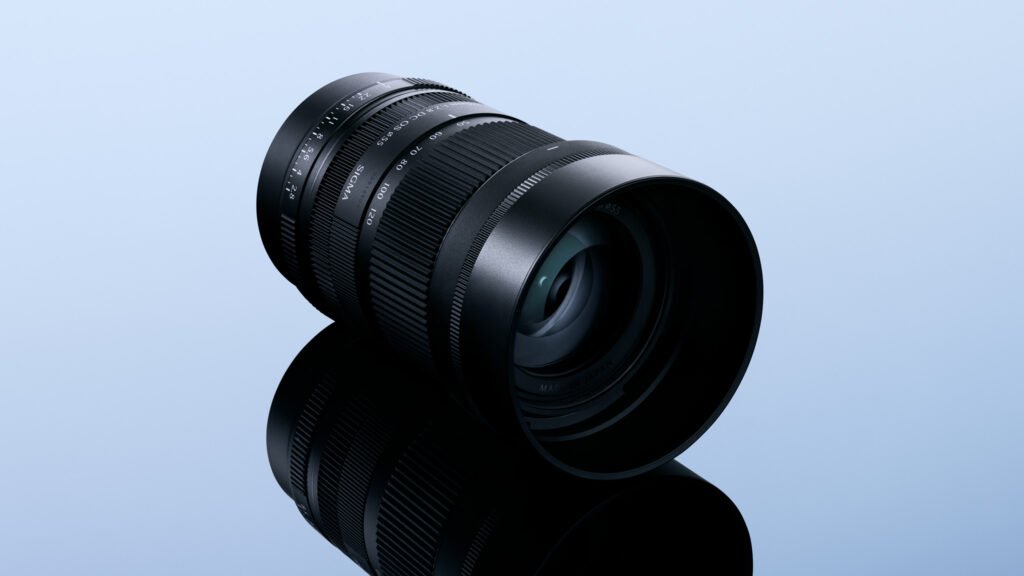
Sigma has introduced a compact constant-aperture telephoto zoom for APS-C mirrorless cameras. The new Sigma 50-120mm F2.8 DC OS | Contemporary costs $799 and arrives October 22, 2026, for Sony E, Fujifilm X and Canon RF mounts.
On an APS-C camera, its field of view is roughly equivalent to 75–180mm on full frame. That makes it a smaller alternative to the traditional 70–200mm F2.8 lens for portraits, indoor sports, events and compressed landscapes. The major attraction is weight: the Sony and Fujifilm versions weigh 390 grams, while the Canon version is reported at 410 grams.
Sigma says the lens combines a constant F2.8 aperture, optical image stabilization and fast linear autofocus in a body only 99 mm long. Those performance claims come from the manufacturer; we have not independently tested the lens.
Price, release date and compatible cameras
The official Sigma America announcement confirms a US price of $799 and availability from authorized dealers on Thursday, October 22.
Three versions will be offered:
- Sony E-mount for APS-C Alpha cameras
- Fujifilm X Mount
- Canon RF Mount for APS-C EOS R cameras
This is a DC lens designed for crop-sensor bodies, not a full-frame telephoto zoom. Full-frame owners should not assume it provides complete sensor coverage simply because the mount fits. Canon RF users should also note that Sigma developed the lens under license from Canon.
Why the 50–120mm range matters
APS-C cameras apply a crop factor to the angle of view. Sigma describes the lens as covering approximately 75–180mm in full-frame terms, giving photographers most of the practical range associated with a 70–200mm zoom while substantially reducing size and weight.
The range is well suited to portraits, school and indoor sports, stage events, ceremonies and detail shots where moving closer is difficult. The constant F2.8 maximum aperture allows the same exposure setting throughout the zoom range and offers more subject separation than slower consumer telephoto zooms.
The tradeoff is reach. A 50–120mm design stops shorter than common 50–140mm APS-C lenses and well below the long end of 70–300mm options. Wildlife and field-sports photographers may still prefer a longer zoom even if it is slower or heavier.
Optical stabilization is rated up to 6.5 stops
Sigma’s OS2 stabilization algorithm is rated for 6.5 stops at 50mm and 4.5 stops at 120mm under CIPA measurement guidelines. Stabilization can make handheld still photography easier in low light and reduce visible shake in video, but it cannot freeze a moving athlete or performer. Fast shutter speeds may still be required.
Autofocus is driven by Sigma’s HLA, or High-response Linear Actuator. The company claims fast, quiet focusing suitable for both still photography and video.
The optical design contains 18 elements in 13 groups, including one FLD element, three SLD elements and four aspherical elements. Sigma says this arrangement controls aberrations and maintains contrast across the frame. An 11-blade diaphragm is intended to produce smooth out-of-focus areas.
Video-friendly design—with fewer physical controls
Sigma says the optical formula minimizes focus breathing, the change in framing that can occur when focus moves from near to far. Reduced breathing can make focus transitions look more natural in video.
The lens also includes an aperture ring, making it the first APS-C zoom in Sigma’s Contemporary series with that control. Photographers and filmmakers can therefore adjust aperture directly on the lens instead of relying entirely on a camera dial.
However, Sigma removed several switches and buttons to keep the body compact. There is no physical focus-mode switch, optical-stabilizer switch, autofocus-lock button or zoom lock. Users who regularly change those settings will need to rely more heavily on camera menus or custom controls.
It completes Sigma’s compact F2.8 trio
The 50–120mm joins Sigma’s 10–18mm F2.8 DC DN Contemporary and 18–50mm F2.8 DC DN Contemporary lenses. Together they cover ultra-wide through telephoto focal lengths with a constant F2.8 aperture, and Sigma says the three-lens kit weighs less than one kilogram.
That is the broader appeal of the new lens. Instead of adapting large full-frame glass to a smaller camera, APS-C shooters can assemble a purpose-built kit that preserves one of the format’s biggest advantages: portability.
Weather resistance has limits
The 50–120mm uses a dust- and splash-resistant structure and a water- and oil-repellent coating on the front element. Sigma specifically warns that the lens is not waterproof. Heavy rain, immersion or large splashes can still cause damage.
The compact design should be easier to carry for travel and long events, but buyers should wait for independent testing to assess autofocus consistency, corner sharpness, flare resistance, stabilization behavior and real-world handling.
How it compares with larger telephoto zooms
A conventional 70–200mm F2.8 full-frame lens often weighs well over one kilogram and costs substantially more. Sigma’s new lens delivers a similar everyday angle of view on APS-C in a 390-gram package, but it is not a direct replacement in every respect.
It provides less telephoto reach than a 70–200mm lens used on the same APS-C body, and the smaller sensor changes depth-of-field behavior at equivalent framing. Photographers who move between APS-C and full-frame bodies may also prefer a full-frame-compatible lens despite the added size.
Who should consider it?
The Sigma 50–120mm F2.8 looks most useful for APS-C photographers who cover people, events or indoor action and value a fast aperture without carrying full-frame-sized glass. It is also attractive to hybrid shooters who want stabilization, linear autofocus and reduced focus breathing.
At $799, it costs more than basic telephoto zooms, so casual users should consider whether they genuinely need F2.8. For photographers already using Sigma’s 10–18mm and 18–50mm lenses, however, the new model completes a coherent lightweight three-zoom system.
Featured image credit: Sigma. Specifications and stabilization figures are manufacturer claims.