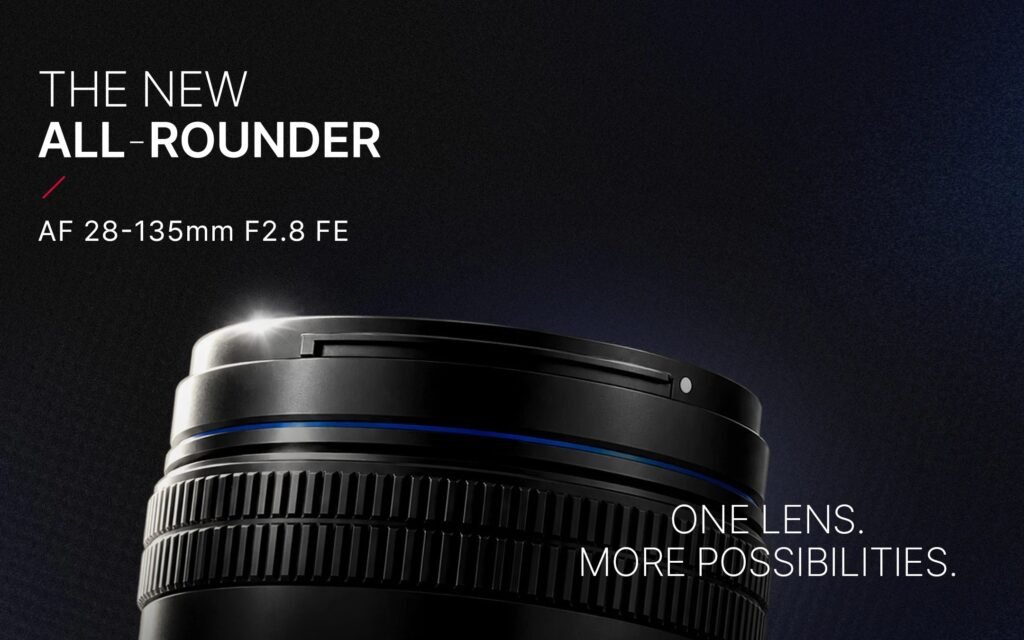
Sony full-frame camera owners may soon have an unusual alternative to carrying both a standard zoom and a short telephoto. Samyang has previewed the AF 28–135mm F2.8 FE, a weather-sealed autofocus lens that keeps a constant f/2.8 maximum aperture across a nearly 5x zoom range.
The company plans to launch the lens in February 2027. Samyang has disclosed most of the core specifications, but it has not announced a price or detailed regional availability. That makes the lens interesting on paper, though still difficult to judge as a buying proposition.
What Samyang has confirmed
The AF 28–135mm F2.8 FE is designed for full-frame Sony E-mount cameras. Its optical construction uses 20 elements in 16 groups, while a nine-blade diaphragm stops down to f/22. The front accepts widely available 82mm filters.
It is an extending zoom rather than an internal-zoom design. The barrel measures 151mm when retracted and extends to about 190mm at the long end. At 854g, or roughly 1.9 pounds, it is lighter than some lens combinations it could replace, but it is not a compact walkaround option.
Samyang also lists weather sealing, although the company has not published a formal ingress-protection rating. Buyers should therefore treat it as added protection against ordinary field use, not as a guarantee against heavy rain or immersion.
Why the 28–135mm range stands out
Most constant-aperture professional zooms stop at familiar boundaries: 24–70mm for general coverage and 70–200mm for telephoto work. Samyang’s lens crosses that divide. It starts at a moderately wide 28mm, covers the classic portrait focal lengths, and reaches 135mm without changing lenses.
That range could be useful for weddings, events, travel, portraits and hybrid photo-video assignments. A photographer could move from a group shot to a tight head-and-shoulders portrait while keeping the same lens mounted. Digital Camera World describes it as the first lens to combine this exact zoom range with a constant f/2.8 aperture.
The main compromise is at the wide end. The difference between 24mm and 28mm can be significant in small rooms, architecture and sweeping landscapes. Anyone who regularly depends on 24mm coverage may still need a second lens.
Autofocus and close-focus specifications
Samyang says the lens uses a voice-coil motor, or VCM, for autofocus. This is the company’s first autofocus lens to use that drive system, according to Digital Camera World. A VCM can support quick, controlled focusing, but published specifications do not establish how fast, quiet or accurate this particular lens will be in real shooting.
Minimum focus distance is 0.27m at the wide end and 0.73m at the telephoto end. Maximum magnification is 0.20x at 28mm and 0.19x at 135mm. Those figures should make close detail shots practical, though this is not a macro lens.
Samyang has not yet provided enough information to evaluate focus breathing, parfocal behavior or video-oriented control features. Those details will matter to filmmakers who want to zoom or pull focus during a shot.
Size and handling tradeoffs
A single 854g lens may be easier to manage than packing two fast zooms, particularly when working in crowded venues or dusty outdoor environments where lens changes are inconvenient. It could also reduce the risk of missing a moment while switching glass.
On the other hand, all of that weight remains on the camera throughout the day. The 39mm change in barrel length may also affect balance on a gimbal. Buyers should wait for complete dimensions, control-layout details and compatibility testing before assuming it will suit an existing rig.
No optical stabilization specification has been confirmed in the initial material. Sony bodies with in-body stabilization may help, but that is not the same as confirming stabilization inside the lens.
Who should consider it
The strongest potential audience is a Sony shooter who values speed and framing flexibility more than minimum size. Event professionals, wedding photographers and one-person hybrid crews could find the 28–135mm span especially useful. Portrait photographers may also appreciate moving between environmental portraits and tighter compositions without swapping lenses.
Travel photographers face a more difficult choice. The broad range is convenient, but the weight and f/2.8 construction make it a substantially different proposition from a small variable-aperture superzoom.
Price, availability and the remaining unknowns
Samyang is targeting February 2027, but the company has not confirmed a retail price, preorder date or market-by-market availability. The brand is also sold as Rokinon in the United States, so local naming and distribution may differ.
Price will determine whether the lens is a compelling alternative to separate zooms or simply an interesting specialist option. Optical sharpness across the frame, distortion correction, flare resistance, autofocus tracking and build quality also remain unverified. Samyang’s teaser is a product announcement, not independent performance evidence, and Gadget N Widget has not handled or tested the lens.
For now, the AF 28–135mm F2.8 FE looks like a thoughtfully targeted all-in-one tool for demanding Sony shooters. Its unusually useful range is the headline feature; the missing price and real-world tests are the reasons to wait before making room in a camera bag.
Sources
- DPReview: Samyang AF 28–135mm F2.8 FE specifications and launch timing
- Digital Camera World: VCM autofocus and market context
- Imaging Resource: announcement coverage
Featured image: official LK Samyang promotional artwork.