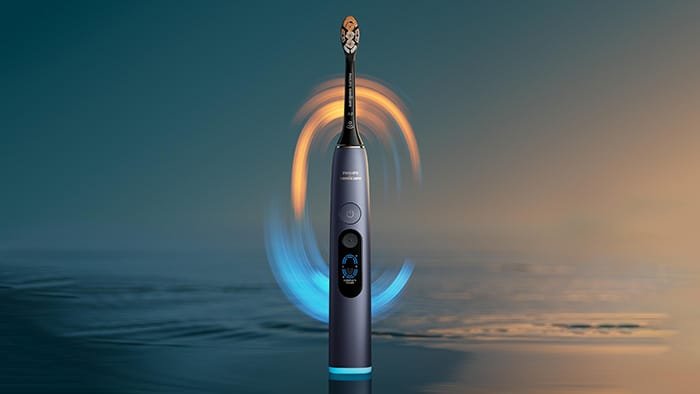
Philips’ most advanced Sonicare toothbrush is now available in the United States and Europe. The Next-Generation DiamondClean 9900 Prestige costs $379.99 in the U.S. and uses motion sensing plus an on-device AI model to show which parts of the mouth need more attention.
The notable change is that its main guidance does not depend on watching a phone while brushing. A display built into the handle shows a 12-section mouth map, while a colored light ring gives live feedback about coverage and pressure. It is still an unusually expensive toothbrush, however, and it does not replace flossing, professional cleanings or dental advice.
What the new DiamondClean 9900 does
The brush tracks its position and motion as it moves around the mouth. Philips divides the mouth into 12 segments and displays the result on the handle after a brushing session. Areas judged complete are distinguished from sections that need another pass.
The light ring at the bottom of the handle provides feedback during brushing. Philips says yellow means an area still needs attention and blue means it is time to move on. Pressure sensing can warn when the user is pressing too hard, and the company’s SenseIQ system can automatically reduce vibration intensity to protect teeth and gums.
Users can choose among eight cleaning modes and three intensity levels from the handle. Philips also includes a rechargeable travel case and its glass-style charging base, depending on the regional package.
The “AI” runs on the toothbrush
Philips describes the guidance system as its third-generation AI and machine-learning model. In this case, AI refers to software that interprets sensor readings about motion, pressure and coverage to estimate where and how the user is brushing.
That is different from a chatbot or a camera analyzing the inside of the mouth. The brush does not diagnose cavities or gum disease, and its mouth map should not be interpreted as a dental examination. Its job is narrower: help users follow a more consistent brushing pattern and identify sections they may have skipped.
The on-handle design is practical because users can see the core feedback without keeping a phone beside the sink. Philips also offers connected features through its Sonicare ecosystem, but the touchscreen and light ring are central to this model’s everyday guidance.
Price and availability
The U.S. launch price is $379.99. Philips originally announced the model in July and said U.S. availability would begin in September through Amazon and selected retailers. It is now listed for sale in the U.S. and Europe, with broader international expansion expected through the rest of 2026 and into 2027.
The U.S. product listing currently shows Quartz Black, Satin Mauve and Silver White. Philips’ global announcement also named Storm Blue and Midnight Green, so color choices may vary by market.
At nearly $380, it sits far above the price of many capable pressure-sensing electric toothbrushes. The value depends on whether the on-handle coverage map changes a buyer’s brushing habits enough to justify the premium.
Philips’ cleaning claims need context
Philips claims that the included A3 All-in-One brush head can remove up to 20 times more plaque than a manual toothbrush. It also advertises up to 15 times healthier gums in six weeks and up to 100 percent more stain removal in less than two days.
Those are manufacturer claims under specific test conditions, not guarantees for every user. Philips notes that the plaque comparison is against a manual toothbrush, the gum result is measured in Clean mode over six weeks and actual results can vary. The brush still depends on correct use, regular replacement heads and a complete oral-care routine.
Repairability gets a small improvement
Philips says the new design uses revised battery encapsulation intended to support battery replacement and repairability. The company has not presented this as a simple user-swappable battery, so buyers should not assume it opens like a conventional battery compartment.
The package uses paper-based materials, and Philips says compatible brush heads use plastic sourced partly through a bio-based mass-balance system. These changes are useful, but the environmental cost of a screen, sensors, rechargeable battery and electronics remains greater than that of a basic manual brush.
Who should consider it?
The DiamondClean 9900 Prestige may make sense for someone who routinely misses areas, applies excessive pressure or benefits from visible habit coaching. Its phone-free feedback could also appeal to users who dislike opening an app for a two-minute daily task.
People who already brush thoroughly with a less expensive pressure-sensing model may gain little from the mouth map. Replacement-head costs should also be included when comparing long-term ownership prices.
Most importantly, the product does not floss between teeth, identify disease or eliminate the need for checkups. It is a high-end coaching tool, not an automated dentist.
Sources
Features, manufacturer performance claims, colors and rollout plans were checked against Philips’ official announcement and the U.S. product listing. Current U.S. pricing and availability were cross-checked with The Verge’s September 28 report.
Featured image: Philips official product artwork.