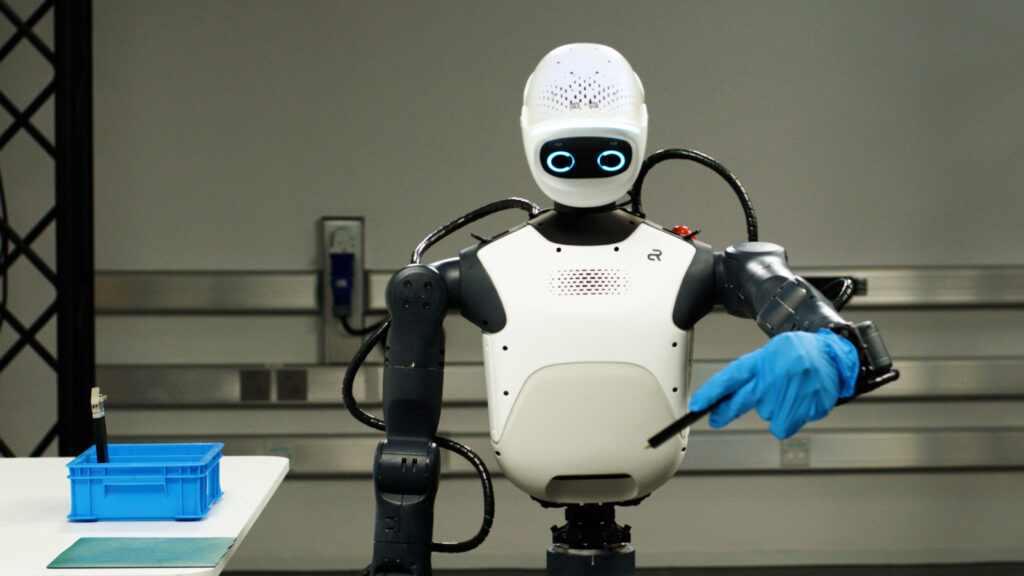
NVIDIA and Agile Robots have introduced a humanoid reference platform aimed at researchers and robotics developers rather than consumers. Called Agile ONE SN, the 1.4-meter (4.59-foot) machine combines an Agile Robots body with NVIDIA’s Jetson Thor computing platform and Isaac GR00T software stack.
The October 21 announcement is part of a wider expansion of NVIDIA’s Isaac robotics platform. It also includes a new open-source runtime, an updated robot-learning framework, simulation assets and datasets intended to make it easier to train, test and deploy machines that can operate in spaces designed for people.
What is inside Agile ONE SN?
According to NVIDIA’s announcement, Agile ONE SN stands 1.4 meters tall, weighs 40 kilograms (88 pounds) and has 31 degrees of freedom. Each arm is rated for a 3-kilogram payload.
The robot uses two five-finger WUJI Hand 2 hands. NVIDIA says each hand provides 20 degrees of freedom, force control running at 1kHz and tactile sensing. Head-mounted and wrist-mounted cameras, lidar and inertial measurement units provide data about the robot’s surroundings and movement.
Onboard processing comes from Jetson Thor, which NVIDIA rates at 2,070 FP4 teraflops with 128GB of unified memory. That hardware is intended to handle perception, reasoning and control locally instead of relying on a permanent connection to a remote data center.
Why NVIDIA calls it a reference platform
Agile ONE SN is not being pitched as a general-purpose household robot that buyers can order for routine chores. It is a preconfigured research system designed to give universities and robotics teams a common foundation for developing and validating humanoid capabilities.
The hardware arrives with NVIDIA Isaac GR00T, a collection that includes a humanoid foundation model, data-capture and deployment workflows, and whole-body control tools. Agile Robots says bringing these pieces together can reduce integration work that might otherwise take weeks to days. That is a manufacturer claim, not an independent benchmark.
Stanford University and ETH Zurich are among the institutions NVIDIA says have expressed interest. Availability is scheduled for early 2027, but neither NVIDIA nor Agile Robots has announced a price, order process or expected production volume.
Isaac Lab 3.0 and a new robot runtime
The humanoid is only one piece of the update. Isaac Lab 3.0 is now generally available as an open-source framework for training and refining robot policies. NVIDIA says it supports workflows ranging from desktop systems to multi-GPU data centers and can use physics engines including Newton and PhysX.
NVIDIA also introduced Isaac OS, an open-source runtime framework built on Holoscan. Its job is to connect AI models, sensor input, controls and robot hardware while maintaining deterministic, real-time performance. In practical terms, it is meant to help developers move the same robotic application from simulation to physical hardware without rebuilding every integration layer.
Three open-source reference workflows for DGX Station cover reinforcement learning for GR00T 1.7 models, dexterous manipulation training in Isaac Lab and post-training Cosmos world models for synthetic data generation. NVIDIA says the Cosmos workflow uses ChatGPT Astra.
More simulated assets and human-motion data
Training robots requires large amounts of structured data and virtual environments. NVIDIA’s new SimReady Central Library includes more than 2,000 simulation-ready robot and factory assets. The separate Human 1M Dataset includes varied human activities, synchronized footage from three views and 3D hand tracking.
The SimReady library is available through Hugging Face. NVIDIA says the complete Human 1M Dataset is limited to Cosmos Coalition partners, so not every developer will receive identical access.
Safety remains a major unfinished question
NVIDIA says Agile ONE SN is planned to integrate with its Halos safety stack. The wording matters: planned integration is not the same as a completed certification or a guarantee that the robot is ready to work around people without restrictions.
Humanoid robots combine powerful motors, moving limbs, cameras and experimental AI software. Real deployments will need safeguards, testing and compliance work suited to each environment. NVIDIA’s own announcement notes that many described products and features remain at different development stages and that timing can change.
Who this announcement matters to
For robotics labs, the appeal is a more integrated route from synthetic data and simulation to onboard deployment. A shared reference platform may also make experiments easier to reproduce across institutions.
For businesses considering warehouse, manufacturing or service robots, the announcement shows how NVIDIA is trying to supply the software, compute and simulation layers beneath many different robot brands. It does not establish a deployment cost or prove that humanoids are already economical compared with specialized machines.
Consumers should treat Agile ONE SN as a development platform, not a near-term home appliance. The clearest confirmed milestones are Isaac Lab 3.0’s general availability and the humanoid’s early-2027 target. Price, broad commercial availability and real-world reliability remain unknown.