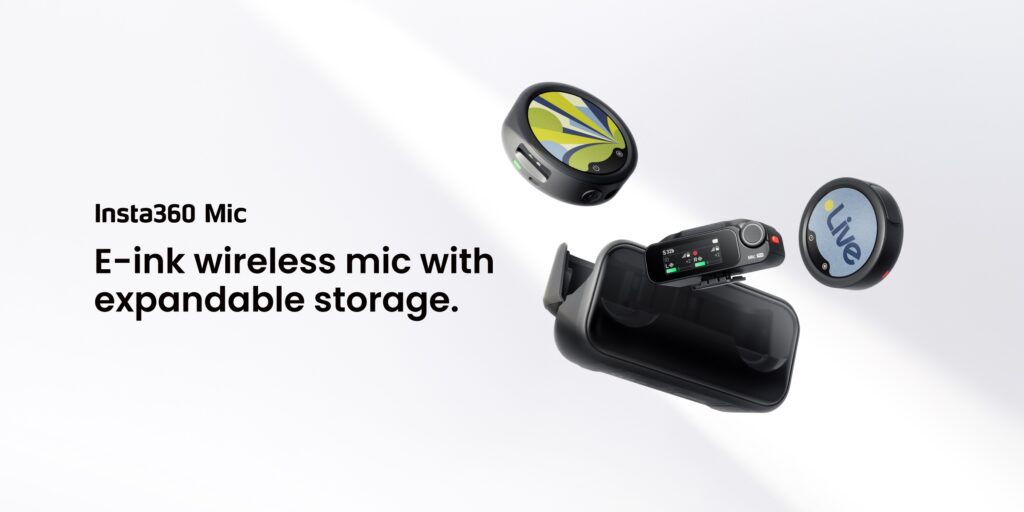
Insta360 has launched a new wireless microphone system that sits between its lightweight Mic Air and the more expensive Mic Pro. The simply named Insta360 Mic brings a customizable color E-Ink display, optional microSD-based internal recording and direct Bluetooth connections to selected Insta360 cameras.
The two-transmitter kit costs $249.99 in the United States and includes a receiver and charging case. Individual transmitters are also available for $79.99. Global availability began October 22 through Insta360’s store, Amazon and authorized retailers.
What is new about the Insta360 Mic?
Each 19.4-gram transmitter carries a 1.2-inch, six-color E-Ink screen. Users can upload a logo, emoji, photograph or other image, and the display continues showing it without constantly drawing power. The idea is partly practical—different artwork can identify multiple speakers—and partly cosmetic for creators who want their branding visible on camera.
The more important production feature is a microSD slot. With a compatible card inserted, the transmitter can make an internal 32-bit-float recording as a backup while audio is also sent to a camera or phone. Unlike the Mic Pro, which uses fixed built-in storage, Mic owners can swap cards when they need more capacity.
A card is optional. Without one, the system still sends audio over Bluetooth or through the included receiver, but it does not create the same onboard backup file.
32-bit float helps with unpredictable volume
Insta360 says 32-bit-float recording preserves a wide dynamic range, giving editors more room to recover sound captured too loudly or quietly. That can be useful for interviews, sports, events and other situations where levels can change suddenly.
It is not a substitute for good microphone placement, wind protection or monitoring. Severe handling noise, clothing rub, distance and a poor acoustic environment can still spoil a recording. We have not tested Insta360’s audio quality or recovery claims.
Battery life and multi-person recording
Insta360 rates each transmitter for up to 13 hours of use and the complete system for up to 34 hours with its charging case. Actual endurance will depend on settings, connection type, recording mode and environmental conditions.
One receiver can connect to as many as four transmitters. The system also supports Mic Pro transmitters, allowing owners to mix the two generations. For multi-camera shoots, two transmitters can send synchronized audio to as many as four receivers at once.
The standard receiver connects to phones over USB-C and to compatible cameras with a 3.5mm cable. That makes the system usable beyond Insta360’s own camera ecosystem.
Direct Bluetooth support skips the receiver
Selected Insta360 cameras can receive 48kHz audio directly over Bluetooth. The confirmed compatibility list includes the X6, X5, Luna Ultra, Luna Pro, GO Ultra and Ace Pro 2. The X6 and Luna models can connect to two transmitters simultaneously.
Direct connection reduces the amount of gear attached to a camera, but buyers using another camera brand should expect to use the receiver and check their camera’s audio-input support before purchasing.
AI noise canceling and automatic gain
A dedicated audio-processing chip runs Insta360’s noise-reduction model. The company says it suppresses background noise while limiting the metallic or watery artifacts that aggressive processing can introduce. Because that description comes from the manufacturer, real-world comparisons will be needed to judge how it performs against rivals.
Two automatic gain modes are included. Auto mode is designed to prevent clipping, while Dynamic mode smooths changing volume for more consistent loudness. Regular, Rich and Bright voice-tone presets provide quick tonal adjustments.
How it differs from Mic Pro and Mic Air
The Mic Pro remains Insta360’s higher-end option. It has a three-microphone array, multiple pickup patterns and 32GB of built-in storage. Its two-transmitter kit costs $329.99, making the new Mic kit $80 less.
The new model keeps the customizable screen, 32-bit-float recording and AI noise processing but uses a single omnidirectional pickup pattern and removable storage. For many vloggers, solo creators and small interview teams, that may be the more practical balance.
Mic Air is smaller and simpler. It lacks an E-Ink display and onboard storage, so it remains the option for buyers who prioritize portability and a lower entry price.
Price, packages and practical limitations
The $249.99 package includes two transmitters, one receiver and a charging case. A $79.99 transmitter can connect directly to supported Insta360 cameras or be added to a compatible receiver setup.
Buyers should budget for a microSD card if internal 32-bit-float backup recording is important. Insta360’s launch materials do not make every storage-capacity and card-speed requirement prominent, so customers should verify the current compatibility list before choosing a card.
The system is available now, but published battery figures, noise-reduction performance and wireless stability are manufacturer claims until independently tested. Compatibility also varies by camera: direct Bluetooth recording is limited to the supported Insta360 models, while other cameras normally need the receiver and suitable input cable.
Who should consider it?
The Insta360 Mic is aimed at creators who want backup recording, longer endurance and visual customization without paying for Mic Pro’s directional recording modes. It is particularly relevant to Insta360 camera owners who can skip the receiver on supported models.
Creators who regularly record complex productions may still prefer Mic Pro’s pickup-pattern choices and built-in storage. First-time users focused on simple mobile videos may find Mic Air easier and cheaper. The new Mic’s main appeal is the middle ground: a flexible two-person kit with removable storage and several flagship-style tools at a lower price.