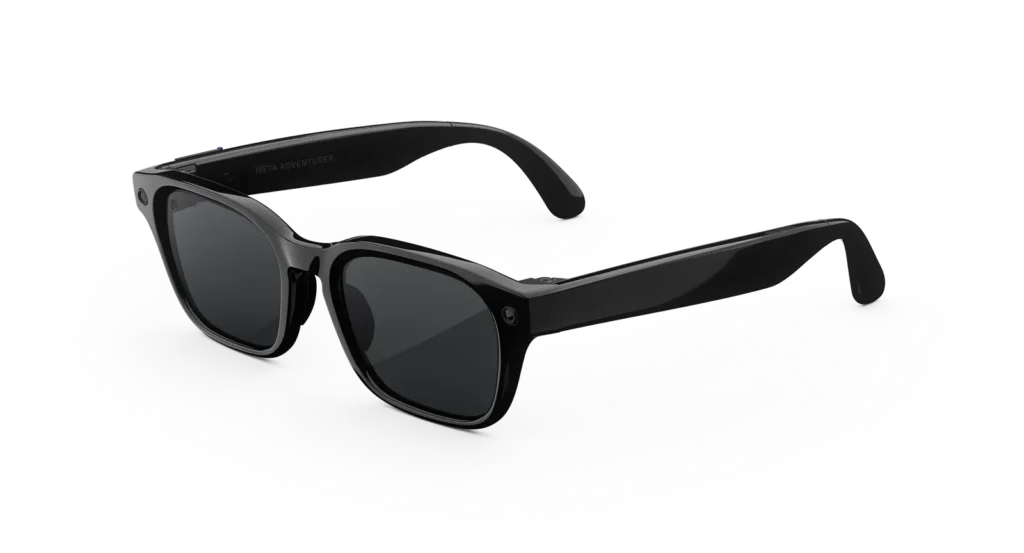
Meta’s lowest-cost camera-equipped AI glasses are now on sale in the United States. The new Meta Adventurer configuration costs $249 and combines a Classic Black frame, grey lenses and a plug-in charging case. It became available on October 23 after opening for preorder in September.
The price is $50 below most Adventurer configurations, but it is not a sitewide discount on every frame and lens combination. Meta’s store currently lists the standard Adventurer with a wireless charging case from $299. The cheaper version reaches $249 by using one fixed color combination and the simpler plug-in case.
What the $249 Meta Adventurer includes
According to Meta’s launch announcement, the entry model includes a black frame, grey lenses and the plug-in case. It is sold in countries where Meta Glasses are available, although prices, prescription options and delivery dates can vary by market.
The lower price does not remove the core electronics. Meta’s current product listing says the $249 model has the same standard features as other Meta Glasses: a 12-megapixel camera, video recording at up to 3K resolution, open-ear audio and built-in Meta AI. It also has six microphones, more than eight hours of claimed battery life and three-way adjustable nose pads.
Meta describes the Adventurer as prescription-ready. Buyers who need corrective lenses should still check the supported prescription range and final price before ordering, because adding prescription lenses may change the cost and eligibility can differ by frame size and region.
The main tradeoff is the charging case
The $249 version includes a case that plugs directly into a power source. Other Meta Glasses configurations come with a wireless charging case: users place the folded glasses inside, and the case carries stored power for charging away from an outlet.
Meta says the glasses themselves otherwise retain the same standard feature set. That makes the cheaper Adventurer less of a stripped-down smart-glasses model and more of a bundle change. The practical question is whether saving $50 is worth giving up the convenience of a battery-equipped case.
For someone who normally charges glasses overnight at a desk, the plug-in case may be sufficient. Travelers and heavy daily users may prefer the $299 wireless-case version because it can provide power while the glasses are stored in a bag. Meta also sells a separate charging stand, but adding accessories can narrow the original price advantage.
What the glasses can do
Meta Adventurer combines conventional eyewear with a camera, speakers, microphones and voice-controlled AI. Users can take photos and record video, listen to music or podcasts, place calls and ask Meta AI questions without holding a phone.
Supported software features include live translation, local recommendations and voice-assisted capture. Meta says its Dynamic Photo feature can take multiple frames and recommend the best one, while Music Match can select Spotify playback based on what the wearer is viewing. Some services require separate accounts, may carry fees and are not available in every country or language.
The camera remains an important distinction from the $349 Ray-Ban Meta Audio glasses, which omit image and video capture. The Adventurer is cheaper and can record, while the Audio model is aimed at buyers who want music, calls and AI assistance without wearing a camera.
How it compares with the broader lineup
The Adventurer is Meta-branded rather than carrying Ray-Ban or Oakley branding. That helps the company offer a lower entry price while keeping the familiar smart-glasses functions. Meta also offers the Adventurer in additional frame and lens colors at higher prices, along with Capri, Nova, Fury and celebrity collaboration models.
The Verge’s Meta Connect coverage confirmed that the black-and-grey Adventurer would launch October 23 for $249. It sits below the $349 camera-free Ray-Ban Meta Audio and the refreshed Ray-Ban Meta Gen 3, which starts at $449 and adds a broader set of styles plus hardware upgrades.
An earlier Android Central evaluation of the 2026 Adventurer family found that its core camera and audio experience closely matched Meta’s other recent glasses, while prescription support was narrower than some Ray-Ban and Oakley alternatives. That review covered the $299 wireless-case version, so its observations about fit and hardware should not be mistaken for a test of the new plug-in bundle.
Privacy and practical limitations
The Adventurer’s camera can be useful for hands-free photos, but it also brings privacy considerations. Meta’s camera glasses use a visible LED to indicate recording. Buyers should understand local recording rules and avoid assuming that a light alone makes every situation appropriate for filming.
Battery life is also a manufacturer claim, not a guarantee. Calls, 3K video, music playback, AI requests and weak wireless connections can shorten real-world endurance. We have not tested this configuration, and Meta has not published independent battery results for the new bundle.
Meta AI functionality depends on supported services, an internet connection and regional availability. The glasses are not a self-contained replacement for a phone, and there is no display inside the lenses. Responses arrive through the open-ear speakers rather than appearing in the wearer’s field of view.
Who should consider the $249 version
The plug-in-case Adventurer is most attractive for first-time smart-glasses buyers who want a camera, open-ear audio and hands-free AI at Meta’s lowest current entry price. It offers the core features without paying for Ray-Ban branding or a portable wireless charging case.
People who spend long days away from outlets should compare the $299 charging-case configuration before buying. Privacy-conscious shoppers may prefer the camera-free Ray-Ban Meta Audio, while prescription users should verify that the Adventurer supports their lenses and bridge fit.
The $249 price is meaningful because Meta did not cut the glasses’ headline camera or AI functions. The compromise is concentrated in the included case and the fixed black-and-grey design—which makes the value easy to understand before checkout.