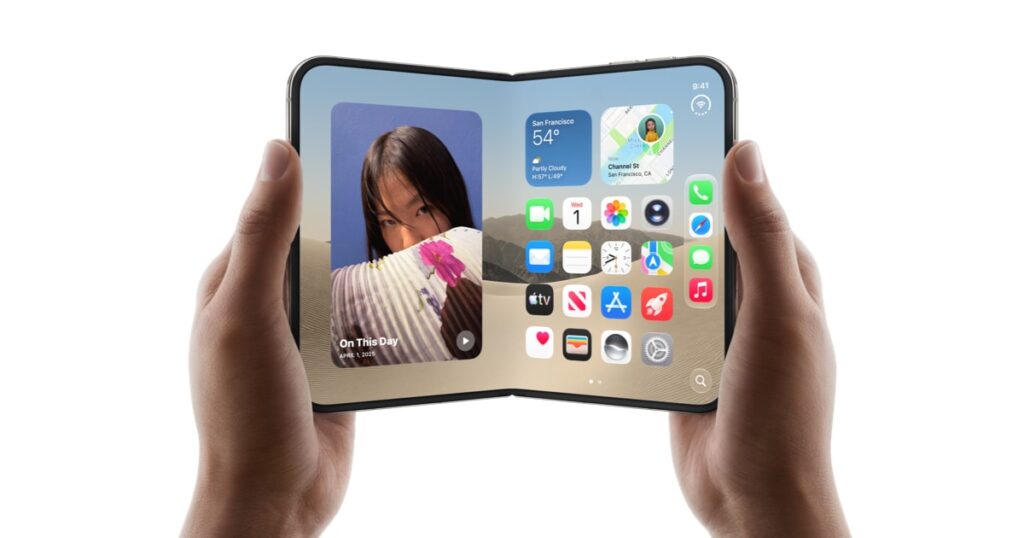
Apple’s first foldable iPhone has reached stores. The iPhone Duo went on sale on October 23, 2026, opening into a 7.6-inch display while folding down around a 5.4-inch outer screen. Its starting price is $1,999 in the United States, placing the new form factor well above a conventional flagship phone.
The launch is important because Apple is entering a foldable market that Samsung, Huawei, Google and other Android manufacturers have spent years developing. It is also a first-generation product with practical compromises: launch stock is tight, not every app uses the larger display well, and the camera system lacks the dedicated telephoto lens found on Apple’s Pro phones.
iPhone Duo price, storage and launch availability
Apple sells iPhone Duo in star white and night sky with 256GB, 512GB, 1TB and 2TB storage options. The base model costs $1,999, while Apple’s official two-part Duo Case is $79 and the Folio with Kickstand is $129. Those accessories matter because the phone’s folding shape makes ordinary iPhone cases unsuitable.
Availability began October 23 in more than 70 countries and regions, including the United States, Canada, China, India, Japan and the United Kingdom. Apple says another 28 markets will follow on October 30. Reuters reported that the first day was largely focused on preorder pickups and that people without reservations were competing for limited store inventory. Buyers should therefore treat Apple’s listed availability date as the start of sales, not a guarantee of immediate delivery.
Two displays change how the iPhone works
Closed, the Duo uses a 5.4-inch outer Super Retina XDR display. Apple says its wider proportions provide about 90 percent of the screen area of an iPhone 18 Pro. Opened, its 7.6-inch inner Super Retina XDR panel is 50 percent larger than the iPhone 18 Pro Max display. Both support ProMotion, Always On and up to 3,000 nits of claimed outdoor peak brightness.
The inner screen has a nano-texture finish intended to reduce glare and make the crease less distracting. Apple uses Touch ID in the side button instead of Face ID, a sensible choice for hardware that may be open, closed or sitting partly folded on a surface. Apple Pencil with USB-C support is promised for later in 2026 rather than available at launch.
iOS 27.1 adapts controls and layouts to the wider canvas. Split View can place two apps side by side, supported apps can open a second window, and people can save app pairs for repeat workflows. The phone can also enter StandBy on either display even when it is not charging. These are the features that give the Duo a reason to exist beyond novelty: reading beside a notes app, comparing two web pages or keeping a call open next to a document is easier than on a standard iPhone.
A20 Pro performance and battery claims
The Duo uses Apple’s A20 Pro chip, paired with a custom vapor chamber and a dual-battery design. Apple claims the six-core CPU is up to 20 percent faster than A19 Pro, while the seven-core GPU is up to 40 percent faster and more efficient. Those are manufacturer benchmarks, not independent guarantees, and sustained performance can vary with temperature and workload.
Apple rates video playback at up to 31 hours on the inner display and 44 hours on the outer screen. Its mixed-use estimate is up to 24 hours when both displays are used equally. Wired charging can reach 50 percent in about 20 minutes with suitable equipment; MagSafe or Qi2 charging can reach 50 percent in about 30 minutes under Apple’s test conditions. The necessary high-output adapter is sold separately.
The phone is eSIM-only worldwide and supports Wi-Fi 7, Bluetooth 6 and Thread. Apple’s new iPhone Handoff feature can move the same phone number between two supported iPhones, but launch support is limited to T-Mobile in the United States and Telekom Germany. Travelers should verify eSIM support with their carrier before buying.
The cameras are flexible but not Apple’s best
The rear system combines a 48-megapixel Fusion Main camera with sensor-shift stabilization and an integrated 2x crop option, plus a 48-megapixel Fusion Ultra Wide camera that supports macro photography. The Main camera can record 4K Dolby Vision video at up to 120 frames per second.
The folding design creates useful shooting options. The outer display can show a live preview to the person being photographed, the main cameras can be used for higher-quality selfies, and the phone can support itself partly open for a video call or time-lapse. There is also a separate Center Stage camera on the outside and an under-display FaceTime camera inside.
The limitation is equally clear: there is no dedicated long-range telephoto camera. Wired’s review also noted that the phone can become warm and that the official MagSafe wallet extends past the edge of the short outer body. Someone paying $1,999 primarily for photography may get more value from a conventional Pro phone with a fuller lens selection.
App support remains the biggest launch risk
Apple has optimized its own apps and highlighted updated layouts from developers including Netflix, Zoom and Slack. When software is designed for the Duo, the larger display can show multi-pane navigation, extra controls or two useful apps at once.
Unoptimized software is less convincing. Wired found that some apps appeared in narrow phone-shaped windows with large unused areas, and cursor support for an external trackpad required enabling AssistiveTouch. That does not stop ordinary iPhone apps from running, but it shows why compatibility and good use of the inner display are different questions.
Anyone who depends on a specialized banking, work, accessibility or business app should check how it behaves on the Duo before making it a primary phone. App support will likely improve, but developers control their own update schedules.
Durability, repair and who should buy it
Apple rates iPhone Duo IP68 under controlled laboratory conditions and uses grade 5 titanium, Ceramic Shield materials and a hinge built from more than 100 components. The company says the front material offers three times better scratch resistance than the previous generation, but that comparison does not remove the normal risks of a flexible inner screen and a moving hinge.
Foldables have more mechanical complexity than slab phones. Prospective buyers should review AppleCare+ pricing, accidental-damage fees and repair terms before purchase. A case also changes the total cost and bulk, while going without one leaves a $1,999 first-generation device more exposed.
The Duo makes the most sense for an iPhone user who genuinely needs a larger pocketable workspace for reading, video, travel and two-app multitasking. It is harder to recommend to someone who prioritizes the lowest price, the strongest zoom camera or proven long-term durability. Apple’s first foldable does things no standard iPhone can match, but the value depends on using that inner display often enough to justify its cost and compromises.