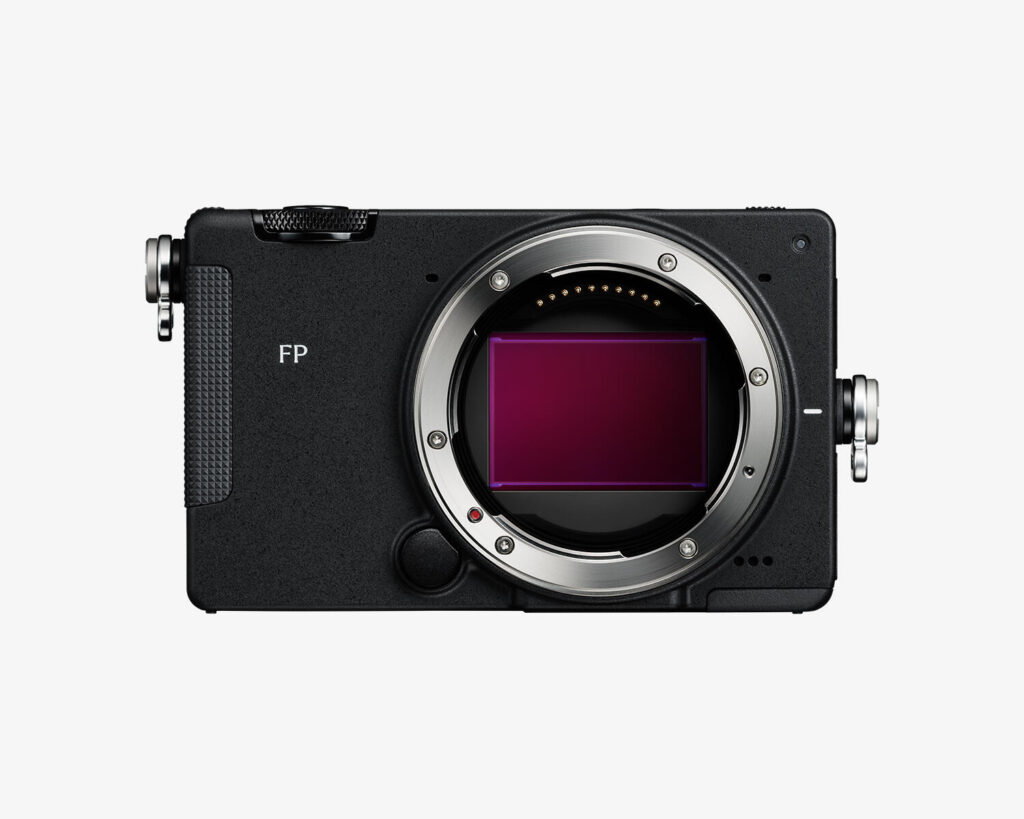
Sigma has announced the FP2, a compact $2,199 full-frame camera built to switch between still photography and serious video work. It will reach authorized U.S. retailers on November 11, 2026, seven years after the original Sigma fp introduced the company’s unusually small, modular camera concept.
The new model keeps the flat, pocketable body but replaces much of the technology inside it. Sigma has added a 24.5-megapixel partially stacked sensor, hybrid autofocus, a tilting touchscreen, 70GB of internal storage and 6K open-gate video. Those are meaningful changes for travel shooters and small production crews, but the FP2 remains intentionally minimalist: it has no built-in viewfinder, no in-body image stabilization and only one SD card slot.
Sigma FP2 price and release date
According to Sigma’s U.S. announcement, the FP2 body costs $2,199 and becomes available November 11. Two $2,749 bundles will also be offered: one adds Sigma’s 50mm F2 DG Contemporary lens, while the other includes the new EVF-21 electronic viewfinder.
The price puts the FP2 well above entry-level full-frame cameras. Buyers also need to budget for an L-Mount lens, memory card and any grip, viewfinder or audio hardware their work requires. That modularity is central to the design, but it means the body-only price does not necessarily reflect the cost of a practical kit.
A faster sensor without chasing more megapixels
The FP2’s 24.5-megapixel full-frame sensor is partially stacked and back-side illuminated. Its resolution is essentially unchanged from the original fp, but the faster readout is meant to reduce rolling-shutter distortion and support quicker autofocus, longer bursts and higher video frame rates.
Sigma rates continuous shooting at up to 20 frames per second for as many as 200 frames. That is a major buffer improvement for action sequences, although the camera still uses an electronic shutter. Fast-moving subjects and artificial lighting therefore remain areas where prospective buyers should examine independent tests carefully.
Autofocus now combines phase and contrast detection. The subject-recognition system can identify people, animals and birds, broadening the FP2’s appeal beyond controlled video and studio work. Sigma says autofocus accuracy, speed and low-light performance have improved, but those are manufacturer claims that need real-world comparison against established systems from Canon, Nikon, Panasonic and Sony.
6K open-gate video is the headline upgrade
The FP2 can record 6K open-gate footage using the full sensor area. Open-gate capture gives editors more room to create wide, vertical and square versions from the same take, which is useful when one project must serve YouTube, television and social platforms.
The camera supports Apple ProRes RAW and Leica’s L-Log profile for post-production. Sigma also quotes up to 14.1 stops of dynamic range in specified 4K full-frame L-Log conditions. A dedicated switch changes between STILL and CINE modes, with separate interfaces for each workflow.
Another notable addition is support for 32-bit float audio, which can preserve a wider range between quiet and loud sounds and reduce the risk of unusable clipping. There is an important limitation: Sigma says this function requires the optional HU-21 hot-shoe unit and compatible Panasonic audio hardware. It is not a built-in, ready-to-use feature with the body alone.
The Verge reports that the FP2 also offers cropped 4K recording at up to 120 frames per second and can save ProRes RAW to an external SSD through its 10Gbps USB-C port. A second USB-C connection handles lower-speed accessories and power, while the move to full-size HDMI should make cabled production setups more durable than the original fp’s micro-HDMI arrangement.
The small body brings useful upgrades
The rear touchscreen now tilts upward by 90 degrees and downward by 45 degrees. That makes low- and high-angle framing easier, and moving the screen away from the body can improve airflow during long video sessions.
Internal storage is another practical safety net. The FP2 includes 70GB alongside its single SD card slot, allowing recording to continue when a card fills. It is useful emergency capacity, but it does not replace the redundancy of dual-card recording for paid work.
Sigma claims roughly 30% longer battery life than the original fp: about 370 still photos or 130 minutes of video. The larger battery increases the ready-to-shoot weight, so the FP2’s “world’s smallest” claim should not be confused with “lightest.” Independent coverage notes that the body-only weight rises only slightly, but the complete camera becomes noticeably heavier once the larger battery and accessories are attached.
What the FP2 leaves out
The minimalist design still comes with compromises. There is no built-in electronic viewfinder. Photographers who want one must attach the EVF-21, which uses a 5.76-million-dot OLED panel and can tilt up to 90 degrees. That improves eye-level and waist-level shooting but makes the camera larger and more expensive.
The body also lacks in-body image stabilization. Sigma offers electronic stabilization for some video modes, but it is not available in every format and cannot substitute for mechanical stabilization in low-light stills. Lens-based stabilization, a gimbal or careful support may be necessary depending on the job.
The flat body has no deep integrated grip, and larger lenses can make the system front-heavy. TechRadar’s early review praised the compact construction and image quality while noting that a viewfinder, grip and other accessories can erode the size and value advantage. GNW has not tested the FP2, so buyers should treat performance conclusions as provisional until more production cameras are independently reviewed.
Who is the Sigma FP2 for?
The FP2 makes the most sense for hybrid creators who value a tiny full-frame core they can build into different rigs. A documentary shooter could use a small lens for discreet handheld work, then add an external SSD, monitor, audio interface and cage for a larger production. Travel photographers may appreciate the compact body, tilting screen and internal storage if they are comfortable working without a built-in viewfinder or stabilization.
It is less convincing for buyers who want a complete camera straight from the box. A conventional full-frame body with a grip, stabilized sensor, built-in EVF and two card slots may be easier and cheaper once the FP2’s accessories are counted.
The practical takeaway
Sigma did not try to turn the FP2 into a conventional mirrorless camera. It kept the modular idea and addressed several of the original fp’s biggest weaknesses with faster autofocus, a much deeper burst buffer, a tilting screen, extra battery life and more capable video recording.
The result is distinctive rather than universally better. At $2,199 before a lens or viewfinder, the FP2 needs a buyer who will genuinely use its small size and cinema-oriented flexibility. For that audience, the November 11 launch brings one of the year’s more unusual full-frame options. Everyone else should compare the cost of a complete FP2 rig—not just the compact body—before deciding.
Featured image: official Sigma product image.