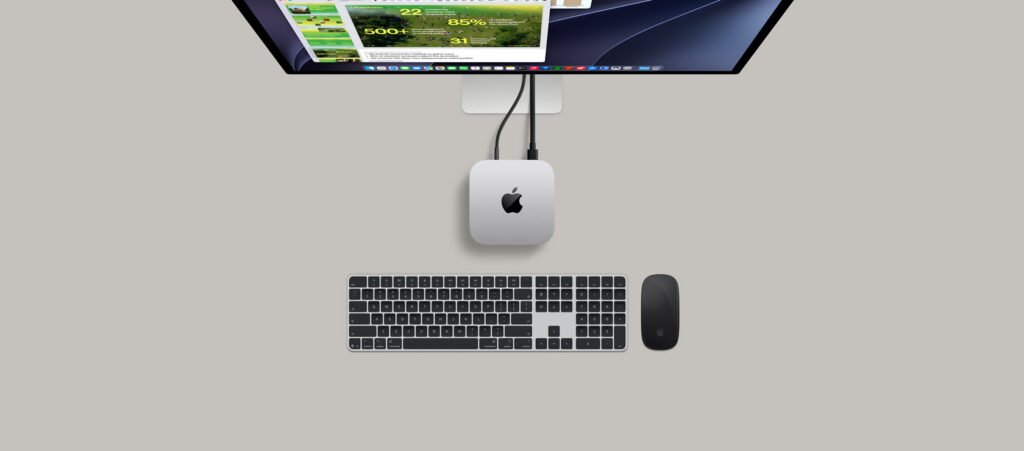
Apple’s newest Mac mini is now shipping with a choice of M6 or M5 Pro processors. The entry model starts at $899, while the more powerful M5 Pro version starts at $1,699. Both keep the compact five-by-five-inch enclosure introduced with the previous generation, but add faster internal storage, 2.5-gigabit Ethernet as standard, Wi-Fi 7 and Bluetooth 6.
The update is aimed partly at people running creative software and AI models locally. That does not automatically make the Mac mini a substitute for cloud computing: useful performance still depends on model size, memory capacity, software support and the exact workload.
What comes with the $899 M6 model
The base M6 Mac mini includes a 12-core CPU, 12-core GPU, 16GB of unified memory and 256GB of storage. Apple lists memory bandwidth at 170GB per second, up from 120GB per second on the earlier M4 model.
The 256GB starting capacity is the clearest limitation. It may be sufficient for web work, office apps and lighter development, but large photo libraries, video projects, games and local AI models can fill it quickly. External storage is an option, although buyers should include the cost of a fast SSD and enclosure when comparing configurations.
Apple says the M6 delivers up to 40 percent faster CPU performance than the M4 and up to twice the ray-traced graphics performance in selected tests. Those are manufacturer benchmark claims, not a promise that every application will show the same improvement.
The $1,699 M5 Pro model is a different class of machine
The M5 Pro configuration begins with 24GB of unified memory and 512GB of storage. It can be configured with up to an 18-core CPU and 20-core GPU, offers 307GB-per-second memory bandwidth and is intended for heavier work such as 3D rendering, code compilation, video production and larger local AI workloads.
It also gets Thunderbolt 5 on its three rear USB-C ports, while the M6 model uses Thunderbolt 4. Buyers who work with very fast external storage, high-resolution media hardware or complex dock setups may benefit from that distinction. For normal monitors and everyday accessories, it is unlikely to justify the price difference by itself.
Connectivity improves on both versions
Apple now includes 2.5Gb Ethernet instead of gigabit Ethernet, with a 10Gb option still available. Its N1 wireless chip provides Wi-Fi 7 and Bluetooth 6 support.
The front panel retains two 10Gbps USB-C ports and a headphone jack. Around the back are three Thunderbolt ports, HDMI, Ethernet and the power connection. The layout remains convenient for frequently connected drives or card readers, but there are no conventional USB-A ports.
Wi-Fi 7 and 2.5Gb Ethernet only reach their full speed when the router, network equipment, cabling and internet or local server can keep up. For many home connections, the practical benefit may be better future compatibility rather than an immediate speed increase.
Why Apple is emphasizing local AI
Every M6 and M5 Pro GPU core includes a neural accelerator intended to speed supported AI tasks. Apple promotes the Mac mini for running tools such as Ollama, LM Studio and agent-style applications locally, along with AI-assisted features in creative software.
Local processing can keep some data on the computer and avoid usage-based fees charged by cloud AI providers. It can also work without sending every prompt over the internet. However, local models still consume substantial memory and storage, and smaller models may be less capable than large services running in data centers.
The base model’s 16GB of unified memory is therefore better suited to smaller models and general-purpose workloads. People buying specifically for larger local models should study the memory requirements of their chosen software before ordering. Unified memory cannot be upgraded after purchase.
The compact design has not changed
The aluminum enclosure still measures roughly five inches square, with cooling air moving through the base. That makes it easy to place under a monitor or in a crowded workspace.
A monitor, keyboard and mouse are not included. The complete setup price can rise quickly for a first-time Mac desktop buyer, while someone who already owns compatible peripherals can use the mini as a relatively self-contained upgrade.
Both versions ship with macOS 27 Golden Gate and support Apple Intelligence and the company’s newer Siri AI features, subject to language, region and usage limitations.
Who should buy it?
The $899 M6 model is the more sensible choice for everyday productivity, coding, photo work and a compact home computer, provided 16GB of memory is enough. Upgrading storage at purchase may be worthwhile for anyone who does not want to manage external drives.
The M5 Pro version is for sustained professional workloads that can use its additional CPU and GPU resources, higher memory bandwidth, configurable memory and Thunderbolt 5. It is poor value if the main tasks are browsing, documents, streaming and light editing.
Owners of a recent M4 Mac mini should look at application-specific gains before upgrading. The faster networking, storage and graphics are meaningful, but the enclosure, port count and general desktop experience remain familiar.
Price and availability
The M6 Mac mini starts at $899, and the M5 Pro version starts at $1,699. Both began shipping on September 22, 2026, through Apple and authorized retailers. Configuration prices rise with additional memory, storage and the optional 10Gb Ethernet port.
Sources
Design, connectivity and performance information was checked against Apple’s official Mac mini page. Pricing, base configurations and the September 22 shipping date were cross-checked with The Verge. Apple’s enterprise and local-AI positioning was reviewed alongside Reuters’ September 22 report.
Featured image: Apple official product artwork.