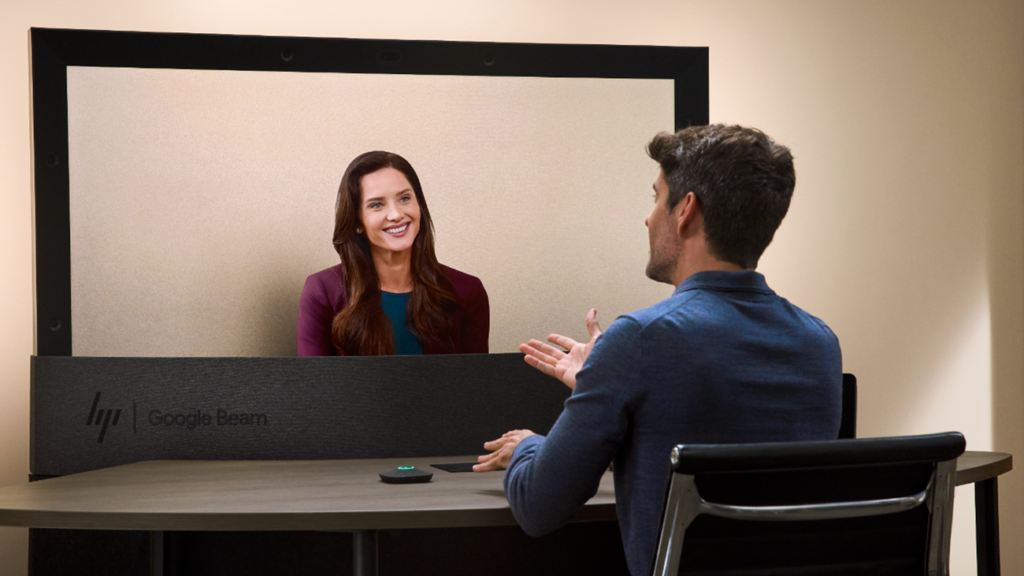
Google is expanding its most unusual video-calling technology beyond offices and demonstration rooms. The company says HP Dimension with Google Beam will be installed at 20 USO locations worldwide, giving deployed service members and their families access to life-size, glasses-free 3D calls.
The October 26 announcement follows a pilot that connected Fort Bliss, Texas, with Trzebień, Poland. Google says the program is now expanding to Grafenwöhr, Germany, and Fort Hood, Texas, while a new documentary series follows four military families who used the system during a deployment in Poland.
This is not a consumer launch and Beam is not an app people can download. It requires specialized HP hardware at both ends, a carefully arranged meeting space and enterprise connectivity. Google has also not published the full list of 20 participating USO locations or a detailed public booking schedule.
What Google and the USO confirmed
Google’s official announcement confirms a 20-location global rollout with the United Service Organizations. It says the goal is to help deployed personnel share conversations and family milestones with more natural eye contact, body language and scale than a conventional laptop or phone call can provide.
The earlier pilot linked families between Fort Bliss and Trzebień. Google now names Grafenwöhr and Fort Hood as expansion points, but does not identify the other locations. It also does not specify how many Beam rooms each site will receive, when every installation will open or how appointments will be allocated.
That makes the announcement meaningful but still limited. It moves Beam into a real public-service setting, while stopping short of a complete deployment map or broad consumer availability.
How a Google Beam call creates 3D depth
Google Beam began as Project Starline, an experimental system designed to make a remote participant appear life-size and three-dimensional without a headset. The commercial HP Dimension unit combines a light-field display, multiple cameras, real-time depth processing, head tracking, spatial audio and adaptive lighting.
The cameras capture the participant from slightly different angles. Google’s AI processing builds a depth-aware representation and sends it to the other Beam system, where the light-field screen presents different views to each eye. The effect creates depth while allowing the participant to move naturally rather than wearing VR goggles or looking at an avatar.
Spatial audio reinforces the illusion by placing the voice near the on-screen person. The technology still depends on displays and cameras, but the interface is designed to fade into the background so people can concentrate on expressions and gestures.
The HP Dimension hardware is substantial
HP’s current product page lists a 65-inch light-field display, seven cameras, a 12-microphone beamforming array and four speakers. Google’s technical specifications put the system at 67.9 by 11.5 by 44.8 inches and 254 pounds, with about 600 watts of power consumption during a call.
The system requires at least 50Mbps of symmetrical bandwidth with less than 100ms latency between units. It supports Google Meet and Zoom as its main calling platforms, while administration is handled through Google Workspace or Zoom device-management tools.
One detail is not completely consistent across official material. HP’s 2025 launch release described a six-camera system, while its current product page lists seven cameras. That may reflect a hardware revision or a different counting method, but neither Google nor HP explains the discrepancy in the USO announcement. The exact configuration installed at each USO site is therefore not confirmed.
It is built mainly for one-to-one 3D calls
HP specifies that the immersive 3D mode is designed for one-to-one conversations. The hardware can also host ordinary two-dimensional group meetings and interoperate with services such as Microsoft Teams and Webex, but participants joining from regular laptops will not receive the same two-way 3D experience.
That distinction matters for families. A parent and child seated together may still appear within the capture area, as Google’s documentary examples suggest, but the product’s officially supported immersive format is not a many-person holographic conference. Beam works best when the people at both ends are positioned for the dedicated room system.
Price does not describe the USO program
When HP introduced Dimension in 2025, the announced hardware price was $24,999, according to The Verge. A Google Beam software license was sold separately, and its price was not publicly disclosed. HP’s current page directs buyers to contact sales instead of showing a retail price.
Those enterprise figures should not be confused with what military families will pay. Google has not announced a user fee for the USO program, nor has it disclosed the program’s total hardware, licensing or installation cost. The USO traditionally provides services through its centers, but access rules for these Beam rooms need to come from participating locations.
Why this deployment matters
Beam’s original enterprise pitch focused on executives, distributed teams and high-value meetings. Military families present a more human test: whether the additional visual cues can make separation feel less severe during deployments.
HP attributes higher information recall, more turn-taking and more nonverbal behavior to Google’s earlier behavioral research. Those are manufacturer-reported findings, not proof that every family will experience the same benefit. The USO rollout could produce more useful evidence because it involves emotionally important conversations over long distances rather than controlled workplace demonstrations.
The project also shows a different direction for immersive technology. Consumer products usually ask people to wear something, such as VR headsets or the lighter AI glasses GNW recently covered. Beam instead puts the complexity into the room, making the person-to-person experience headset-free but far more expensive and less portable.
Limitations families should understand
Beam cannot remove scheduling, time-zone or travel constraints. Both parties need access to equipped locations, and the required bandwidth and hardware make spontaneous calls harder than using FaceTime, WhatsApp or Google Meet on a phone.
The system also uses multiple cameras, microphones and AI processing, so privacy policies and local room procedures will matter. Google’s announcement focuses on the emotional experience and does not detail retention settings, recording controls or whether calls at USO sites can be recorded. Users should ask the location about those rules before a session.
Finally, the 20-site commitment is global, not 20 locations in the United States. Until Google or the USO publishes the complete list, families should not assume their nearest center will receive a system.
The practical takeaway
Google Beam is moving from impressive demonstrations into a focused real-world deployment. The combination of life-size 3D video, eye-contact cues and spatial audio could make conversations feel more natural for families separated by military service. The Fort Bliss-to-Poland pilot gives the rollout a concrete foundation, and the expansion to 20 USO locations is a significant step.
But this remains specialized infrastructure, not the next version of consumer video chat. The full location list, opening timetable, appointment process, privacy procedures and exact deployed hardware are still unknown. Military families interested in trying Beam should watch for announcements from their local USO rather than buying equipment or expecting a phone app.