Intel has agreed to acquire Classiq, an Israeli company that builds software for designing quantum algorithms. The October 26 agreement is meant to combine Intel’s silicon spin-qubit hardware, manufacturing work and quantum software with Classiq’s higher-level development platform.
The companies describe the goal as a full-stack quantum computing platform: hardware, control technology, compilers and application-development tools working together. That is a substantial strategic change for Intel, but it is not a finished commercial quantum computer. The deal still requires regulatory approval, the purchase price has not been officially disclosed, and the transaction is expected to close in the first half of 2027.
What Intel has actually announced
Intel says it entered a definitive agreement to buy Classiq. After the transaction closes, Classiq’s team and software would become part of Intel’s quantum computing business. Until then, the two companies will continue operating independently.
The announcement does not identify the purchase price or say whether Intel will pay with cash, stock or a combination. Israeli publications have reported figures between $2.2 billion and $2.3 billion, but those numbers are not confirmed by Intel and should be treated as estimates rather than official deal terms.
Intel also says it intends to keep Classiq’s existing integrations with multiple quantum hardware platforms. That promise matters because Classiq has marketed itself as hardware-agnostic rather than as software tied to one type of qubit.
What Classiq adds to Intel’s quantum effort
Writing a useful quantum program is very different from writing ordinary software. Developers must translate a problem into quantum operations, fit those operations within the limits of a particular machine and reduce circuit depth, errors and resource use.
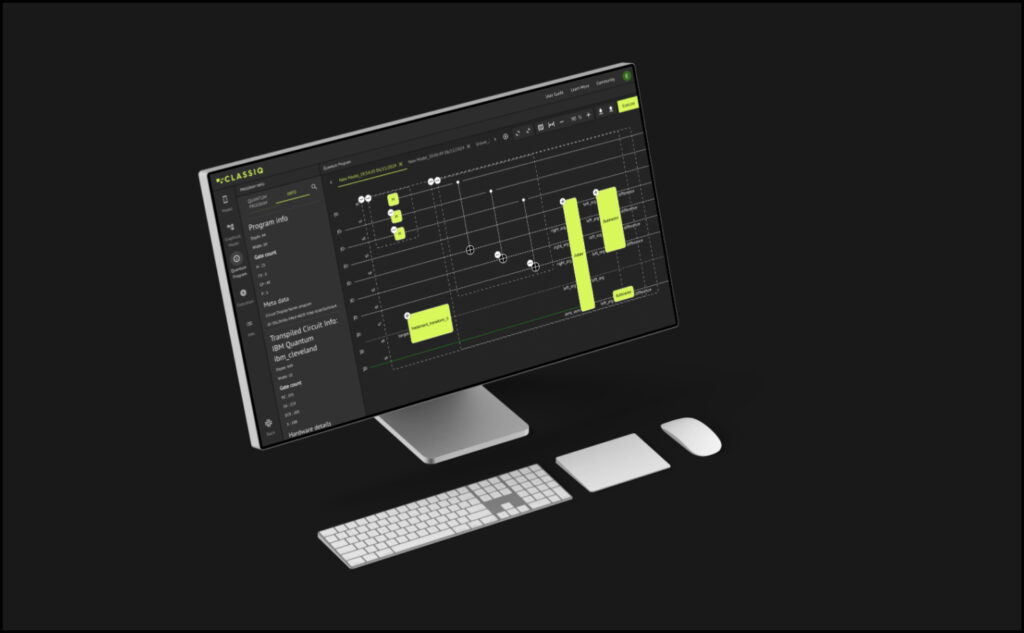
Classiq’s platform lets teams describe the intended function at a higher level, then uses synthesis and optimization tools to generate a hardware-ready quantum circuit. Its software includes a development environment, compiler-style automation, visualization, execution tools and integrations with cloud and hardware providers.
In a 2025 funding announcement, Classiq said its platform could target services such as AWS Braket, Microsoft Azure Quantum and Google Cloud, plus hardware from IBM, IonQ, QuEra, Quantinuum, Rigetti and others. The company reported raising $110 million in that Series C round, bringing its disclosed funding at the time to $173 million.
Intel is betting on silicon spin qubits
Intel’s hardware strategy uses silicon spin qubits. Information is stored in the spin state of individual electrons inside structures that resemble extremely small transistors. Intel argues that this approach can benefit from semiconductor-manufacturing tools and processes the company already understands.
Its best-known public research chip, Tunnel Falls, contains 12 quantum dots that can form between four and 12 qubits depending on how a laboratory configures the device. Intel reported a 95% yield rate across the wafer and said a single 300-millimeter wafer produced more than 24,000 quantum-dot test devices.
Those results are research milestones, not proof of a fault-tolerant commercial computer. Useful large-scale quantum systems still face difficult problems involving error rates, qubit control, cryogenic operation, interconnects and software. The acquisition is designed to bring the hardware and software work under one roof, but it does not eliminate those engineering barriers.
Why “full stack” matters
A quantum computer needs more than a quantum processing unit. It also requires classical control electronics, calibration, error handling, compilers, development tools and applications that can turn a business or research problem into operations the hardware can execute.
Intel already builds CPUs, GPUs and specialized accelerators, and it has spent years researching qubits and cryogenic control. Classiq fills a more visible gap at the application-development layer. Intel compares the company’s role to electronic-design-automation software, which lets chip designers work at a higher level instead of placing every transistor by hand.
If that model works, a developer could describe a chemistry, finance, optimization or materials problem and let the platform synthesize a circuit for available quantum hardware. That could make experimentation easier even before Intel has a broadly available QPU of its own.
Classiq says it will remain hardware-agnostic
The most important near-term question for current Classiq customers is whether its platform will continue supporting competing quantum systems. Intel says it plans to preserve the company’s multi-platform integrations and its modality-agnostic approach after closing.
That is a commitment, not a permanent guarantee. Product priorities can change after an acquisition, and developers will need to watch licensing, cloud availability, integration roadmaps and support for rival hardware. For now, Intel has explicitly said the open ecosystem will continue.
The CEO investment deserves transparency
Intel chief executive Lip-Bu Tan was a personal investor in Classiq before becoming Intel’s CEO. Classiq’s own February 2022 funding announcement lists Tan among the individual investors in its $33 million Series B round.
Intel’s acquisition announcement does not discuss that earlier investment or explain how potential conflicts were handled. It is therefore reasonable for investors to look for related-party disclosures, recusals or board-approval details in future regulatory filings. The prior investment does not show wrongdoing, but it is a relevant financial relationship that should not be omitted from coverage of the deal.
What the acquisition does not provide yet
Intel has not announced a commercial QPU release date, quantum-computing performance target, customer pricing or a migration plan for existing Classiq users. It also has not said how many Classiq employees will join Intel or whether the company’s Tel Aviv operations will change.
Most importantly, the deal does not mean quantum computers are about to replace PCs or data-center CPUs. Quantum processors are expected to work alongside classical systems for specialized workloads. Intel’s existing CPU and manufacturing businesses remain far larger and more immediate, especially while component costs and a difficult PC market affect conventional computing—the kind of pressure covered in GNW’s recent look at falling PC shipments and higher memory costs.
What happens next
The transaction is subject to regulatory approvals and customary closing conditions. Intel expects it to close during the first half of 2027. Until that happens, customers should treat the companies’ roadmaps, contracts and support arrangements as separate.
After closing, the practical tests will be straightforward: whether Classiq keeps broad hardware support, whether Intel can connect the software cleanly to its own SDK and spin-qubit research, and whether the combined platform produces useful applications rather than only demonstrations.
The practical takeaway
Intel is buying a software layer that could make its long-running quantum hardware research easier for developers to use. Classiq brings high-level modeling, automated circuit synthesis and integrations across the existing quantum ecosystem. Intel brings manufacturing scale, control technology and a silicon-based qubit strategy.
The combination is strategically logical, but the limits are just as important as the ambition. The official purchase price is unknown, regulatory approval is pending, Intel’s commercial quantum hardware timeline remains unclear and large-scale fault-tolerant computing is still an unsolved engineering challenge. This is a serious platform bet, not evidence that mainstream quantum computing has arrived.
Sources
- Intel: definitive agreement to acquire Classiq
- Classiq quantum software platform
- Classiq: $110 million Series C and platform integrations
- Intel: Tunnel Falls silicon spin-qubit research chip
- Classiq: 2022 funding round naming Lip-Bu Tan as an investor
- Dow Jones: deal terms and closing timeline
- CTech: reported acquisition valuation