Samsung Electronics has issued extraordinary preliminary results for the third quarter of 2026: approximately 195 trillion Korean won in consolidated sales and 107.4 trillion won in operating profit. At the October 8 exchange rate cited by Reuters, the operating-profit estimate is about $80.2 billion.
The surge is being driven by memory chips used in AI infrastructure, according to analysts. Yet the same shortage that benefits Samsung’s semiconductor operation is raising component costs for phones, PCs and consumer electronics. That tension makes the guidance important beyond financial markets: it is another sign that AI data centers are competing with everyday devices for limited memory supply.
Samsung’s confirmed preliminary numbers
In its official earnings guidance, Samsung estimated third-quarter sales at 195 trillion won and operating profit at 107.4 trillion won. The company said the underlying estimate ranges were 194 trillion to 196 trillion won for sales and 107.3 trillion to 107.5 trillion won for operating profit.
For comparison, Samsung reported 171.5 trillion won in sales and 89.49 trillion won in operating profit in the second quarter of 2026. In the third quarter of 2025, those figures were 86.06 trillion won and 12.17 trillion won respectively. On that basis, the latest operating-profit estimate is almost nine times the year-earlier result.
These are consolidated guidance figures prepared under Korean International Financial Reporting Standards. Samsung has not yet provided the detailed performance of its semiconductor, smartphone, display, appliance and contract-manufacturing businesses. Full results are scheduled for October 29.
Why AI memory is producing record profits
Reuters reports that demand for AI servers has tightened supplies of high-bandwidth memory, conventional DRAM and NAND flash. HBM is especially valuable because AI accelerators need extremely fast access to large pools of data while training and running models.
Samsung sells several of the memory types that are being pulled into this build-out. Analyst Douglas Kim estimated that the company’s HBM bit shipments rose nearly 50% from the previous quarter, although Samsung has not confirmed that number in its brief guidance.
The shortage is not limited to the most advanced AI memory. When manufacturers direct investment and production toward high-margin server components, availability and prices can also shift for the conventional DRAM and storage used in laptops, phones and other devices. Reuters says Samsung and Micron expect the supply imbalance to persist into 2028.
Why the record may be bad news for device buyers
Higher memory prices can increase the bill of materials for smartphones, computers, graphics cards, game consoles, smart TVs and storage products. Manufacturers then have several choices: charge more, accept lower profit margins, reduce memory or storage in base models, delay promotions, or redesign products around cheaper components.
None of this confirms an immediate Samsung Galaxy or PC price increase. Retail prices depend on contracts, inventories, product positioning and competition, and many large manufacturers purchase components well in advance. Still, the direction of the memory market makes generous RAM and storage configurations more expensive to deliver.
TrendForce expects conventional DRAM contract prices to rise 10% to 15% in the fourth quarter compared with the third, according to Reuters. That would be slower than the roughly 60% increase reported for the second quarter, but it would continue the upward pressure.
Consumers planning an upgrade should compare the exact RAM and storage configuration rather than focusing only on processor names. A cheaper base model with less memory may age faster, while an expensive upgrade may reflect both vendor markup and genuinely higher component costs.
The reported mobile loss needs a caveat
Reuters says analysts estimate Samsung’s mobile business lost more than $1 billion during the quarter, citing higher component costs and a result worse than expected. That is not yet a figure reported by Samsung itself.
The company’s October 8 guidance includes only consolidated sales and operating profit. It does not disclose whether the mobile division lost money or how much each segment contributed. The October 29 report will be the appropriate source for confirmed divisional results.
The apparent conflict—record companywide profit alongside pressure on Samsung’s own phones—illustrates the unusual economics of the AI boom. A company can earn much more selling scarce memory to data-center customers while paying more for similar components inside the consumer products it also builds.
Samsung’s foundry business is a separate challenge
Samsung is also a contract chipmaker that manufactures processors designed by other companies. Analysts cited by Reuters expect that foundry business to remain unprofitable because factory utilization is still low relative to its fixed costs.
Memory profitability therefore should not be treated as proof that every part of Samsung’s semiconductor operation is thriving. The company is trying to close the advanced-manufacturing gap with TSMC, whose own third-quarter revenue reached a record T$1.49 trillion, or roughly $46.7 billion, on AI demand.
What to watch on October 29
Samsung’s full earnings release should reveal how much profit came from memory, whether the mobile division actually recorded a loss, how its foundry utilization is changing and what management expects for memory supply and pricing. Investors will also be watching for its shareholder-return policy.
For consumers, the most useful signal will be Samsung’s view of conventional DRAM and NAND supply. If shortages remain deep into 2027 and 2028, memory-heavy products may stay expensive even if processors and displays improve. If AI spending slows or manufacturers expand supply more quickly, price pressure could ease.
Until the detailed report arrives, the confirmed takeaway is narrower but still significant: Samsung has forecast record consolidated operating profit, and the AI-driven memory market is the leading explanation. The reported segment winners and losers remain preliminary.
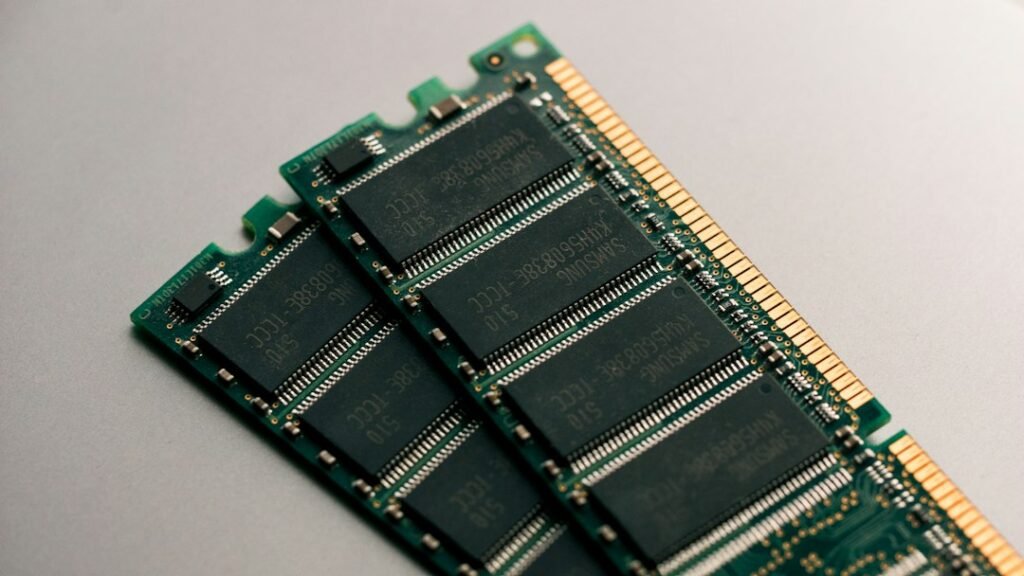
Featured image: Samsung RAM modules photographed by Harrison Broadbent, via Unsplash.