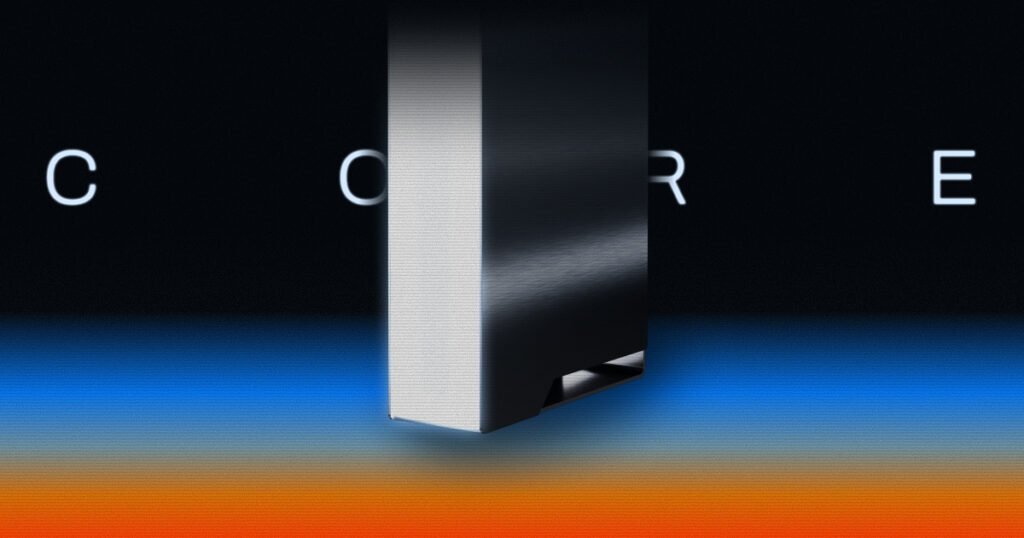
Ghost has opened orders for Core, a $3,499 computer designed to run personal AI models and agents locally instead of relying on a remote model for every conversation. The compact, screenless machine pairs an Nvidia workstation GPU with four preinstalled open-weight models and software meant to build a long-term memory from a user’s apps, files and connected devices.
Core is a bold attempt to turn local AI from a technical hobby into a packaged consumer product. It is also expensive, untested outside the company and built around an unusually broad view of personal context. Buyers should understand both the hardware and the limits of Ghost’s privacy promise before placing an order.
What the $3,499 Core includes
Ghost lists the following hardware:
- GPU: Nvidia RTX Pro 4000 Blackwell SFF Edition with 24GB of GDDR7 ECC memory and 432GB/s bandwidth
- CPU: AMD Ryzen 5 7600 with six cores and 12 threads
- System memory: 64GB of DDR5 RAM
- Storage: 1TB NVMe SSD
- Claimed AI performance: 770 AI TOPS
- Connectivity: Wi-Fi and Bluetooth
The company says there is no required subscription. Its order page advertises a one-year warranty, a 30-day return period and free shipping for the first batch. That batch is listed to ship on October 31, 2026, although the live availability control was still checking stock when reviewed. Prospective buyers should confirm availability at checkout rather than assuming a unit is reserved.
This is not a normal desktop replacement. Core has no built-in display, and TechCrunch reports that owners interact with it through a phone or companion app. Voice interaction also goes through the app rather than a microphone in the box.
Four models come preinstalled
Ghost’s current product page names four local models: Qwen 3.8-Next, Qwen 3.8-27B, Gemma 4-31B and Muse-Glimmer-30B. That list is slightly broader than early reporting that named only three models. Ghost also says users can install alternatives from Hugging Face or load their own models.
The 24GB GPU is the central component. It gives Core enough dedicated memory to run useful local models, though larger models may still need quantization, partial offloading or other compromises. Ghost has not published independent benchmarks showing response speed, prompt capacity, agent reliability or how each bundled model is configured.
The company’s 770-TOPS number is a manufacturer rating, not a direct measure of how quickly Core will complete real jobs. AI TOPS can be useful for comparing hardware under a specific precision, but it does not replace task-based testing.
Core wants to remember more than a chatbot
Ghost describes Core as a personal AI computer that runs continuously and builds context over time. It can connect to email, calendars, files, browser activity, finances, recordings, cameras, health records, smart-home devices and services such as Whoop, Oura and Eight Sleep.
The intended advantage is proactivity. Instead of waiting for every prompt, an agent could combine information from several sources and surface a reminder or take an approved action. Ghost gives examples such as noticing a change in recovery data, tracking a package or warning that a routine may conflict with tomorrow’s weather.
Those examples are company demonstrations, not independently verified capabilities. The practical value will depend on which integrations work at launch, how accurately Core interprets context and how safely it handles actions involving messages, accounts or purchases.
“Local AI” does not mean every task stays offline
Ghost says Core’s conversational AI, memory, conversations and connected data are stored and processed on the owner’s hardware. Its privacy policy states that the product does not fall back to a remote AI model for conversational AI or memory processing.
However, some online functions still need outside services. Web searches, phone calls and similar tasks can pass the necessary request through Ghost’s managed gateway and then to a third-party provider. Ghost says its gateway forwards that content without saving it, but the outside provider may retain or use the request under its own policy. Users can supply their own API keys to connect directly to a provider, which removes Ghost from that path but does not eliminate the provider’s data practices.
Remote access also uses an encrypted relay by default. Ghost says the relay forwards traffic without retaining the content, and owners can replace it with their own setup such as Tailscale.
That is a more precise privacy story than simply saying “no data ever leaves the home.” The main AI and memory are local, while internet-dependent actions may still disclose task information to the services needed to perform them.
Screen history and credentials deserve careful setup
Core can import a browser profile, including history, bookmarks, autofill data, extensions, saved passwords and signed-in sessions. Its optional screen-history feature captures screen images and recognized text with details such as the app, window title, time and available page address.
Ghost’s policy says private browsing does not automatically pause screen capture. That is an important warning for anyone who enables the feature on a work computer or a shared device. Users will need to review permissions carefully rather than treating local storage as a substitute for access control.
Memories can also persist separately from the source that created them. Deleting a file or conversation may not remove a derived memory, and copies viewed on a paired phone or computer can enter that device’s backups. Erasing Core does not erase those separate copies.
Who Core is for—and who should wait
Core is most relevant to developers, local-AI enthusiasts and privacy-conscious early adopters who want an integrated system without assembling and configuring a Linux workstation themselves. Its value is the combination of hardware, preinstalled models, persistent memory, integrations and agent software—not merely the parts inside the enclosure.
Most consumers should wait for independent reviews. Ghost has not yet provided the kind of testing needed to judge:
- real model speed and response quality;
- power consumption, heat and fan noise during continuous operation;
- reliability of app and smart-home integrations;
- how well permission controls prevent unwanted actions;
- security of saved credentials and remote access;
- repairability, component upgrades and long-term software support.
The 1TB drive may also fill quickly if owners keep several large models, extensive screen history and personal files on the same machine. Ghost has not clearly explained user-accessible storage expansion on the public product page.
The practical significance
Core represents a larger shift in personal computing: AI assistants are moving from isolated chat windows toward systems that continuously observe, remember and act. Running the main model and memory locally can reduce dependence on a cloud subscription and give owners more control over sensitive context.
But local processing does not remove every risk. A proactive agent becomes useful by gaining access to accounts, devices and intimate data, which makes permission design and security at least as important as model performance.
At $3,499, Core is an early-adopter product rather than a mass-market PC. The idea is credible, and the hardware is specific enough to evaluate, but Ghost’s biggest claims—reliable autonomy, strong privacy and a simple out-of-box experience—still need independent testing after units ship.
Sources
- Ghost: Core overview and specifications
- Ghost: Core order page, warranty and shipping details
- Ghost and Core privacy policy
- TechCrunch: Ghost launch and funding report
Featured image: Ghost.