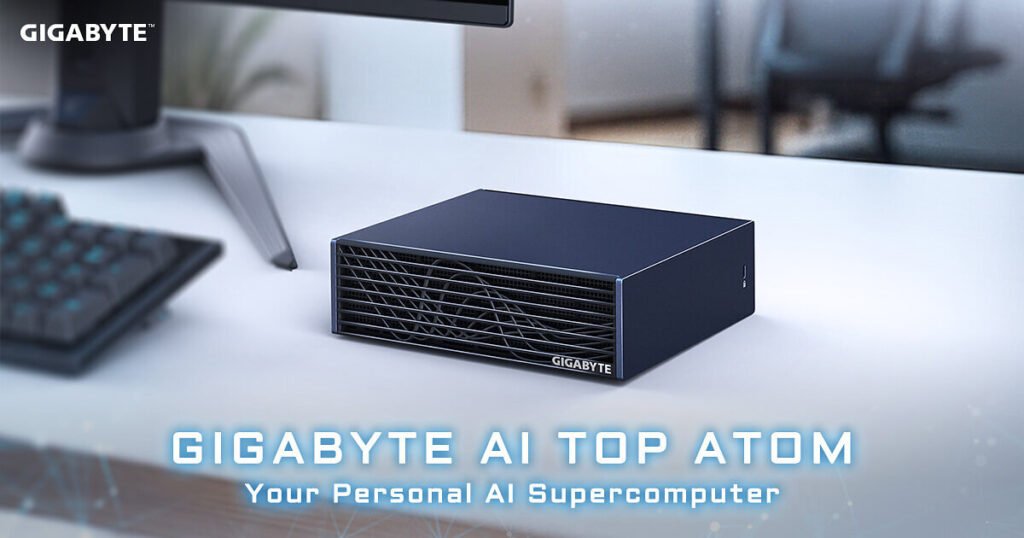
Gigabyte has added a lower-memory version of its AI TOP ATOM desktop AI system, giving developers a new 64GB option alongside the existing 128GB model. The company says the new configuration will be available from October 23, 2026, although pricing, sales channels and regional availability have not yet been confirmed.
The headline change is simple, but important: unified memory is one of the biggest constraints on a compact computer built to run large AI models locally. Cutting the capacity in half should broaden the range of configurations available to buyers, but it also makes the new model a more targeted machine for smaller models, inference, retrieval-augmented generation and early-stage development.
What Gigabyte announced
According to Gigabyte’s October 2 announcement, the 64GB AI TOP ATOM retains the hardware design of the existing system and is based on Nvidia’s DGX Spark platform. Gigabyte positions it for developers, researchers, enterprise teams and educational environments that want a dedicated on-premises AI development box.
The company specifically highlights local model inference, prototyping, data analysis and application validation. Keeping those jobs on a local system can reduce dependence on cloud services and may give a team more control over sensitive project data. That does not automatically make local AI cheaper or easier, however; the answer will depend heavily on the purchase price, power use, software requirements and the size of the models involved.
The hardware remains unusually compact
Gigabyte’s current AI TOP ATOM product page describes the platform as a one-liter desktop built around Nvidia’s GB10 Grace Blackwell Superchip. The existing specification lists a 20-core Arm CPU, Blackwell graphics and up to one petaflop of FP4 AI performance. Gigabyte’s published chassis dimensions are 150 by 150 by 50.5 mm, with a weight of 1.2 kg.
The platform-level connectivity is stronger than a typical mini PC. Gigabyte lists 10Gb Ethernet, Wi-Fi 7, Bluetooth 5.4, HDMI 2.1a, three 20Gbps USB-C ports and dual QSFP connections driven by Nvidia ConnectX-7 networking. It also runs Nvidia DGX OS, based on Ubuntu Linux.
Gigabyte has not yet published a complete 64GB-specific specification table, so buyers should not assume that every storage option or regional bundle offered with the 128GB models will carry over unchanged. The company says product details and sales channels can vary by market.
Why 64GB changes the buying decision
Unified memory is shared between the CPU and GPU, which lets the accelerator work with a larger pool than the dedicated VRAM found on many consumer graphics cards. That is useful for local AI, where loading model weights can consume tens of gigabytes before accounting for context, caches and other workloads.
Still, 64GB is not interchangeable with 128GB. It will offer less room for large models, long contexts and simultaneous services. Developers working on compact or quantized models may find it sufficient, while teams that expect to fine-tune larger models or keep several AI tools active at once will have more reason to choose the 128GB version.
Gigabyte says up to four AI TOP ATOM units can be clustered through ConnectX-7 networking and Nvidia Sync. Clustering can expand the available memory and compute resources, but it also adds hardware cost and software complexity. A four-node setup should therefore be viewed as a specialized deployment option rather than a simple substitute for buying a single higher-memory computer.
Software may matter more than the peak-performance claim
The system includes access to Nvidia’s CUDA-accelerated AI software ecosystem and Gigabyte’s AI TOP Utility. Gigabyte lists model downloads, inference, retrieval-augmented generation and machine-learning workflows among the utility’s current capabilities.
That software support is central to the product’s appeal. A one-petaflop FP4 claim is a maximum theoretical figure for a very low-precision format, not a promise of identical performance across every model. Real-world speed will vary with model architecture, precision, memory use, storage and software optimization.
The Arm-based processor and Linux operating system are also worth noting. Many modern AI tools support this environment, but developers who rely on x86-only binaries, Windows applications or niche extensions should confirm compatibility before ordering.
Price is the missing piece
Gigabyte says the 64GB AI TOP ATOM will officially go on sale October 23, with pricing and channels varying by region. It has not announced a universal MSRP.
That omission makes it impossible to judge the new configuration’s value yet. A meaningful discount from the 128GB model could make the 64GB version appealing for local inference, classroom labs and proof-of-concept work. A small price gap would make the extra memory of the 128GB version easier to justify, particularly because unified memory cannot be upgraded like standard desktop RAM.
For now, the most sensible approach is to treat the 64GB AI TOP ATOM as a new entry point rather than a direct replacement. Buyers should wait for regional pricing and the final 64GB storage configuration, then compare those details with the size of the models they actually plan to run.
What to watch before October 23
- Regional price: Gigabyte has not published a single global MSRP.
- Storage configuration: the company’s announcement does not spell out which SSD capacity will ship with the 64GB version.
- Model fit: 64GB can be useful for local AI, but the practical limit depends on model precision, context length and software overhead.
- Application compatibility: verify support for Ubuntu Linux and the Arm architecture.
- Expansion cost: multi-unit clustering requires additional systems and networking hardware.
The new option makes Gigabyte’s compact AI desktop line more flexible. Whether it becomes the sweet spot will come down to a number the company has not shared yet: the price.