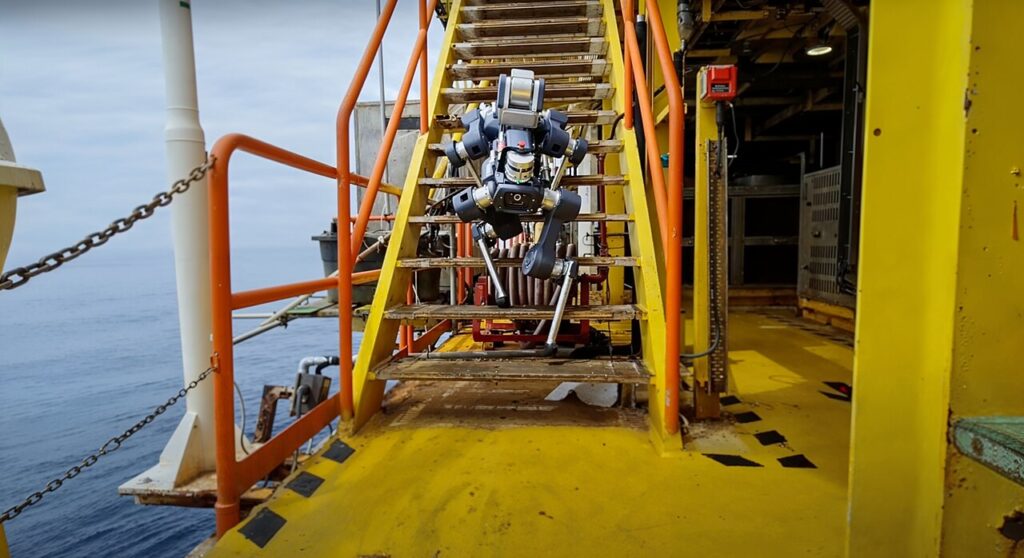
Swiss robotics company ANYbotics has started customer deliveries of ANYmal X, a four-legged inspection robot designed for oil, gas and chemical facilities where ordinary electronics can become an ignition risk. Initial customers include Equinor and DSM-Firmenich, following an early-access program that involved BP, Shell, PETRONAS, Petrobras, BASF and SLB.
The significance is not simply that the robot can walk through an industrial plant. ANYmal X is designed for explosive atmospheres where a spark, hot surface or electrical fault could ignite flammable gas. Its job is to repeat inspection routes, collect visual, thermal, acoustic and optional gas measurements, and send structured findings into maintenance systems while reducing routine human entry into hazardous areas.
What ANYmal X is designed to do
ANYmal X walks through narrow passages, gratings, stairs and multi-level facilities without requiring companies to rebuild the site around it. It can read instruments, look for visible changes, measure temperature, listen for abnormal equipment sounds and identify some gas or air leaks.
The standard protected payload includes a zoom camera, a 640-by-512 radiometric thermal camera, an acoustic imager and a conventional microphone. An optional gas-sensing module can measure selected combustible, toxic and atmospheric gases. The sensors sit on a pan-and-tilt unit so the robot can inspect equipment from different angles.
Those capabilities are aimed at pumps, compressors, valves, piping, electrical equipment and other assets that workers currently inspect during manual rounds. The robot is not described as repairing equipment. It gathers repeatable condition data and flags changes for engineers and maintenance teams to review.
Why “explosion-protected” is difficult for a walking robot
Equipment used in hazardous process areas must be engineered so it does not provide an ignition source. A mobile robot complicates that problem because it needs a large battery, high-power motors, exposed sensing hardware, data connections and joints capable of handling stairs and uneven surfaces.
ANYbotics says the robot’s AI computer and inspection equipment are housed in sealed, nitrogen-filled chambers. Its 12 leg actuators and battery use flameproof casings, non-metallic shells insulate metal components, conductive feet provide grounding and automatic cutoffs monitor temperature. Charging and data links use energy barriers intended to prevent exposed connections in hazardous areas.
Onboard software checks the machine before, during and after a mission. The company also says the system has been tested against shock, vibration, corrosion, solar radiation and salt mist. These are manufacturer descriptions rather than independent field-test results, but they explain why this product took four years of development and more than 10 patents.
The certification has a defined scope
ANYmal X has an ATEX EU-type examination certificate for operation in Zone 1 and Zone 2 gas atmospheres, according to the company’s product documentation. Its stated classification covers Gas Group IIB and temperature class T4. That is an important achievement, but it is not permission to operate in every explosive environment.
The robot is not intended for Zone 0, explosive dust atmospheres or IIC gases such as hydrogen and acetylene. ANYbotics also says IECEx certification will be available with first production after the required series-production audit. Buyers should confirm the final certificate, configuration and local requirements for each deployment instead of relying on a broad “explosion-proof” label.
Charging and nitrogen refilling take place outside the hazardous area. The dock needs a sheltered non-hazardous location, and the nitrogen refill system has specific purity and clearance requirements. Those infrastructure details matter when estimating the cost and practical reach of a deployment.
Battery life, mobility and connectivity
ANYbotics lists more than three hours of runtime per charge, followed by autonomous docking. The robot can return to its dock, recharge and resume stored missions without an operator carrying it between rounds.
It is rated to handle stairs up to a 45-degree angle, with a maximum rise of 230 millimeters and a minimum run of 210 millimeters. The robot itself is listed at IP65, while the inspection payload is rated IP67. Preliminary operating conditions include temperatures from minus 10 to 50 degrees Celsius, humidity from 5 to 95 percent without condensation and altitude up to 2,000 meters.
Connectivity includes Wi-Fi 6 and 5G or 4G LTE. Stored missions can continue offline, with measurements buffered locally and synchronized later. Remote assistance still requires a connection, so operators need to plan for coverage gaps inside steel-heavy plants and offshore facilities.
Shift connects robot readings to maintenance work
ANYmal X operates with ANYbotics Shift, the company’s fleet and inspection platform. Shift schedules missions, monitors robot position and battery state, organizes measurements by asset and tracks changes over time. It can exchange data with maintenance and enterprise systems through an API, including platforms from SAP, Yokogawa and SLB.
That software layer may be as important as the walking hardware. A thermal image or unusual sound has limited value if it cannot be tied to a specific pump, compared with earlier readings and converted into a work order. ANYbotics says its wider inspection system already supports more than 120,000 autonomous inspections each month across over 50 customers in power, metals and materials.
Those fleet figures come from the manufacturer and do not isolate ANYmal X deployments. The new explosion-protected model is only now entering customer delivery, so evidence about long-term uptime, maintenance needs and false-alert rates remains limited.
Who this robot is for
ANYmal X is not a consumer robot and does not have a public list price. ANYbotics works with each customer to define inspection goals and routes before providing an offer. The complete deployment can include the robot, docking equipment, charger, nitrogen refill station, an ATEX-rated control tablet and the Shift platform.
The likely buyers are large industrial operators that can justify the cost through fewer hazardous manual entries, more frequent inspections and earlier detection of leaks or failing equipment. Smaller sites will need to compare the system with fixed sensors, conventional inspection cameras, drones and human rounds.
The strongest use case is not replacing every technician. It is sending a repeatable sensor platform through dangerous areas while trained staff review the results, investigate anomalies and make maintenance decisions. Human oversight remains necessary when conditions change, communications fail or the robot encounters an obstacle outside its planned route.
What remains unknown
ANYbotics has not published a standard price, delivery volume or total cost of ownership. It has also not disclosed how often the nitrogen system needs service, how much maintenance the protected joints require or how performance changes after years of exposure to corrosive industrial environments.
Independent testing is still needed to verify navigation reliability, sensor accuracy, battery endurance, docking success and anomaly detection under real plant conditions. Customers also need clear procedures for cybersecurity, emergency recovery and deciding when a flagged condition requires immediate human inspection.
ANYmal X is scheduled for a public demonstration at ADIPEC 2026 with SLB and Kuwait Oil Company. That should provide a closer look at how the certified hardware and inspection software work together. For now, customer deliveries mark an important transition from limited trials to commercial deployment, but the robot’s value will depend on measurable safety and maintenance results after it has spent significant time in the field.