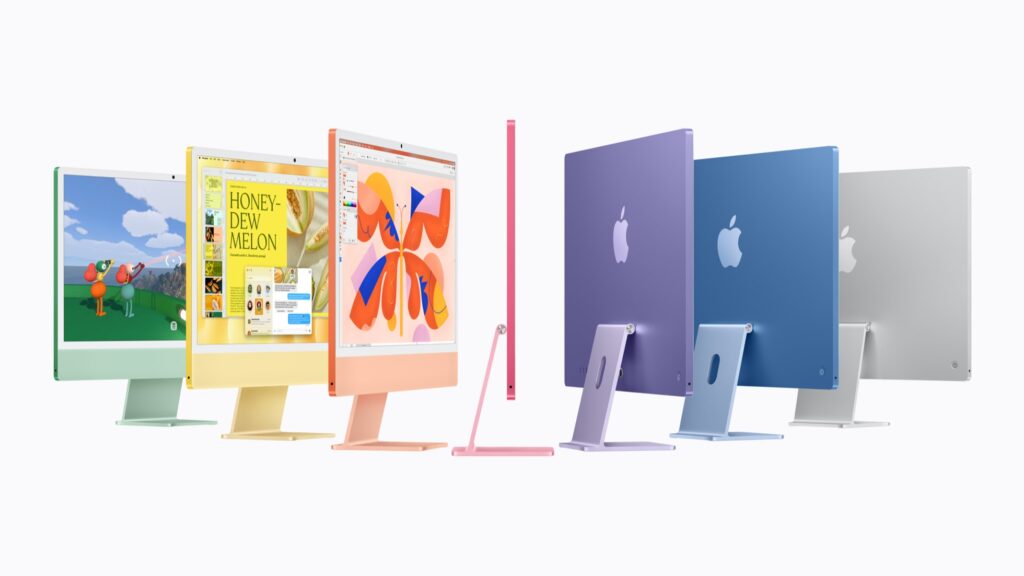
Apple has updated the 24-inch iMac with its M6 chip, faster wireless networking and quicker storage while leaving the familiar all-in-one design largely intact. The new desktop starts at $1,499, opens for preorder on October 28 and reaches customers and stores on November 6.
The headline upgrade is performance: Apple offers M6 configurations with either a 10-core CPU and 10-core GPU or a 12-core CPU and 12-core GPU. But the practical buying decision involves more than processor cores. Port count, memory limits, Ethernet availability, Touch ID and display options also differ between the two starting models.
M6 iMac price and release date
The entry M6 iMac costs $1,499 with a 10-core CPU, 10-core GPU, 16GB of unified memory and a 256GB SSD. Education pricing starts at $1,449.
The higher-tier model starts at $1,699 with a 12-core CPU, 12-core GPU, 16GB of memory and 256GB of storage. Its education price begins at $1,599. Preorders open Wednesday, October 28, in 35 countries and regions, including the United States. Retail availability begins Friday, November 6.
Both starting prices deserve context. A 256GB SSD can feel restrictive for photo libraries, video projects, games and local AI models, so many buyers will need a storage upgrade or an external drive. Apple’s configure-to-order pricing can push the total well above the advertised entry figure.
The 10-core and 12-core models are not just speed tiers
The $200 jump to the 12-core version buys two additional CPU cores and two additional GPU cores, but it also changes the surrounding hardware. The base model has two Thunderbolt 4 ports. The higher model provides four Thunderbolt 4 ports and supports more configuration choices.
The 10-core version can be configured with 24GB of unified memory and up to 1TB of storage. The 12-core version can reach 32GB of memory and 2TB of storage. Apple’s nano-texture display option is also limited to the 12-core model.
Touch ID is another difference. The higher model includes a Magic Keyboard with Touch ID as standard, while the entry model requires an upgraded keyboard configuration. Buyers comparing only the chip specification could miss these everyday distinctions.
What the M6 chip changes
The M6 includes Neural Accelerators in each GPU core, a Dual 16-core Neural Engine and up to 170GB/s of memory bandwidth. Hardware acceleration covers H.264, HEVC, ProRes and ProRes RAW workflows, along with AV1 decoding and ray tracing.
Apple claims the new iMac can deliver up to 1.5 times faster general performance, twice the graphics performance and five times the on-device AI performance of the M4 iMac in selected tests. It also advertises up to twice the ray-traced gaming performance.
These figures come from Apple-controlled benchmarks using particular applications, workloads and configurations. They should not be read as universal speed increases. Browser work, office applications, games, video exports and local language models stress different parts of the system, and independent testing will be needed to show sustained performance and thermal behavior.
The 24-inch 4.5K display is mostly unchanged
The iMac still uses a 23.5-inch panel marketed as a 24-inch 4.5K Retina display. It has a 4480-by-2520 resolution, 500 nits of brightness, P3 wide color, True Tone and support for one billion colors.
That remains a sharp, color-capable screen for office work, photos and general creative use, but the update does not introduce a larger 27-inch model, higher refresh rate, HDR-grade brightness or OLED technology. People who have been waiting for a bigger all-in-one will still need to consider a Mac mini or Mac Studio with a separate monitor.
The optional nano-texture glass can reduce reflections in bright rooms, but it is available only with the 12-core model and adds cost. Buyers should see it in person if possible because the finish can subtly change perceived contrast and requires specific cleaning care.
Wi-Fi 7, Bluetooth 6 and optional faster Ethernet
Wireless connectivity moves to Wi-Fi 7 and Bluetooth 6, using Apple’s N1 networking chip. These upgrades can improve throughput, latency and device handling when the iMac is paired with compatible networking equipment and accessories.
Apple also offers 2.5 Gigabit Ethernet, but the option is restricted to the 12-core configuration. It is not standard on every iMac, and independent reporting lists it as a $30 upgrade. That matters for offices, creators and home-server users who regularly move large files over wired networks.
Up to two external 6K displays can be connected, creating a large workspace around the built-in panel. The system still uses Thunderbolt 4 rather than Thunderbolt 5, so professionals with the newest high-bandwidth storage and capture hardware should confirm compatibility and speed requirements before ordering.
Faster storage does not fix the small base capacity
Apple says SSD read and write performance can be up to twice as fast as the previous generation. Faster storage should improve application launches, project loading and file transfers, especially in demanding creative workflows.
Speed and capacity are separate issues, however. The standard 256GB drive leaves much less usable space after macOS, applications, caches and local files. External Thunderbolt storage can be economical, but it adds cables and occupies one of the limited ports—an especially important tradeoff on the two-port base model.
Camera, speakers and microphones carry over
The M6 iMac retains a 12MP Center Stage camera that can keep people framed during calls and provide a Desk View of the workspace. The audio system uses two pairs of force-cancelling woofers, two tweeters and Spatial Audio with Dolby Atmos support. A three-microphone array handles calls and recording.
These integrated components are part of the appeal of an all-in-one: buyers do not need to choose a separate webcam, speakers, microphone and display. They also reduce flexibility. If one integrated component becomes outdated or fails, replacing it is more complicated than swapping a standalone accessory.
macOS 27 and Apple Intelligence
The new iMac ships with macOS 27 and supports Apple’s current Apple Intelligence and Siri AI features. Apple highlights on-device model use, Visual Intelligence, writing assistance, intelligent photo tools and natural-language automation in Shortcuts.
Feature availability depends on language, region and software version. Some server-based Apple Intelligence functions have daily usage limits, and Apple says expanded access to certain features will eventually be available for a fee. Buyers should choose the hardware for work it can do today rather than relying on every AI promise or future service.
Who should buy the M6 iMac?
The iMac remains a strong fit for families, schools, reception areas, small businesses and creators who want a clean desk with a high-resolution screen and capable computer in one device. Owners of Intel iMacs will see the largest jump in responsiveness, efficiency and software support.
Recent M4 iMac owners have less reason to upgrade. The display, enclosure, camera and general form factor remain similar, while Apple’s biggest performance claims depend on specialized AI and graphics workloads. An M4 system that already meets the user’s needs should remain useful.
The base model makes sense for web work, documents, video calls and light editing if 16GB of memory and external storage are acceptable. The 12-core model is the more flexible long-term choice for creative work because it offers four ports, higher memory and storage ceilings, optional nano-texture glass, faster Ethernet and standard Touch ID.
What remains to be tested
Independent reviews still need to measure CPU and GPU performance, fan noise, thermal limits, SSD speed across capacities and real local-AI workloads. It will also be important to compare the total configured price with a Mac mini plus monitor, webcam, speakers and peripherals.
The M6 iMac is a meaningful internal upgrade, but it is not a redesign. Its value depends on whether a buyer wants the simplicity and color-coordinated appearance of an all-in-one enough to accept a fixed 24-inch display, limited base storage and fewer upgrade paths.