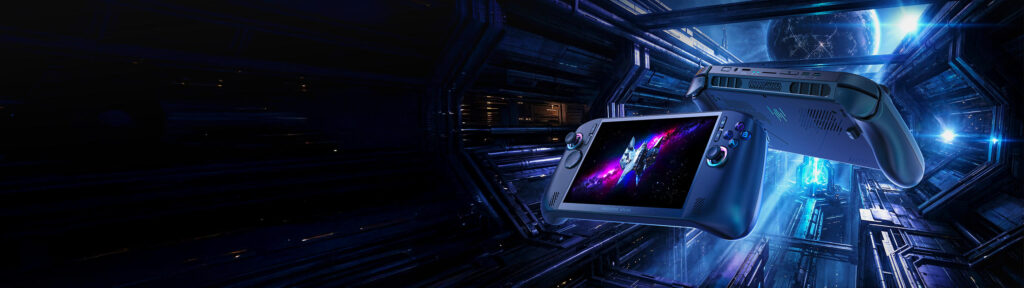
Acer is bringing its first Predator-branded gaming handheld to the United States. The Predator Atlas 8 will go on sale November 1, 2026, through Best Buy for $1,299.99, according to launch details reported by The Verge.
This is not a small or inexpensive Nintendo Switch alternative. It is a full Windows 11 PC built around Intel’s new handheld-focused Core Ultra platform and Arc G3 graphics, with an 8-inch display, integrated controls, and enough ports to double as a compact desktop when connected to a monitor and accessories.
What Acer is launching
The US launch configuration pairs an Intel Core Ultra X7 processor with Intel Arc B390 graphics and 24GB of LPDDR5X memory. The B390 is Intel’s top Arc G3 handheld part, using 12 Xe3 graphics cores. Acer’s official Predator Atlas 8 product page describes the broader platform as supporting up to 32GB of memory, but buyers should pay attention to the exact Best Buy listing: the announced $1,299.99 US model has 24GB.
Storage is listed at up to 1TB using a PCIe Gen 4 NVMe SSD. Acer has not yet provided all the practical details buyers may want, including how easy it will be to replace the SSD or service the battery. Those questions matter more on a premium handheld expected to serve as a primary gaming PC.
An 8-inch, 120Hz display
The Atlas 8 uses an 8-inch 1920-by-1200 touchscreen with a 16:10 aspect ratio, 120Hz refresh rate, variable refresh rate support, 500-nit claimed brightness, and 100 percent sRGB color coverage. Acer also lists Corning Gorilla Glass Victus with a DXC coating.
That combination should make the screen sharper than the 1280-by-800 panels used in some earlier handhelds. Variable refresh rate is especially useful because portable PCs rarely hold one fixed frame rate in demanding games. It can smooth the experience when performance moves within the screen’s supported range without requiring the system to render at 120 frames per second.
The tradeoff is straightforward: a higher-resolution, high-refresh display can consume more power and asks more of the GPU. Owners may choose lower in-game resolutions, frame-rate caps, or image upscaling to stretch battery life.
Why Intel Arc G3 is the key change
Intel says its Arc G3 processors were designed specifically for handheld gaming PCs. The B390 combines Xe3 graphics, ray-tracing hardware, and XeSS 3 features including super resolution, frame generation, and low-latency technology. The processor design also combines two performance cores, eight efficiency cores, and four low-power efficiency cores.
Those specifications make the Atlas 8 an important test for Intel’s latest mobile gaming push. AMD-powered handhelds have dominated this category, so the more meaningful question is not only peak benchmark performance. Driver maturity, game compatibility, idle power use, and sustained performance in a compact chassis will determine whether the new platform is competitive in everyday use.
Acer and Intel have made performance claims around the new hardware, but they remain manufacturer claims until independent testing measures frame rates, heat, fan noise, and battery life across a useful selection of games.
Controls and cooling are built for long sessions
The integrated controller includes TMR joysticks and dual-mode triggers. Tunneling magnetoresistance sensors are designed to reduce physical wear compared with traditional potentiometer sticks and should help resist the drift problems that have affected many game controllers. Dual-mode triggers can switch between longer analog travel for racing games and a shorter response for shooters.
Acer’s official announcement says the cooling system uses two fans, including a metal AeroBlade fan. That hardware sounds substantial, but chassis temperatures and acoustics cannot be judged from a specifications sheet. The 8-inch body provides more cooling room than a smaller handheld, although the more powerful components also create more heat to remove.
Ports make it more than a handheld
Two Thunderbolt 4 ports give the Atlas 8 more flexibility than a basic USB-C charging port. Users can connect external displays, docks, storage, wired networking, and other peripherals. Acer also includes a UHS-II microSD card reader and a 3.5mm audio jack.
That makes a docked setup practical: plug in power, a monitor, a keyboard, and a mouse, and the same device can act as a Windows desktop. Thunderbolt support may also appeal to owners of fast external storage or compatible GPU enclosures, though performance and enclosure compatibility will vary.
Wireless features listed by Intel for the platform include Wi-Fi 7 and Bluetooth 6. Real-world support depends on the final configuration, router, accessories, and local wireless conditions.
Battery life remains the biggest unknown
Acer lists battery options of up to 80Wh, with 60Wh offered on select models. The company has not supplied a clear, independently verified gaming-runtime figure for the US launch unit. Battery capacity alone cannot answer that question because power limits, display brightness, game settings, resolution, wireless use, and frame-rate caps can change runtime dramatically.
Buyers should therefore treat battery life as an open question until reviewers test the retail configuration. For demanding games, the Atlas 8 is likely to benefit from performance profiles and sensible frame-rate limits. A large battery can help, but it also contributes to weight, and Acer has not made portability the central selling point of this premium model.
The $1,299.99 price changes the comparison
At $1,299.99, the Atlas 8 is priced well above mainstream handheld consoles and many Windows handhelds. It also overlaps with capable gaming laptops that offer larger displays, full keyboards, more upgrade options, and sometimes discrete graphics.
The Atlas 8’s argument is portability and flexibility: it puts a complete Windows gaming PC, built-in controls, a high-refresh touchscreen, and Thunderbolt connectivity into one device. That combination could suit travelers, commuters, and players who want to move between handheld and docked use without maintaining two computers.
However, value-conscious shoppers should compare total ownership cost. A dock, high-capacity microSD card, case, charger, keyboard, mouse, or external monitor can add significantly to the purchase price. A gaming laptop may remain the better choice for people who mostly play at a desk.
Windows compatibility is broad, but not universal
Because the Atlas 8 runs Windows 11, it should support major PC game stores, launchers, productivity applications, and accessories. Acer is also including two months of Xbox Game Pass Premium with eligible purchases.
Windows provides a larger software library than a closed console, but it can be less convenient on a small touchscreen. Launchers, update dialogs, account prompts, and desktop interfaces are not always designed for controller-only use. Acer also cautions that individual game compatibility can depend on anti-cheat systems, drivers, and publisher support.
Intel’s graphics-driver cadence will be worth watching. New GPU architectures sometimes need game-specific fixes after launch, particularly for older titles or games with unusual rendering paths.
Availability starts at Best Buy
The Predator Atlas 8 is scheduled to be available online and in Best Buy stores on November 1, 2026. The Verge reports that early preorder inventory sold out, but that does not tell us how many units were offered or how much stock will be available at launch.
Shoppers should verify the listed memory, storage, battery, and included accessories before ordering because Acer’s product page describes multiple possible configurations. The $1,299.99 launch model is the reference point, but future variants could differ.
Who should consider it
The Atlas 8 makes the most sense for PC gamers who specifically want premium handheld hardware, a larger 8-inch screen, Windows software freedom, and strong docking options. It is also one of the first chances to see Intel’s newest handheld graphics architecture in a retail product.
Most buyers should wait for independent reviews before committing. Key unanswered questions include real battery life, fan noise, grip comfort, weight balance, sustained performance, driver stability, repairability, and how the retail unit compares with similarly priced laptops and rival handhelds. The specifications are ambitious; at $1,299.99, the finished experience needs to be equally convincing.