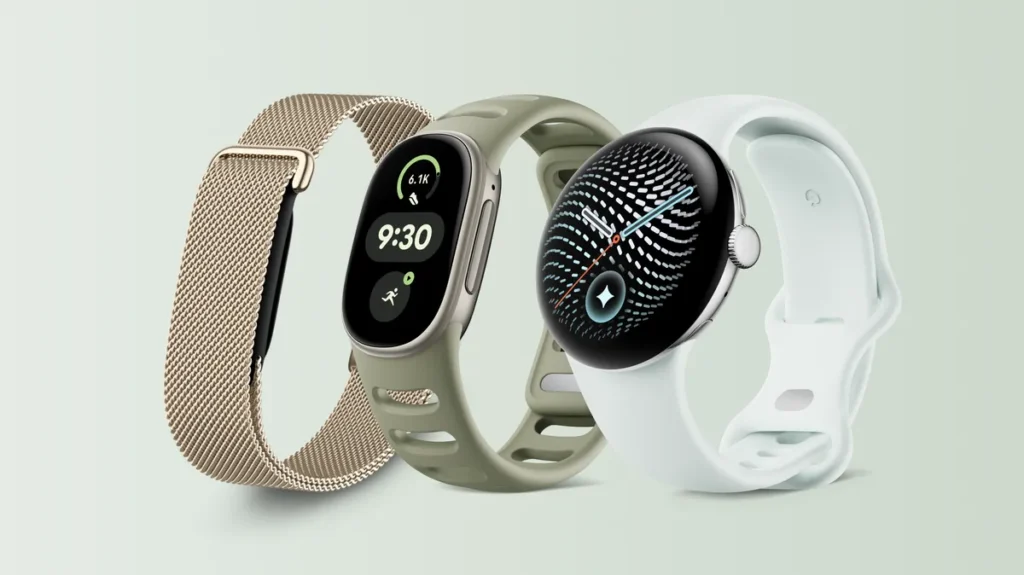
Google’s Fitbit Edge is now on sale for $179.99, offering a new middle ground between the screenless Fitbit Air and the more capable Pixel Watch 5. It is a traditional fitness band with a bright display, built-in GPS, ECG readings and up to seven days of battery life—but it deliberately skips several smartwatch features.
GNW previously covered the early Fitbit Edge preview before Google confirmed the final hardware. The October 27 retail release closes that loop with official pricing, specifications and independent reviews now available.
This is not a hands-on review. Hardware impressions and test results are attributed to the publications that performed them.
The Edge replaces the aging Charge 6 at the upper end of Fitbit’s tracker lineup. Google is also using it to introduce a repairable design with a user-replaceable battery, a welcome change for a small wearable that is usually discarded when its battery wears out.
Fitbit Edge price and availability
According to Google’s official announcement, the Fitbit Edge costs $179.99 in the United States and went on sale October 27 through the Google Store and retail partners. The standard purchase includes three months of Google Health Premium.
A Stephen Curry Special Edition costs $219.99 and adds a water-repellent, moisture-wicking band in rye and orange colors. The regular model comes in four finishes: Obsidian with a matte-black case, Fog with polished silver, Olive with satin pyrite and Canyon with warm gold.
The Edge is more expensive than the Charge 6’s original price, and its full value depends partly on whether the buyer plans to keep Google Health Premium after the trial. Personalized coaching and some deeper trend interpretation sit behind that subscription rather than being included permanently with the hardware.
A larger screen without becoming a smartwatch
The Edge is 11.5mm thick and uses a recycled-aluminum housing. Google says its Hybrid OLED screen provides 46% more viewing area than earlier Fitbit trackers and is the company’s brightest tracker display so far. A physical side button offers a more reliable way to pause workouts or return to a previous screen than a touch-only interface.
The redesigned Fitbit OS shows steps, weather, workouts, sleep, cycle tracking and heart-rate information through tiles and complications. It also supports phone notifications, Google Maps directions and media controls. However, it does not run Wear OS and cannot install the broader app catalog available on a Pixel Watch.
Independent reporting from The Verge confirms two important omissions: there is no microphone or speaker for taking calls, and there is no NFC chip for contactless payments. The older Charge 6 supports tap-to-pay, making the missing NFC hardware a real downgrade for buyers who use their tracker as a wallet.
Built-in GPS and automatic workout recognition
Fitbit Edge can start more than 50 exercise modes from the wrist. Its built-in GPS means runners, cyclists and walkers can record a route without carrying a phone. Google claims the upgraded chipset and antenna design deliver up to 40% better GPS accuracy than previous generations, though that figure still needs broader independent testing.
An integrated altimeter records elevation changes during hills, stairs and outdoor workouts. That is a practical addition for hikers and runners and one of the clearest hardware improvements over the Charge 6.
Google also says its contextual activity model can automatically recognize and categorize up to 100 workout types. The model can use movement patterns, routines and—when permission is granted—location context. A visit to a tennis court, for example, can help the app infer that an unrecorded activity was tennis. Automatic classification is convenient, but users concerned about location privacy should review the Google Health app’s permissions rather than accepting every default.
Health sensors are extensive, but this is not a diagnosis tool
The tracker includes an optical heart-rate sensor, ECG capability, blood-oxygen tracking, skin-temperature sensing and overnight metrics such as heart-rate variability and sleep stages. Google’s Health Guardian tools can flag shifts in high or low heart rate and generate longer-term wellness trends related to blood pressure and insulin resistance.
Some features depend on country, age, device settings or a Google Health Premium subscription. They are designed to identify patterns and support conversations with a clinician, not to diagnose disease or replace medical testing. Buyers should check regional availability before treating any advertised health feature as guaranteed.
Independent testing is now available, and the results are mixed. Android Authority’s review praised the lightweight design, readable display and week-plus battery life, but reported inconsistent GPS results and criticized the lack of workout progress alerts and customizable exercise screens. Those findings do not prove every unit will behave identically, but they are a useful warning for runners who prioritize route accuracy.
Seven-day battery life comes with conditions
Google rates the Fitbit Edge for up to seven days per charge. A full charge takes about 90 minutes, while five minutes on the magnetic charger can provide roughly one day of use. Those figures depend on settings and usage.
Keeping the display always on reduces the estimate to roughly two days, according to The Verge. Frequent GPS workouts and continuous health monitoring can also shorten runtime. The seven-day claim is therefore best understood as a light-to-moderate-use maximum, not a promise for every owner.
The hardware carries IP68 dust and water resistance and a 5ATM rating, making it suitable for swimming and everyday exposure. Water resistance can decline as seals age and does not mean the device is protected from every high-pressure or hot-water environment.
The replaceable battery may be the biggest upgrade
Google calls the Edge its first repairable fitness tracker. Its modular internal design includes a user-replaceable battery, and the official specifications confirm the feature. The housing also uses 100% recycled aluminum, while the battery cell contains recycled cobalt and lithium.
A replaceable cell could extend the useful life of the tracker well beyond the usual battery-degradation cycle. Google has not yet made the complete replacement process, battery price and long-term parts availability clear, so repairability should be evaluated again once service documentation and spare parts are broadly available.
Who should buy the Fitbit Edge?
The Edge is aimed at people who want a visible display, reliable workout controls, GPS and detailed health tracking without the distractions or daily charging of a full smartwatch. It is especially attractive to Charge 6 owners who value the larger screen, altimeter and replaceable battery.
It is less compelling for anyone who relies on wrist payments, needs to answer calls, wants third-party apps or dislikes subscription-dependent insights. Budget buyers can spend less on a basic tracker, while people who need a richer app ecosystem may be better served by a smartwatch.
The practical advice is to match the Edge to the features you actually use. Its comfortable design, larger screen, long battery life and repair-friendly hardware make it appealing as a focused health tracker. But runners should weigh the mixed GPS testing, while Charge 6 owners may miss NFC payments and buyers should account for the ongoing Premium cost. At $179.99, it is a credible middle option rather than an automatic recommendation.
Featured image: Official Google product image showing Fitbit Edge between Fitbit Air and Pixel Watch 5.