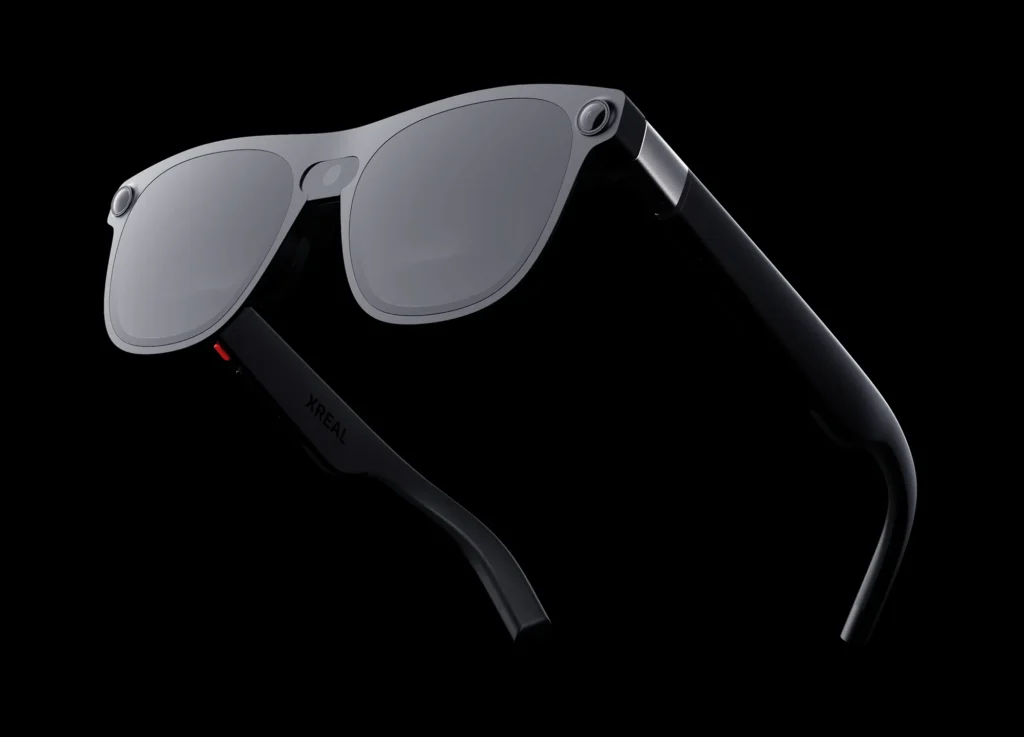
XREAL has moved its Aura glasses from preview to a real product launch. The new optical see-through wearable runs Google’s Android XR platform, includes Gemini, and uses a separate pocket-size computer to keep the glasses themselves comparatively light. Orders opened on October 28, 2026, with a limited launch price of $1,099 for the 12GB/256GB model and $1,299 for the 16GB/512GB version.
The regular prices are $1,279 and $1,499, respectively. XREAL says shipments should begin in mid-November. The initial rollout covers the United States, Canada, Japan, and South Korea, though exact order timing can vary by market. The company’s launch promotion is expected to run through December.
What XREAL Aura actually is
Aura is not a conventional pair of camera-first smart glasses and it is not a fully enclosed VR headset. Its transparent lenses let wearers see the room directly while digital windows and 3D objects appear in the same field of view. Five levels of electrochromic dimming can darken the lenses when a more private or immersive display is useful.
The glasses connect by cable to a 265-gram compute puck. That unit carries the Snapdragon Reality Elite processor, battery, wireless radios, storage, and most of the heat-producing hardware. The glasses contain XREAL’s X1S spatial coprocessor, displays, sensors, speakers, microphones, and cameras. The split design reduces what sits on a user’s face, but it also means Aura is never truly cable-free.
XREAL lists the glasses at 95 grams. That is far lighter than a large mixed-reality headset, yet noticeably heavier than ordinary prescription glasses. Comfort will therefore depend on fit, nose pressure, cable management, and how long the device is worn. XREAL sells medium and large fit options for interpupillary distances of 60–66mm and 66–72mm.
The display and tracking hardware
Each eye gets a Sony Micro-OLED panel with a 1,920 × 1,200 resolution and a refresh rate of up to 120Hz. XREAL specifies a 70-degree field of view, peak brightness of 1,050 nits, 32 pixels per degree, full sRGB coverage, and individual factory calibration. Those numbers indicate a much larger spatial canvas than simple notification glasses, though they do not tell us how easy fine text will be to read during long work sessions.
Two world-facing tracking cameras support six-degrees-of-freedom positioning and hand tracking. A separate high-resolution camera can provide visual context to AI features, with a privacy indicator intended to alert people nearby when the camera is active. Bose-tuned open-ear speakers and a four-microphone array handle audio and voice input while leaving the ears unobstructed.
The compute puck includes a 4,455mAh battery, Wi-Fi 6/6E, Bluetooth 5.3, location hardware, a fingerprint button, active cooling, and two USB-C ports. One port connects the glasses. The other supports charging and DisplayPort input, letting Aura act as a large virtual screen for a compatible laptop, phone, or handheld game system.
Android XR makes this more than a portable monitor
Aura’s most important feature may be its software. Android XR brings Google Play apps, spatial interfaces, and Gemini into a wearable device that can anchor windows around the user. XREAL says buyers will have access to millions of conventional Android apps and more than 150 experiences built specifically for XR.
Users can arrange as many as five virtual screens, connect Bluetooth keyboards, mice, and game controllers, or use hand gestures, voice, and the puck’s touch surface. Google apps including YouTube, Maps, Photos, Chrome, and Gemini are central to the pitch. XREAL also highlights immersive entertainment and games such as Demeo, along with 180-degree and 360-degree video.
Gemini can respond to questions about supported on-screen content or what the wearer is viewing through the cameras. In theory, that makes Aura useful for contextual help, navigation, learning, and task guidance rather than only screen mirroring. The practical limits will depend on app support, permissions, connectivity, and how consistently the assistant understands a scene.
Who the $1,099 launch price is for
Aura is aimed at early adopters who want portable spatial computing without the isolation and bulk of an opaque headset. Frequent travelers could use a private virtual display in a plane seat or hotel room. Developers gain an Android XR device with familiar Android tooling. Gamers can connect a handheld system or controller, while productivity users can build a multi-window workspace without carrying monitors.
That flexibility does not make Aura inexpensive. The discounted entry model still costs more than many laptops and handheld gaming PCs. Buyers also need to accept the tethered puck, limited initial retail reach, and an app ecosystem that is younger than Android on phones. Prescription-lens users will need an insert, and the correct IPD size matters for clarity.
Battery-life expectations also deserve caution. XREAL publishes the puck’s capacity and charging specifications but does not present a single universal runtime figure for every workload. Display brightness, spatial tracking, Wi-Fi use, Gemini activity, and mirrored content can all change power draw. Shoppers should wait for independent endurance and comfort testing if all-day use is essential.
Why this launch matters
Aura gives Android XR its clearest consumer test so far in lightweight optical see-through hardware. Google is taking a partner-led approach: XREAL supplies the optics and wearable design, Qualcomm provides the main processor, and Google supplies the operating system, apps, and Gemini layer. It resembles the ecosystem strategy that helped Android spread across phones, but XR hardware has tougher fit, battery, optics, and privacy problems.
The product also shows the tradeoff manufacturers are making today. Moving compute and battery into a puck keeps the glasses lighter and the real world visible without camera passthrough latency. In exchange, users carry an extra device and cable. A fully self-contained design would be cleaner, but likely heavier, hotter, or less capable with current components.
For most consumers, Aura is a wait-and-see product rather than an impulse purchase. Its launch is still significant because the hardware is available to order, the price and specifications are confirmed, and Android XR now has a serious see-through device built around everyday apps. If the software, comfort, and battery life hold up in independent reviews, Aura could make spatial computing feel more like a portable display platform and less like a headset session.
Availability and confirmed pricing
- 12GB RAM / 256GB storage: $1,099 launch price; $1,279 regular price
- 16GB RAM / 512GB storage: $1,299 launch price; $1,499 regular price
- Shipping: Expected to begin in mid-November 2026
- Initial markets: United States, Canada, Japan, and South Korea, subject to local order timing
- Where to buy: XREAL’s online store, with Best Buy availability in the United States and wider retail distribution planned later
Sources: XREAL Aura product page and specifications, XREAL launch announcement, TechCrunch launch coverage, and Android Authority launch coverage.