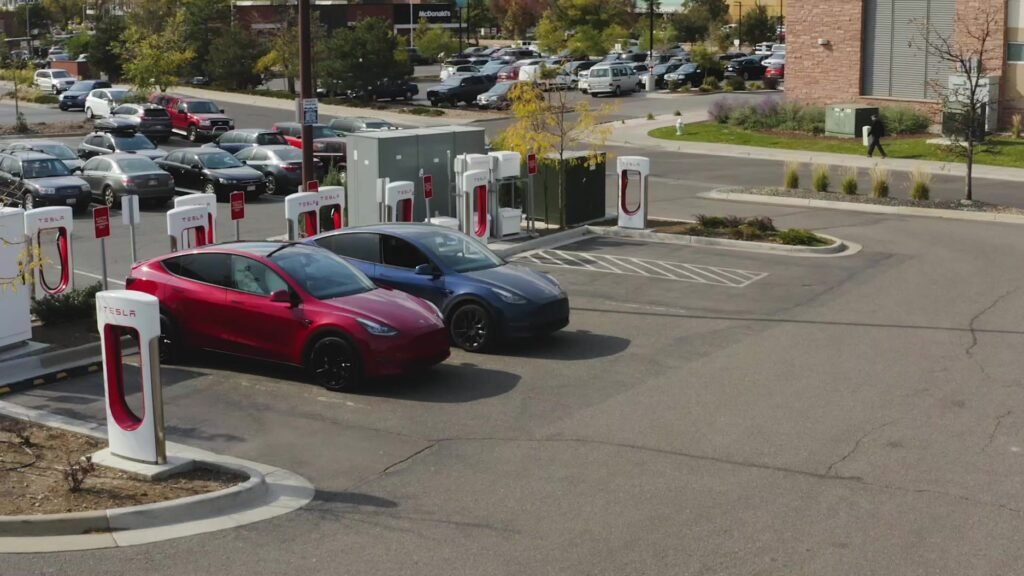
Tesla is adding an emergency escape option for drivers who need to leave a Supercharger before they can safely unplug. The feature, called Emergency Drive Away, lets a compatible Tesla shift into Drive while the charging cable is still attached—but using it will physically damage both the car and the charging equipment.
The U.S.-only feature is tied to software version 2026.38.3. It is deliberately designed as a last resort for a threatening situation, not as a faster way to end an ordinary charging stop.
How Emergency Drive Away works
A Tesla normally refuses to shift out of Park when it detects a connected charging cable. That interlock helps prevent a driver from tearing the connector out by accident, but it also means a driver must release and remove the handle before leaving.
With Emergency Drive Away available, shifting into Drive while connected to a Supercharger brings up a warning on the center display. The driver must hold the brake and confirm activation. The car can then move, forcing the charging handle to separate and fall away.
That confirmation step matters. It reduces the chance of an accidental activation while still keeping the escape process inside the vehicle. The Verge reports that Tesla introduced the option after owners pressed for a quicker exit method following a deadly shooting at a Supercharger location in Twin Falls, Idaho, in August.
The escape comes with real damage
Tesla is unusually blunt about the tradeoff: activating the feature will damage the vehicle and the Supercharger. The connector is not a reusable breakaway plug, and the charge port may need repair. Tesla has also said a service visit is mandatory after activation.
The company warns that deliberate misuse will bring additional penalties, although it has not publicly explained what those penalties will be. That leaves important questions about repair bills, insurance claims and how Tesla will distinguish a genuine emergency from misuse.
For owners, the practical rule is simple: do not test the feature for curiosity and do not use it merely to save time. If the situation is safe enough to unplug normally, the conventional release process remains the right choice.
Which Tesla vehicles are supported?
Emergency Drive Away is associated with Tesla software update 2026.38.3 and is initially limited to the United States. Specialist Tesla reporting indicates that older Model S and Model X vehicles built before 2021 are excluded. Owners should check the Software section of their car’s touchscreen or Tesla app rather than assume the feature has reached their vehicle, because over-the-air updates can roll out in stages.
Tesla has not announced an international release schedule. Regional charging hardware, safety rules and liability requirements could affect whether the same option is offered elsewhere.
Why the feature matters at public chargers
Charging is different from refueling because drivers can remain parked for much longer, often at the edge of a shopping center or beside a highway. A locked connector is useful in normal conditions, yet it can become a barrier if someone needs to leave immediately without stepping outside.
Emergency Drive Away changes that calculation. It gives a driver an official, software-controlled escape path without requiring a third-party adapter. The benefit is narrow but meaningful: personal safety can take priority over expensive hardware when seconds matter.
It also highlights the tension in safety interlocks. The same software rule that prevents routine accidents can become a constraint in an exceptional event. Tesla’s solution keeps the normal lockout in place and adds a clearly labeled override rather than weakening the everyday protection.
What owners should know before relying on it
- It is for emergencies only. Tesla says misuse may lead to penalties.
- Damage is expected. The car’s charge port and Supercharger hardware can both require repair.
- Availability is limited. The first rollout is for compatible U.S. vehicles on software 2026.38.3.
- Older cars may not qualify. Pre-2021 Model S and Model X vehicles are reported as unsupported.
- It is not a guarantee of safety. Drivers still need to assess their surroundings, leave only when the path is clear and contact emergency services when safe to do so.
Tesla says its network now includes more than 80,000 Superchargers worldwide, so even a rarely used emergency function can apply across a large number of charging sessions. The company’s official Supercharger page provides current network background, while independent coverage from electrive details the new activation flow and software requirement.
The bottom line
Emergency Drive Away is a destructive feature by design. That makes it a poor fit for everyday convenience but potentially valuable in the rare situation it was built for. Tesla owners in the United States should treat it like other emergency equipment: know that it exists, understand the consequences and hope they never need to use it.
Featured image: Courtesy of Tesla, Inc.