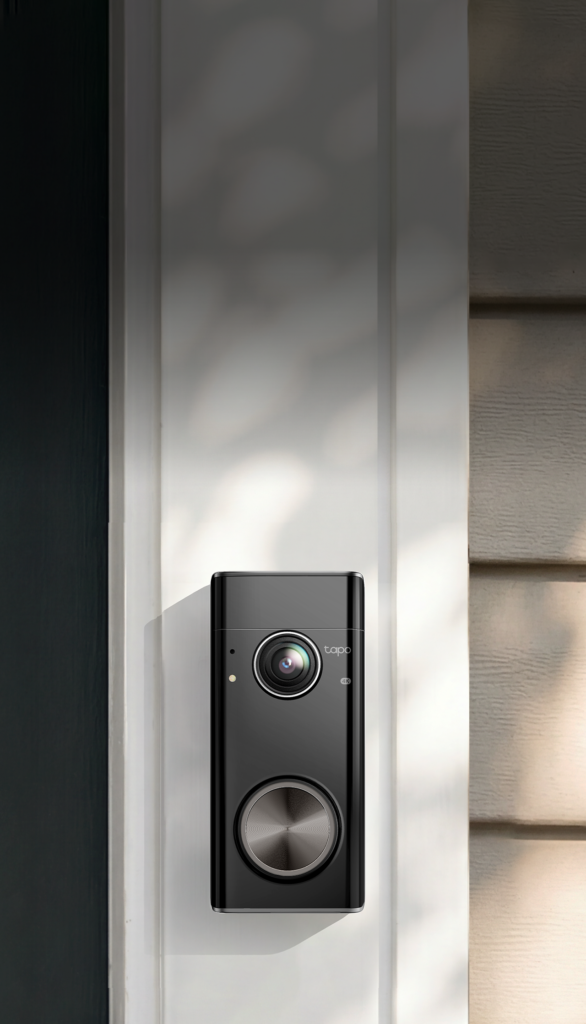
TP-Link’s Tapo Doorbell Pro D260 is now launching in the United States at a $219.99 MSRP, bringing 4K video, radar-assisted motion sensing and subscription-free smart alerts to a doorbell that can run on either battery or wired power.
The combination is aimed at shoppers who want premium security features without committing to a monthly cloud plan. Local recording and most detection features are included, although several practical limitations—including a facial-recognition restriction in Texas and Illinois—are worth understanding before buying.
4K video with a 180-degree doorstep view
The D260 records in 4K and uses a 180-degree diagonal field of view designed to show a visitor from head to toe while keeping packages on the ground in frame. Its 1.97mm f/1.83 lens is paired with infrared and full-color night-vision modes, built-in lights and a quoted night-vision distance of 30 feet.
Higher resolution can help with faces, clothing and package details, but it also creates larger files and places more demand on Wi-Fi and storage. Image quality under difficult porch lighting, motion blur and nighttime conditions will need independent testing; Tapo’s promotional samples are manufacturer demonstrations rather than a hands-on result.
Radar and local AI handle the alerts
Tapo combines conventional motion analysis with radar sensing. The company says radar helps measure movement, distance and direction, reducing alerts caused by shadows, moving branches, rain or passing headlights. An Aerial View feature can show the path a visitor took near the door.
On-device detection can label people, packages, animals and vehicles without an extra monthly fee. Users can select which event types should produce notifications and set activity zones to ignore parts of the camera’s view.
The doorbell also supports facial recognition for familiar visitors. Tapo says facial profiles are processed and stored locally on the device by default rather than uploaded to the cloud. However, the company explicitly says facial recognition is not available in Illinois or Texas because of local privacy rules. Buyers in those states still receive the other person, package, animal and vehicle detection options.
Local recording does not require Tapo Care
The D260 accepts a microSD card with up to 512GB of capacity, sold separately. Local recording and the core smart alerts work without a Tapo Care subscription. Customers who prefer off-device backup can subscribe to Tapo Care for cloud storage and up to 30 days of video history.
This makes the doorbell different from products that place recorded-video access or basic object alerts behind a required monthly plan. “No subscription required” does not mean every service is free: the buyer still needs to supply a microSD card for local storage, and cloud features remain optional paid extras.
Battery and wired installations behave differently
Tapo advertises up to 180 days of battery life. That figure is based on laboratory testing with about 300 seconds of combined recording and live-view use per day. The company says increasing use to 360 seconds per day reduced its estimate to 140 days, and actual endurance will vary with traffic, temperatures, settings and Wi-Fi quality.
Battery operation offers the easiest placement, while hardwiring unlocks pre-roll footage and continuous 24/7 recording. Pre-roll can preserve up to four seconds before a detected event, which helps show what happened before a notification was triggered.
There is an installation detail homeowners should not miss. According to Tapo, wiring the D260 to a traditional indoor chime can operate as a trickle-charging setup, but that mode does not support 24/7 recording. Continuous recording requires a different full-power wiring arrangement that bypasses the existing chime. Buyers should check their transformer, wiring and desired chime behavior before installation.
Calls, voice masking and quick replies
When someone presses the button, the D260 can place a doorbell-style call to the owner’s phone. Two-way audio lets the user speak with the visitor, while voice masking can disguise the user’s voice when talking to an unfamiliar person. Preset quick responses are available for moments when answering live is inconvenient.
The doorbell supports both 2.4GHz and 5GHz Wi-Fi. The longer-range 2.4GHz band may be useful at an exterior entrance, while 5GHz can offer more bandwidth when the router is nearby. It also carries an IP66 weather-resistance rating for dust and water exposure.
Smart-home compatibility and what is missing
Tapo lists compatibility with Amazon Alexa, Google Assistant and Samsung SmartThings. Supported displays and speakers can provide doorbell announcements or show a live view, and a separate Tapo Hub can act as an indoor chime.
The D260 includes mounting brackets, horizontal and vertical wedges, hardware, extension wires and a USB-C charging cable. It does not include a separate plug-in chime, though it has a built-in chime and can use compatible speakers, a Tapo Hub or an existing wired chime depending on the installation.
Apple Home compatibility is not listed. Matter currently does not define a broadly deployed camera specification, so shoppers should not assume the doorbell will appear in every smart-home platform merely because other Tapo accessories support Matter.
Price and practical value
The Tapo Doorbell Pro D260 carries a U.S. MSRP of $219.99 and launched September 30. Tapo previously sold a $1 reservation that generated a $60 launch-day coupon, but that reservation window closed September 29; it should not be confused with a permanent public sale price.
On paper, the D260’s strongest points are 4K video, flexible power, dual-band Wi-Fi and local storage combined with no-cost detection. The major caveats are the separate microSD purchase, installation differences between chime and continuous-recording modes, and unavailable facial recognition in Texas and Illinois.
Complete specifications and installation notes are available on the official Tapo D260 product page. T3’s launch coverage provides additional context on how the camera and subscription-free features compare with Tapo’s earlier doorbells.