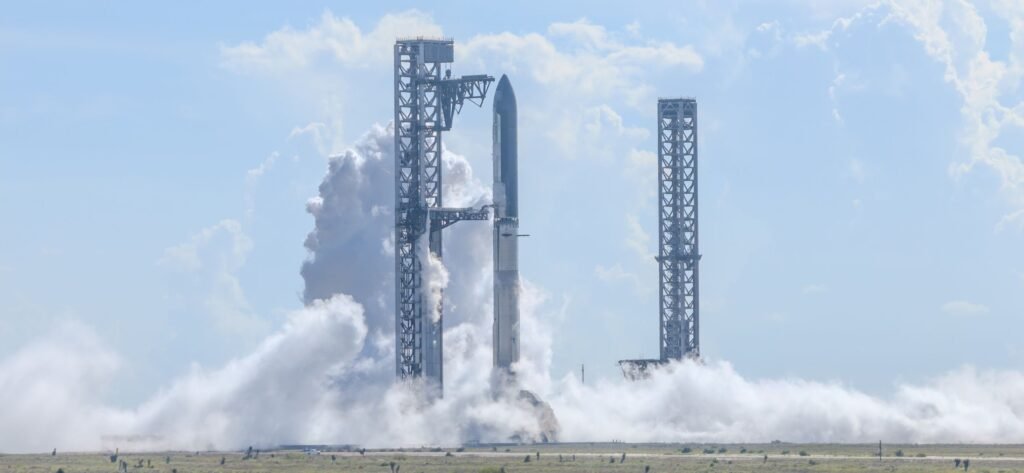
SpaceX’s Starship has reached Earth orbit for the first time. Flight 14 lifted off from Pad 2 at Starbase, Texas, at about 7:48 a.m. Central Time on September 28, 2026, and completed an orbital-insertion burn roughly 25 minutes later.
The milestone moves Starship beyond the deliberately suborbital trajectories used on its first 13 test flights. It does not mean the entire mission went to plan: an engine failure during ascent complicated the flight, and the final return of the upper stage had not been publicly confirmed when this article was published.
What Flight 14 has completed
SpaceX’s official Flight 14 page labels the vehicle as on orbit. SpaceX also said the Super Heavy booster splashed down in the Gulf after separation. The upper-stage Starship then performed the burn needed to enter orbit—the central new objective for this test.
- Starship launched from SpaceX’s South Texas site.
- The Super Heavy booster separated and returned toward an offshore splashdown zone.
- Flight controllers approved the orbital-insertion burn after checking that the vehicle retained enough redundancy for a later deorbit.
- Starship entered orbit for the first time.
- The vehicle deployed 26 next-generation Starlink V3 satellites, according to reporting during the mission.
The Guardian reported that one engine failed on ascent. Mission controllers initially considered whether that problem should prevent the orbital burn, then decided the spacecraft could safely proceed.
The original mission was much longer
SpaceX’s published plan called for Starship to fly at about 275 kilometers, or 171 miles, above Earth, complete approximately six orbits over nearly 10 hours, relight a single Raptor engine for deorbit and finish with a controlled splashdown in the Pacific Ocean west of Chile.
Reporting after orbital insertion said SpaceX was preparing for an earlier return instead of the full six-orbit profile. Because the flight was still developing at publication time, a successful deorbit burn, atmospheric reentry and upper-stage splashdown should not be treated as confirmed.
Why reaching orbit matters
Earlier Starship flights intentionally followed suborbital paths. Those trajectories allowed SpaceX to test ascent, separation, reentry and ocean landing procedures while limiting where hardware could fall after a failure. Flight 14 is different because it demonstrates the speed and control needed to remain around Earth.
That step is necessary before Starship can regularly deploy satellites, carry large payloads or support future crewed missions. It is also important to NASA, which plans to use a modified Starship as a lunar lander for its Artemis program. Today’s result is progress toward those uses, but it is not a demonstration of human-rated reliability.
Flight 14 carried operational Starlink V3 satellites
The payload was another major change. SpaceX planned to deploy 26 Starlink V3 satellites into operational orbit rather than release temporary test articles on a suborbital path.
SpaceX says each V3 satellite can add 1 terabit per second of network capacity, for a claimed 26 Tbps across this mission. The company describes that as roughly 10 times the capacity added by one Falcon 9 launch carrying V2 Mini satellites. Those are manufacturer estimates; real customer capacity and performance will depend on deployment, orbital checkout, ground infrastructure and network demand.
Three satellites carry cameras intended to examine Starship’s heat shield from orbit. The imagery should help engineers study tile condition before attempting future returns to the Texas launch site.
This was not a full reusability test
Neither stage was scheduled for a tower catch. The booster targeted the Gulf, while the upper stage’s original plan ended in the Pacific. That means Flight 14 can prove orbital capability and gather reentry data, but it cannot by itself prove SpaceX’s bigger goal of rapidly flying the same booster and spacecraft again.
The engine failure is also a reminder that Starship remains an experimental system. Reaching orbit is a major achievement, but the quality of the deorbit, heat-shield performance and landing sequence will determine how complete the test ultimately was.
What to watch next
The most important remaining questions are whether the Starlink satellites complete checkout, why the engine failed, how SpaceX changed the return plan and what condition the vehicle reaches during reentry. SpaceX is expected to use those findings to refine the next flight and decide when it can safely attempt recovery closer to Starbase.
Update note: This article reflects publicly confirmed information available around midday Central Time on September 28. Flight 14 was still being tracked as an active mission.
Featured image: official SpaceX Flight 14 artwork.