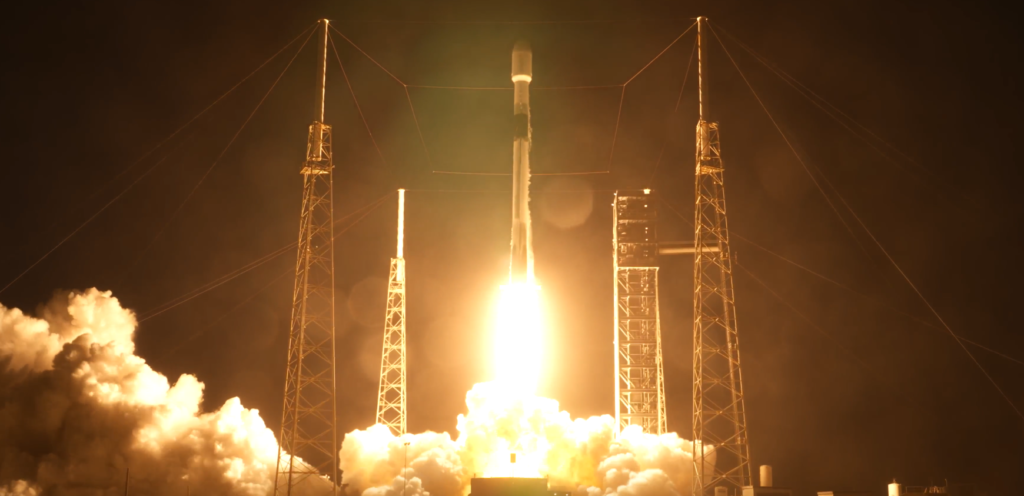
NASA has put two new commercial satellite-relay demonstrations into orbit, moving its plan to replace aging government-owned communications infrastructure closer to real-world testing. The payloads from Viasat and SES Space & Defense launched October 20 aboard SpaceX’s Bandwagon-5 rideshare mission from Cape Canaveral Space Force Station.
The mission is not another consumer broadband launch. Its purpose is to test whether private satellite networks can carry science data, 4K imagery, telemetry, tracking information, and spacecraft commands for NASA missions in low Earth orbit. If the demonstrations work as intended, future spacecraft could connect through commercial networks instead of relying primarily on NASA’s Tracking and Data Relay Satellite system.
What launched on Bandwagon-5
Viasat’s demonstration centers on Maxwell, a Rocket Lab-built spacecraft carrying Ka-band and L-band communications terminals. Viasat says the Ka-band terminal will connect to its high-capacity ViaSat-3 network, while the L-band terminal will use its global L-band system for telemetry, tracking, and command.
The company also plans to test direct-to-ground links through its Real-Time Earth ground-station service using S-, X-, and Ka-band frequencies. According to Viasat’s October 21 announcement, on-orbit testing is scheduled to run for five months through March 2027.
SES placed its demonstration equipment aboard Planet Labs’ Pelican-12 satellite. Its approach divides the work across different orbits: the O3b mPOWER constellation in medium Earth orbit is intended to move high-rate mission data, while geosynchronous satellites handle lower-rate connections used for spacecraft health, tracking, and commands.
SES says Pelican-12 carries a software-defined radio and a flat tracking antenna designed for low-latency, high-throughput links. The test is meant to show that a spacecraft can remain connected as data travels through commercial relay satellites to ground stations.
Why spacecraft need two kinds of links
A spacecraft does not send only one type of traffic. Large instrument files and high-resolution images require fast, high-capacity connections. Commands, location data, and status messages use less bandwidth, but they need to be dependable and available when operators need them.
NASA’s launch report says the Viasat and SES systems will test both high-rate and low-rate relay services. Viasat also plans to use autonomous routing to move information among Maxwell, satellites in geosynchronous orbit, and ground stations.
The practical goal is to reduce the periods when a low Earth orbit satellite must wait to pass over a particular ground station before sending data. A relay network can receive information in space and forward it through other satellites, potentially improving contact time and shortening the delay between observation and delivery.
NASA is preparing to retire TDRS
NASA has relied on the Tracking and Data Relay Satellite constellation for decades. TDRS spacecraft in geosynchronous orbit have supported the International Space Station, Earth-observing missions, launch vehicles, and other spacecraft by relaying information between orbit and the ground.
The agency is now moving toward a commercial-first model for near-Earth communications. In 2022, NASA’s Space Communications and Navigation division awarded a total of $278.5 million to six companies through the Communications Services Project. Viasat says its two awards account for $81 million of that work.
NASA’s objective is not simply to swap one set of satellites for another. Commercial providers are testing multiple architectures, including radio-frequency relays, optical links, and networks spanning low, medium, and geosynchronous Earth orbit. The agency says this could make communications more flexible and scalable while allowing NASA to focus its own resources on deep-space missions.
What this could change for Earth data
Faster satellite relay services matter beyond spaceflight operations. Earth-observation spacecraft collect data used in weather forecasting, wildfire monitoring, agriculture, mapping, disaster response, and climate research. A shorter path from spacecraft to analysts can be important when conditions are changing quickly.
The same infrastructure could eventually support commercial spacecraft operators that need near-real-time tasking or rapid delivery of imagery. Viasat specifically describes Earth observation, scientific missions, and growing low Earth orbit constellations as potential markets for always-available connections.
That does not mean these demonstrations will immediately create a new consumer service. They are infrastructure tests, and any benefits for everyday users would be indirect—through faster access to satellite-derived information or lower-cost mission operations.
What remains unproven
A successful launch is only the start. The spacecraft still must establish their planned links, route data across multiple networks, and show that the connections meet NASA’s reliability, latency, throughput, and operational requirements. Viasat and SES describe expected performance, but those are company projections until the demonstrations produce results.
NASA has not announced that either system has been selected as the permanent TDRS replacement. Its Communications Services Project includes other providers and will continue testing relay capabilities through 2027. NASA has previously said it plans to purchase commercial relay services for near-Earth science missions by 2031, leaving several years for evaluation and procurement.
Why the launch matters
The October 20 mission turns NASA’s commercial-relay strategy from planning into new hardware operating in orbit. Viasat will test a dedicated spacecraft and multi-band network, while SES will test relay equipment aboard an Earth-observation satellite using a multi-orbit architecture.
If the trials succeed, NASA could buy communications as a service instead of owning every relay satellite itself. The bigger change is structural: spacecraft operators may be able to choose among interconnected commercial networks in much the same way terrestrial organizations purchase communications capacity today. The next meaningful milestone will be verified on-orbit performance, not the launch alone.