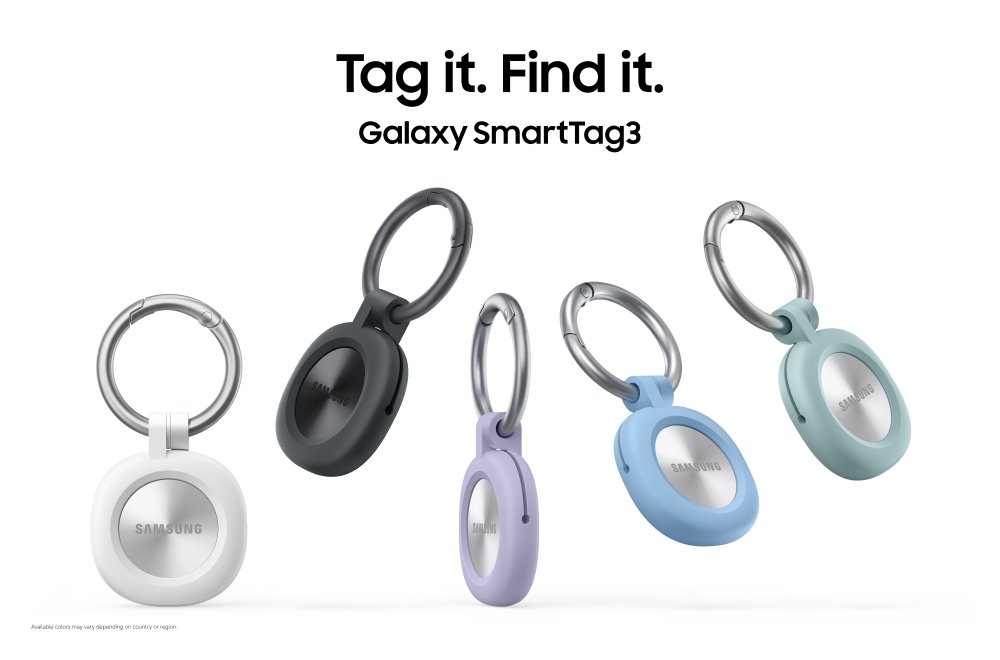
Samsung’s next Bluetooth tracker is designed to be easier to carry, easier to share across mixed-phone households and harder to lose track of at a distance. The Galaxy SmartTag3 will reach the United States in early November 2026 for $29.99 as a single tracker or $99.99 for a four-pack.
The most important change is broader phone support. SmartTag3 can now share core finding functions with iPhones, ending the strictly Galaxy-only approach of earlier models. That does not make it a full AirTag replacement for iPhone owners, however: Samsung says several of its best functions remain unavailable on iOS.
Galaxy SmartTag3 price and release date
Samsung will sell Galaxy SmartTag3 in black and white. Sales begin first in South Korea on October 7, followed by the United States by early November. Additional markets are expected in 2027, according to Samsung’s global announcement.
U.S. pricing is unchanged from the previous generation:
- One Galaxy SmartTag3: $29.99
- Four-pack: $99.99
The tracker itself no longer has the large keyring opening used on SmartTag2. Samsung will instead sell a Silicone Case with a keyring and a separate Loop Case. Buyers who want to attach it directly to keys, a backpack or a pet collar should therefore budget for an accessory or another secure holder.
A smaller tracker with much longer claimed battery life
Galaxy SmartTag3 is approximately 35% smaller by volume and 33% lighter than SmartTag2. It uses a replaceable CR2032 coin cell, so the tracker does not become electronic waste when its original battery is depleted.
Samsung claims up to 550 days of normal use and up to 790 days in Power Saving Mode. Those figures come from Samsung’s internal tests with prerelease hardware and typical-use simulations, not independent long-term testing. Real battery life will vary with usage, temperature and the replacement-battery brand. Power Saving Mode also turns off functions including Compass View and some sound settings, leaving basic Bluetooth finding available.
The enclosure carries an IP67 rating, meaning Samsung rates it for dust resistance and temporary immersion in fresh water up to one meter for 30 minutes. The company cautions that it is not intended for pool or beach use and that water resistance can decline over time.
Bluetooth 6.0 and UWB improve nearby finding
SmartTag3 combines Bluetooth 6.0 Channel Sounding with ultra-wideband, or UWB, for direction and distance guidance. Samsung says Compass View can begin working from as far as 60 meters under unobstructed line-of-sight conditions—about three times the range of the previous generation—before UWB takes over for more precise close-range guidance.
That best-case range comes with important hardware limits. Bluetooth Channel Sounding is initially supported only on the Galaxy Z Fold8 Ultra, Galaxy Z Fold8, Galaxy S26 Ultra and Galaxy S26 Plus. Compass View requires a compatible Galaxy phone running Android 12 or newer, and walls, electronics and other obstacles can reduce both range and accuracy.
When the tag is outside the owner’s direct Bluetooth range, participating Galaxy devices can anonymously detect it and send an updated location to the Galaxy Find Network. Samsung says more than 900 million devices participate worldwide. The practical speed of an update will still depend on how many opted-in Galaxy devices happen to pass nearby, along with network and regional conditions.
iPhone support is useful, but incomplete
Cross-platform support is the headline upgrade, especially for families in which some people use Galaxy phones and others use iPhones. Through SmartThings Find, supported users can check or share a tag’s location and use Search Nearby. A relative borrowing tagged luggage, for example, can be given access from an iPhone.
But the small print matters. Samsung’s U.S. press release says Compass View, Ring Phone and Left Behind Alert are not available on iOS. The tag also relies on Samsung’s Galaxy Find Network rather than Apple’s Find My network or Google’s Find Hub.
In other words, iPhone compatibility is most valuable for shared access in a Galaxy-centered household. An iPhone-only buyer will receive a reduced feature set and will probably be better served by a tracker built around Apple’s network.
New alerts can flag movement or boundary changes
Place Notification lets an owner define an area and receive a warning when the tag enters or leaves it. Samsung suggests uses such as noticing when a bicycle moves away from its normal parking place or when a pet leaves a garden. The feature is labeled as a trial, and the reported position can differ from the tag’s actual location.
Movement Detection Alert can issue a notification after a disconnected tag is detected moving, while Location History stores up to seven days of recorded positions. These functions depend on nearby participating Galaxy devices, so alerts can be delayed or may not arrive in areas with sparse network coverage.
Existing conveniences remain. NFC Lost Mode can show a prewritten message and contact details when someone scans the tag with an internet-connected NFC phone. The tag button can also trigger preset SmartThings routines, and supported Galaxy users can receive a Left Behind Alert after the phone loses its connection to the tag.
Who should consider SmartTag3?
The new model makes the strongest case for Galaxy owners who want longer battery life, better long-range direction finding and more proactive notifications. Its replaceable battery and unchanged $29.99 price are welcome, while iPhone sharing makes it less awkward for mixed-device families.
The compromises are equally clear: the attachment cases cost extra, full precision finding needs one of a limited number of newer Galaxy phones, and iOS users miss several prominent features. It is also a finding aid—not a real-time GPS tracker with its own cellular connection. Its usefulness away from the owner depends on nearby Galaxy devices detecting it.
Featured image: official Samsung product artwork. Source: Samsung Newsroom.