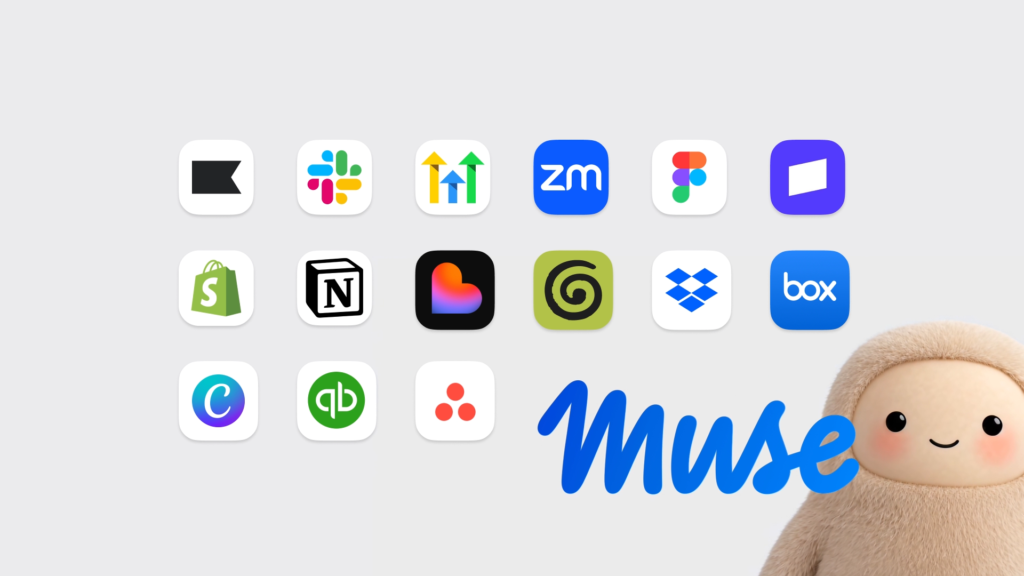
Meta is extending its Muse AI agent into small-business operations with a new set of connectors for commerce, accounting, design, communication and project-management tools. The company announced Muse for Small Business on September 29, positioning it as an assistant that can work across the services a company already uses rather than forcing owners into a separate business suite.
The launch matters because it moves Muse beyond general planning and web tasks into workflows that can touch sales data, customer records, marketing assets and financial information. Meta says the system can analyze those sources, recommend actions and prepare work, but it should still ask for approval before anything is published, sent or purchased.
Which business apps can Muse connect to?
The initial connector list includes Asana, Box, Canva, Dropbox, Figma, Granola, HighLevel, Intuit QuickBooks, Klaviyo, Lovable, Notion, Shopify, Slack, Stripe and Zoom. Muse can also connect to Facebook Pages, Instagram professional-account analytics and Meta ad accounts.
That mix covers several common small-business jobs. A retailer could combine Shopify sales with campaign results; a service business could pull context from Slack, Zoom or Notion; and an owner could ask questions about expenses or cash flow using QuickBooks data. Meta also says Muse supports custom connectors for services that are not on the built-in list.
This is not a separate AI model or a stand-alone business edition. It is an expansion of the Muse agent introduced earlier in September, with additional skills and access to more business data sources.
What Muse is supposed to do
Meta’s examples focus on jobs that often fall to an owner or a very small team. Muse can review sales, advertising and social activity to draft a growth plan; identify email and calendar items that need attention; evaluate which marketing efforts appear to be working; prepare a campaign; and look for unusual expenses.
The agent can also draft customer messages, flag emails that may need a response and suggest next steps without waiting for a new prompt. Meta describes Muse as an agent rather than a conventional chatbot because it can continue multi-step work across connected services.
Those are manufacturer claims, not results from our own testing. Real usefulness will depend on the quality of each connector, how accurately Muse interprets a company’s data and how well it handles exceptions. A polished demo is not the same thing as reliable bookkeeping, inventory management or customer support during a busy week.
Approval controls are the most important feature
Giving an AI access to storefront, accounting and customer systems creates obvious risks. Meta says Muse will not publish content, send messages or spend money without the user’s approval. The broader Muse service also provides an activity trail so users can review completed and planned actions.
That safeguard is especially important when the agent works with tools such as Stripe, Shopify, QuickBooks or an advertising account. Owners should still begin with the narrowest permissions available, connect one service at a time and review early outputs closely. Sensitive financial and customer data deserves the same access discipline as any employee or contractor account.
It also remains unclear how consistently approval requests will appear in complicated workflows that cross several services. Meta has described the control model, but it has not published independent reliability results for every connector or every type of business task.
Availability and price
Muse is currently available to adults in the United States and Canada. Meta says the service is free for most common uses, with subscription plans available for people who need more capacity. The small-business announcement does not provide a separate price or say that companies must buy a dedicated business plan.
Reuters reported on September 29 that Muse recorded an estimated 2.8 million downloads during its first two weeks, citing Sensor Tower. The same report confirms that Meta is pitching the new connectors as a way to help owners run their businesses and find customers.
Who should pay attention?
Muse for Small Business is most relevant to owners who already spread work across several cloud services and spend time copying information between them. A useful agent could reduce that administrative load by assembling context, drafting material and surfacing decisions in one conversation.
The tradeoff is concentration. Connecting more systems gives Muse better context, but it also increases the amount of business information available to one service. Companies with regulated data, formal approval chains or strict retention requirements should evaluate the product’s controls and connector permissions before using it for real operations.
For now, the practical question is not whether Muse can replace an accountant, marketer or operations manager—it cannot responsibly be assumed to do so. The more realistic test is whether it can save a small team time on low-risk preparation while leaving consequential decisions with a person.
Featured image: Meta official press artwork for Muse for Small Business.