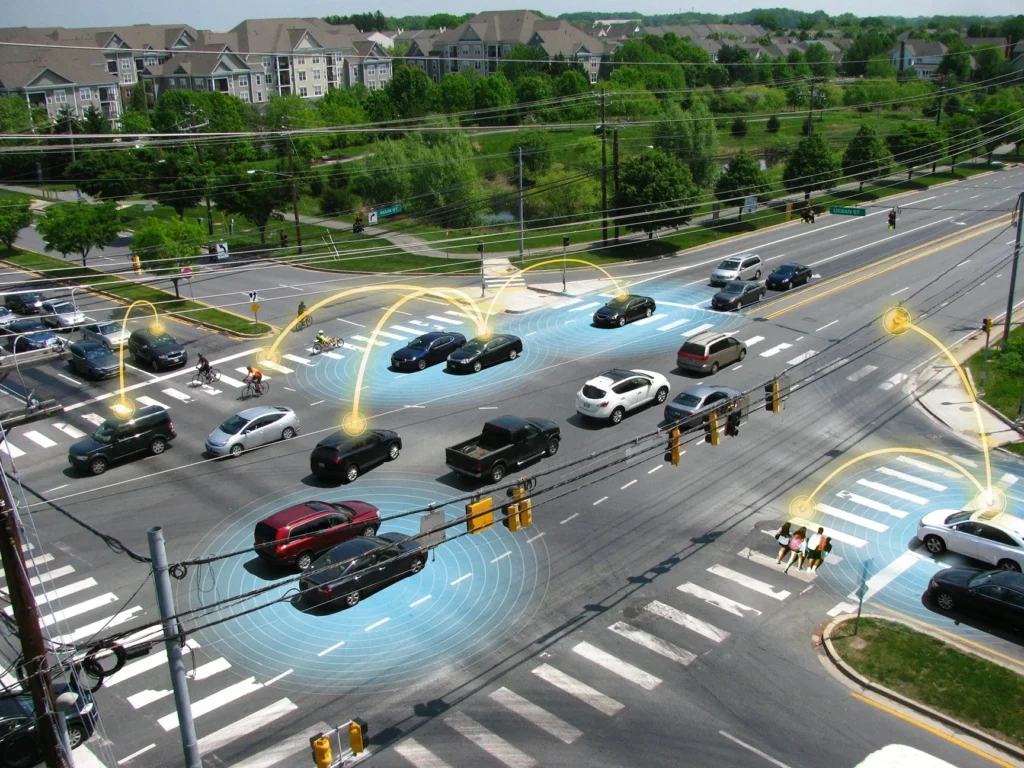
Cars are getting better at watching the road, but cameras and radar still cannot see through buildings, around parked trucks or across a blind intersection. LG Electronics is demonstrating a different approach: let vehicles, road infrastructure, mobile devices and cloud services warn one another before a hazard comes into view.
At the 2026 ITS World Congress in Gangneung, South Korea, LG is showing an integrated safety platform built around its Soft V2X technology. The live road demonstrations run from October 20 through October 22 and use a vehicle with LG telematics hardware, connected devices and a pedestrian mobile app.
The important caveat is that this is a technology demonstration, not a consumer product launch. LG has not announced a price, a retail release date, supported car models or a list of cities where drivers can use it.
What LG is demonstrating
V2X means “vehicle to everything.” In practice, it is a family of connections that can let a car exchange safety messages with other vehicles, traffic lights, roadside equipment and vulnerable road users. LG’s demonstration combines two communication paths:
- Direct V2X: nearby vehicles and devices can exchange time-sensitive messages without sending every warning through a distant cloud server.
- Vehicle-to-network (V2N): a cellular network and cloud server can bring in information from a wider area and coordinate services beyond direct radio range.
LG calls the combined system Soft V2X. The company says its demonstration covers obstructed intersections, approaching pedestrians and cyclists, and hazards outside the driver’s line of sight. A pedestrian app supplies another part of the picture, while the connected vehicle and roadside systems share warnings.
That hybrid design matters because neither communication route is perfect by itself. Direct links can be fast and local, but they depend on compatible radios and devices nearby. Cloud links can cover a broader area, but service quality may vary with network conditions. LG says its platform uses predictive quality-of-service information to choose and coordinate the V2X and V2N paths.
Why hidden hazards are the useful test
Most modern driver-assistance systems begin with sensors mounted on the car. Those sensors are valuable, but physics sets a hard limit: a camera cannot identify a cyclist hidden behind a delivery van until the cyclist becomes visible.
A cooperative system could receive a warning earlier from a phone, another car or a connected intersection. The goal is not to replace onboard sensing. It is to add information from places the car cannot see and give the vehicle or driver more time to react.
LG says the platform includes end-to-end message security and a V2N server based on standards from the 5G Automotive Association and ITS Korea. Those details are important because a false or delayed road-safety message can be worse than no message. Still, LG has not published independent test results for latency, false alarms, security resilience or performance in congested mobile networks.
How Euro NCAP fits in
LG describes its scenarios as aligned with the European New Car Assessment Programme, the independent organization behind Europe’s vehicle star ratings. Euro NCAP revised its protocols for 2026 around four stages: safe driving, crash avoidance, crash protection and post-crash safety.
Euro NCAP’s longer-term roadmap also calls for testing safety functions enabled by vehicle-to-vehicle, vehicle-to-infrastructure and broader V2X communication. That gives automakers and suppliers a practical incentive to turn cooperative warnings into repeatable safety features rather than isolated pilot projects.
LG calls this the world’s first integrated V2X-V2N demonstration aligned with Euro NCAP cooperative-safety scenarios. That “world’s first” wording is the company’s claim and is based on LG’s internal research using public information as of October 2026; it should not be read as an independent certification.
What has to happen before drivers benefit
The biggest challenge is deployment, not a single clever algorithm. A cooperative warning works best when many parts of the road system participate. Cars need compatible hardware and software. Phones or wearables need permission to share relevant safety data. Intersections need connected equipment. Mobile networks and cloud systems need reliable coverage, and cities, automakers and suppliers need compatible standards.
Privacy also needs careful design. A pedestrian-warning service has to communicate enough location and motion information to prevent a collision without creating an unnecessary trail of personal movement data. LG’s announcement mentions message security, but it does not explain data retention, user consent, anonymization or what happens when a pedestrian disables the app.
Drivers should also expect the technology to arrive unevenly. New vehicles with modern telematics systems are easier to support than older cars. Busy urban corridors may get connected infrastructure before rural roads. Cross-brand interoperability will be essential if a warning from one company’s phone app is expected to reach another company’s vehicle.
Availability, pricing and the practical takeaway
LG has not announced a consumer price, launch market or timetable for Soft V2X. The company is presenting the technology to the automotive and transportation industries and says it is working with Toyota and regional intelligent-transportation groups on broader cooperative-safety adoption and standards.
For car buyers, the near-term takeaway is not to wait for a product called Soft V2X. Instead, watch how automakers describe connected hazard warnings, whether those features work across brands, what happens when cellular service drops, and whether the manufacturer promises ongoing security updates.
The demonstration points toward a useful evolution of advanced driver assistance: vehicles that combine what their own sensors see with trusted warnings from the road around them. The concept is promising, but the real test will be large-scale, independent validation in messy everyday traffic—not a controlled congress route.