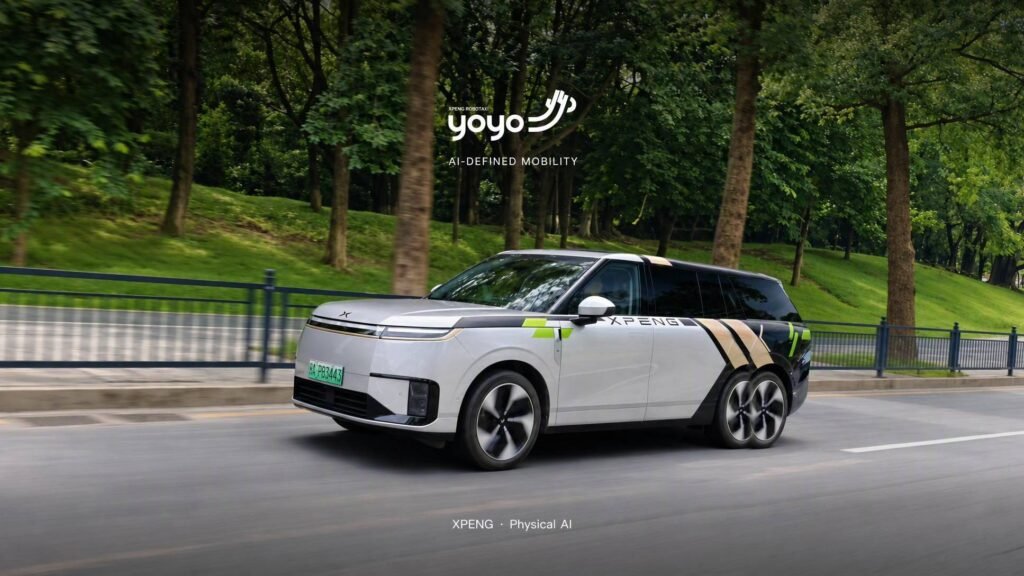
XPENG has given its autonomous ride-hailing program an official name—XPENG YOYO—and opened online registration to members of the public in China. The October 8 announcement moves the program beyond employee-only trials, but the new access remains invitation-based and should not be confused with a nationwide commercial robotaxi launch.
For consumers, the practical news is narrow but meaningful: people with invitation codes can now register for pilot ride slots through XPENG’s dedicated online service. The company has not announced unrestricted access, a public fare schedule, a fleet size, or a firm date when anyone will be able to hail a YOYO.
What XPENG announced
In its official October 8 press release, XPENG said the YOYO name will serve as the commercial identity for its robotaxi business. Registration opened in China on the same day through invitation codes, extending a program that had previously focused on internal users.
The company describes the change as a step from technical validation toward real-world operations. That wording matters. Registration is a way to recruit outside riders and test the complete service experience; it is not evidence that YOYO is already operating as an unrestricted taxi network.
Independent reporting from CarNewsChina says the booking system is offered through a mini-program and that the announcement did not specify the fleet size or a date for open public service.
What the YOYO vehicle uses
The YOYO robotaxi is based on XPENG’s GX SUV platform. XPENG says each vehicle uses four of its in-house Turing AI chips with a combined 3,000 TOPS of computing performance. Driving decisions run through the company’s VLA 2.0 vision-language-action model.
Unlike many robotaxis that combine cameras with lidar and detailed pre-mapped routes, XPENG says YOYO uses a vision-led system without lidar or high-definition maps. That could simplify deployment and reduce hardware complexity, but the company’s claims do not yet provide enough public data to compare safety, reliability, or operating cost directly with rival systems.
XPENG says the platform is engineered for Level 4 autonomous driving. Level 4 does not mean the vehicle can drive everywhere in every condition. It means the automated system can perform the complete driving task without human intervention inside its approved operating domain, which may be limited by city, road type, weather, speed, or other rules.
A fast development timeline, with limits
XPENG announced its robotaxi plans in November 2025 and began regular road testing in January 2026. A production version rolled off the line in Guangzhou in May, followed by employee ride trials in July. The company says those tests covered the full chain from online booking to automated pickup and drop-off.
CnEVPost reports that the program had completed more than 2,000 internal rides in Guangzhou by late August. XPENG also received a Guangzhou remote-testing qualification in August that allows testing without a safety operator in the driver’s seat on designated roads.
That permission applies to specified testing conditions, not every street and not every customer trip. XPENG has previously targeted passenger services without safety drivers in 2027. The current invitation program should therefore be understood as a controlled expansion of testing and service validation, with the exact supervision arrangement likely to depend on the route and regulatory approval.
What riders may experience
XPENG is trying to make the ride feel more like a premium mobility service than a bare test vehicle. The company says invited users can set the cabin temperature and activate a fragrance system before pickup. Inside, the vehicle includes reclining “zero-gravity” seats, massage functions and a rear entertainment screen.
Earlier internal rides were priced at 1 yuan mainly to test payment and service workflows. XPENG has not announced standard passenger fares for the external pilot, so that nominal internal-test price should not be treated as the future cost of a YOYO ride.
Why this matters
The program shows how XPENG wants to use the same core hardware and AI development across consumer driver-assistance systems and a more tightly controlled Level 4 service. It also gives the automaker a route into mobility services without necessarily operating every fleet itself.
CEO He Xiaopeng has said XPENG intends to earn revenue through vehicle sales, technology services and a share of operating income, while local partners handle offline operations. That makes YOYO as much a technology platform for ride-hailing companies as a taxi brand for passengers.
The company chose a short English name partly for future international recognition and says it is discussing partnerships in Europe, the Middle East and Southeast Asia. Those plans remain preliminary: no overseas operating partners, launch cities, prices or service dates were included in the October 8 announcement.
For now, YOYO matters most as evidence that XPENG is putting external passengers into a factory-built robotaxi program rather than keeping the project inside a laboratory. The next meaningful milestones will be transparent safety data, the number of approved operating areas, the scale of the fleet and a clear timetable for rides without onboard safety staff.
Availability, price and open questions
- Where: Registration is open in China; the active pilot is centered on Guangzhou.
- Access: Invitation code required. Unrestricted booking has not been announced.
- Price: No public fare schedule has been confirmed.
- Fleet: XPENG has not disclosed the current public-pilot fleet size.
- Driverless operation: Testing without an in-seat safety operator is permitted on designated Guangzhou roads, but XPENG has not said that every invited ride will operate that way.
- Global rollout: The name and business model are designed for international expansion, but there is no confirmed overseas service date.
Sources: XPENG, Reuters, CarNewsChina, and CnEVPost.