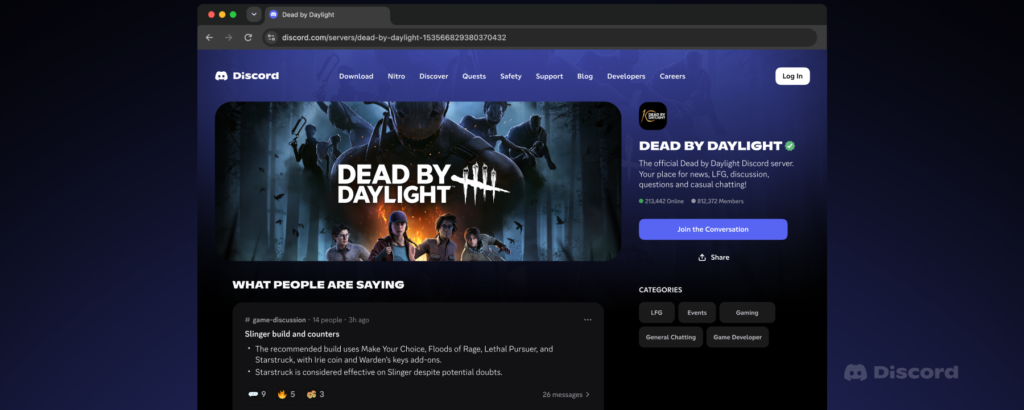
Discord is preparing to make some conversations easier to find outside its app. Beginning in mid-December 2026, text from selected public channels in large, Discoverable Servers may appear on Discord’s public Server Web Pages and in search-engine results.
The change does not open private servers, direct messages, group DMs, role-restricted channels, or private threads to search. But it does change the practical audience for posts made in participating public channels: a message written for a Discord community could also become an answer found through Google or another search engine.
Discord announced the plan on October 27 and has already started rolling out privacy and server-management controls. For most adult accounts outside several named regions, the member setting is on by default. That makes this worth checking before the first messages begin appearing on the web.
What Discord is changing
Discord is expanding Server Web Pages for Discoverable Servers. These are public web pages that describe a server and help people decide whether to join. Discord says every Discoverable Server will have one from November 16, 2026, even if its moderators have not manually published a page.
Two separate features can add community content to those pages:
- Channel Summaries: automated summaries of active discussions from November 16 onward. They can begin appearing on Server Web Pages on November 16.
- Channel Messages: eligible messages shown in their authors’ own words. Discord plans a gradual rollout from mid-December, and these messages may be discoverable through web search.
The two systems have separate admin controls. A server can enable summaries for one set of channels and messages for another, or turn either feature off completely. Discord also warns that AI-generated summaries may not always be accurate.
Which servers and channels are included?
The change is limited to Discoverable Servers, Discord’s most public type of community. Discord says these servers have at least 1,000 members, are at least eight weeks old, meet activity and safety requirements, and have chosen to appear in Server Discovery so anyone can find and join without an invite.
A normal friends-only server is not covered. Neither is a Community Server that has not enabled Server Discovery. Within a Discoverable Server, only eligible public channels can contribute content. Private and role-restricted channels are excluded. Public threads and forums may be included when their parent channel participates, but private threads and private forums are not.
Discord says participating channels will show an icon in the channel header and a pop-up before a member posts. The notice should reappear if administrators newly enable web exposure for a channel.
What can appear in search?
Discord says Channel Messages will initially expose text only. Usernames and avatars will not appear alongside those messages on Server Web Pages. Messages sent before the mid-December launch will not be included, regardless of the account setting.
That is a narrower change than “all Discord messages are becoming public,” but anonymity should not be assumed. A message can still contain a name, handle, location, link, project detail, or other clue written by the author. It may also be recognizable from its wording or context. Removing the profile label does not remove information typed into the message itself.
Channel Summaries are different. They describe broader topics rather than presenting individual posts, and Discord says usernames will not be shown. Members cannot individually opt out of summaries; server administrators decide which channels can feed them.
How members can opt out
On desktop or the web version of Discord, open User Settings > Data & Privacy. Turn off “Show my message content from Discoverable channels on web pages.” One switch applies across every Discoverable Server on the account, including when Discord is used on mobile.
The setting controls eligibility at the moment a message is sent. Messages sent while it is off cannot later be surfaced as Channel Messages. Turning it off does not retroactively cover messages posted while it was on, even if those messages have not yet appeared on a web page.
According to Discord’s member help page, the setting is on by default for most adult accounts. It is off by default in the EU/EEA, United Kingdom, Canada, Brazil, Australia, and South Korea. Accounts in Discord’s teen age group are excluded and cannot enable Channel Messages until adulthood.
What server administrators can control
Owners and members with Administrator permission can open Server Settings > Community > Web Presence on desktop or the web. Discord provides independent toggles and channel lists for Channel Summaries and Channel Messages.
Public channels are included by default. Administrators can deselect individual channels, select all or none, or disable either feature server-wide. A new public-channel setup screen also offers All Content, Summaries Only, Messages Only, or Off. These options are disabled for private channels.
Discord’s administrator documentation says the controls began rolling out on October 27. Moderation teams that do not want public-channel content on the web should review them before November 16 rather than waiting for a default Server Web Page to go live.
Deleting a message may not erase every copy immediately
If a member deletes an eligible post, Discord says it will remove the message from the app and its Server Web Page. However, search engines operate their own indexes and caches. A deleted message may continue appearing in results for a while, and an additional removal request to the search provider may be necessary.
Switching the account setting off is also not a “remove my history” button. It prevents newly sent messages from being displayed going forward. Earlier eligible messages remain unless the author deletes them. Likewise, when an administrator disables a feature or removes a channel, that stops new content from appearing but may not immediately take down material already published.
Why Discord is doing this
Discord’s argument is familiar to anyone who has searched for technical help and found the useful answer locked inside a server. Many communities have moved troubleshooting, game guides, release notes, and project knowledge away from traditional forums. Search engines cannot normally index those discussions, so the same questions are asked repeatedly and useful answers are difficult to discover.
Discord says it has more than 63,000 Discoverable Servers and wants their public knowledge to work more like the open forums they often replaced. Public search could help a game community surface a build guide, let a developer expose answers to common questions, or lead a new member directly into the relevant conversation.
The tradeoff is reach. “Public inside a server” can feel different from “indexed on the open web,” even when anyone could technically join. Discord is adding notices and controls, but users and moderators still need to understand the defaults.
What to do before the rollout
Members who participate in large public communities should check the Data & Privacy setting now. In an eligible channel, look for the web-discovery icon and read the notice before posting. Avoid putting personal information into a public-channel message simply because a username will not be displayed beside it.
Server administrators should review every public channel, not just the obvious forum or help channels. A sensible approach is to enable web messages only where durable, searchable answers are part of the channel’s purpose, while keeping casual chat, support cases, and sensitive community discussions off the public web.
This is not a breach and it does not make private Discord spaces searchable. It is a discoverability expansion for selected public areas. The important practical change is that eligible messages can move from a community context into a search context—and the safest time to choose your settings is before that starts.
Sources
- Discord: Making Content from Discoverable Servers Easier to Discover (October 27, 2026)
- Discord Help Center: Discoverable Content on the Web (updated October 27, 2026)
- Discord Help Center: Discoverable Server Web Presence (updated October 27, 2026)