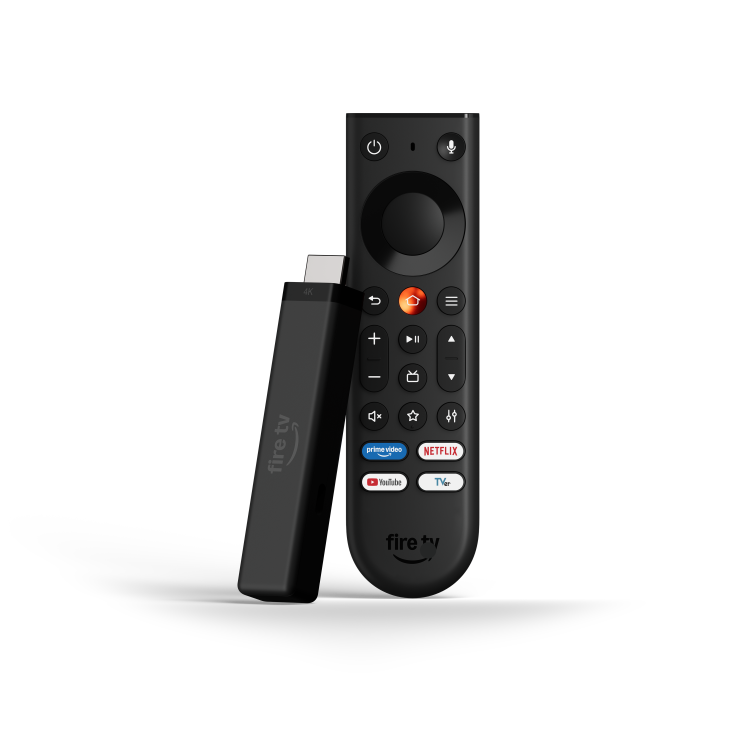
Amazon has released a new Fire TV Stick 4K that can draw power directly from a compatible television’s USB port, removing the usual wall adapter from many setups. The $59.99 streaming stick also introduces a slimmer body, Wi-Fi 6 and a redesigned remote, but its move to Amazon’s Vega OS creates an important tradeoff for people who previously relied on Android app sideloading.
The third-generation Fire TV Stick 4K is available now in the United States and several other markets. Amazon is also preparing a temporary $39.99 US price for Prime Big Deal Days beginning October 6, according to TechRadar.
Direct Power makes installation cleaner
The most practical change is Amazon’s Direct Power design. Instead of connecting the stick to a separate wall adapter, many buyers can use the television’s USB port to power it. That means fewer cables behind a wall-mounted TV and one less adapter to pack while traveling.
There is a limitation: not every television USB port supplies the same amount of power. Amazon’s setup guidance says users may see an insufficient-power warning on some TVs. If that happens, a compatible wall adapter and cable may still be necessary. “No power adapter required” should therefore be read as the normal setup, not a guarantee for every display.
What the new Fire TV Stick 4K supports
Amazon lists 4K Ultra HD output with HDR10+ and Wi-Fi 6. Independent specification reporting also identifies a 1.7GHz quad-core processor, 8GB of storage, Bluetooth 5.3 and support for AV1 video at up to 4K and 60 frames per second.
Amazon says apps launch more than 35% faster and content can begin playing up to 20% faster than on the previous generation. Those are manufacturer test claims, not results from our own testing. TechRadar notes that Amazon’s comparisons are based on internal data and do not substitute for direct, independent benchmarks.
The $59.99 model sits below the Fire TV Stick 4K Max. Buyers who want premium features such as Dolby Vision, Dolby Atmos and Wi-Fi 6E should compare the Max before ordering. The standard model instead focuses on simpler installation, mainstream 4K streaming and a lower price.
The remote has received a useful redesign
The included 2026 Fire TV Remote now has a flat front and a curved, weighted back. Its asymmetrical shape is meant to make the correct orientation easier to recognize without looking down. Amazon also gave the Home button a raised metal surface and shaped or indented other controls so they are easier to identify by touch.
A customizable star button, previously associated with higher-end remotes, can open a preferred app or accessibility feature. The remote includes the usual playback, Alexa voice and TV-control buttons.
Amazon says the remote works with Fire TV streaming players released from 2019 onward and with Amazon Ember televisions. It will be sold separately for $14.99 and is scheduled to ship in late October. Owners of compatible older Fire TV hardware can therefore upgrade the controller without replacing the streaming device.
A pricier Remote Plus is coming in 2027
Amazon has also previewed the Fire TV Remote Plus for early 2027. It will add an aluminum body, backlit buttons and a “Find My Remote” feature that makes the controller play a sound when summoned through Alexa.
Amazon has not announced the Remote Plus price. People mainly interested in the locator feature may want to wait, while the regular $14.99 remote is the more immediate and affordable upgrade.
Vega OS is the biggest limitation
The new stick runs Vega OS, Amazon’s streaming-focused operating system. Amazon says future Fire TV Sticks will use Vega, describing it as a platform built for quick app launches and a smooth interface.
That change matters because Vega OS is not the Android-based Fire OS used by many earlier Fire TV products. Standard Android APK files are not automatically compatible, and the familiar sideloading workflow is no longer the same. Users who depend on niche apps, alternative app stores or utilities installed outside Amazon’s store should verify Vega availability before upgrading.
Mainstream services such as Prime Video, Netflix, YouTube and Disney Plus are expected to cover the needs of many households. The risk is mainly for power users with a carefully customized older Fire TV setup.
Alexa Plus is becoming more central
Amazon is adding an Alexa Plus hub to Fire TV and deeper Alexa Plus integration in the mobile app. The company says the assistant can use context such as awards and current events to handle more detailed requests for movies and shows. A new Amazon Music app for Fire TV is also planned for later this fall.
Alexa Plus availability and features can vary by account and region, so the streaming stick should not be purchased solely for an AI capability that may not yet be active for a particular user.
Who should buy it?
The new Fire TV Stick 4K makes the most sense for someone who wants a clean, compact 4K streaming setup and uses mainstream apps. Direct Power is especially appealing for wall-mounted TVs, guest rooms and travel.
Existing Fire TV Stick 4K owners should not rush to replace a working device only for the performance claims. The redesigned remote can be purchased separately, while people who use sideloaded Android apps may prefer to keep an older Fire OS model. Buyers seeking Dolby Vision, Dolby Atmos, more storage or faster networking should compare the Fire TV Stick 4K Max.
At $59.99, the value is reasonable but not exceptional. The confirmed $39.99 Prime Big Deal Days price beginning October 6 is the more compelling point of entry—provided Vega OS supports every app the buyer needs.
Featured image: Amazon.