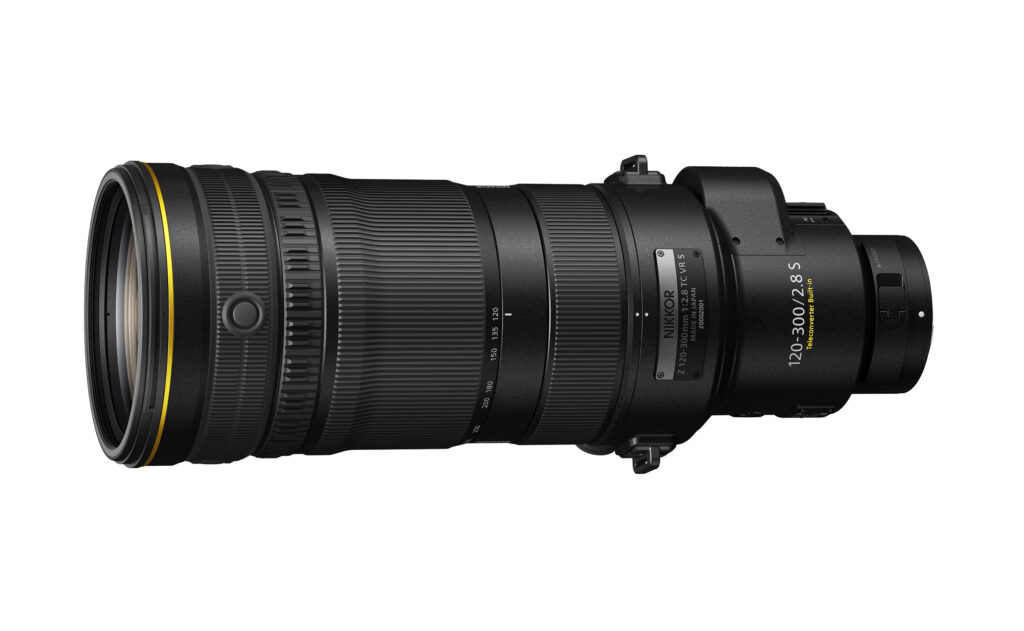
Nikon has introduced the NIKKOR Z 120–300mm f/2.8 TC VR S, a professional Z-mount zoom built for sports, wildlife and other assignments where the subject distance changes quickly. Its headline feature is a built-in 1.4x teleconverter: move a lever and the lens changes from a 120–300mm f/2.8 zoom to a 168–420mm f/4 zoom without removing it from the camera.
The flexibility comes at a serious price. Nikon’s suggested U.S. retail price is $13,999.95, with availability expected in mid-November 2026. At roughly six pounds, this is also specialist equipment rather than a walk-around telephoto. The payoff is a range that could replace several large lenses during a fast-moving event.
What Nikon announced
Nikon announced the lens on October 29, 2026. It is an S-Line, full-frame Z-mount lens with internal zoom and internal focusing, so its 353.5 mm length does not change while zooming or focusing. Nikon says it is the first announced interchangeable zoom to combine a constant f/2.8 maximum aperture with a built-in 1.4x teleconverter, based on the company’s own research as of the announcement date.
That “world’s first” wording deserves the qualification Nikon supplies. It is a manufacturer claim about announced interchangeable zoom lenses, not an independent industry certification. The practical feature is unambiguous, however: photographers can switch between the native 120–300mm range and a longer 168–420mm range without attaching an external converter.
The teleconverter is the main practical advantage
A built-in converter matters most when there is no safe time to change equipment. At a football match, tennis court or track event, action can move from close to distant in seconds. An external teleconverter requires taking the lens off the camera, exposing the mount and sensor area, and handling another accessory. Nikon’s internal mechanism avoids that interruption.
The 1.4x conversion multiplies both ends of the zoom range: 120mm becomes 168mm and 300mm becomes 420mm. It also costs one stop of light, so the maximum aperture changes from f/2.8 to f/4. That is normal for a 1.4x converter. Buyers should not interpret “constant f/2.8” as applying when the converter is engaged.
Why a constant f/2.8 aperture still matters
Without the converter, f/2.8 is available across the entire 120–300mm range. That can help keep shutter speeds high in indoor arenas, under stadium lights or during evening events, while also creating a shallow depth of field that separates a subject from a busy background.
Compared with a variable-aperture zoom, the camera does not have to reduce the aperture as the photographer zooms toward 300mm. That consistency simplifies exposure and can be especially useful when shooting a burst during a rapidly changing play. Still, the lens does not create light: high shutter speeds in dim venues may still require high ISO settings, depending on the camera and the scene.
Autofocus and stabilization are manufacturer claims
Nikon uses its Silky Swift VCM autofocus drive, also called SSVCM. The company says the system provides fast, accurate and smooth focus tracking for moving athletes. Until independent production-lens testing is available, that should be treated as Nikon’s performance claim rather than a measured result.
The company also claims up to 6.5 stops of vibration reduction when the lens is paired with a camera that supports Synchro VR. Nikon’s published figure is based on the CIPA 2024 standard, measured at the telephoto end on a Nikon Z6III, in Normal mode, with the built-in teleconverter disabled. Stabilization can reduce camera shake, but it cannot freeze a player or animal that is moving quickly; action photographers will still need an appropriate shutter speed.
Optical construction and coatings
The optical design contains 30 elements in 24 groups, including the eight elements in five groups used by the built-in converter. Nikon lists ED, Super ED, fluorite, aspherical and SR elements. The front element has a fluorine coating, while Meso Amorphous Coat and ARNEO Coat are intended to reduce reflections, ghosting and flare.
Nikon says image quality remains strong across the frame and compares the rendering with a prime lens. That is an ambitious claim for a zoom spanning 120mm to 300mm before conversion, and 168mm to 420mm after conversion. Real-world comparisons will need to examine sharpness, contrast, autofocus consistency, flare and bokeh at multiple focal lengths rather than relying on a single specification.
Size, weight and handling
The lens measures approximately 128 mm in maximum diameter and 353.5 mm long. Weight is about 2,735 g, or 6 lb 0.5 oz. Nikon notes that this is around 515 g lighter than its older F-mount AF-S 120–300mm f/2.8E FL ED SR VR, but six pounds is still substantial before adding a camera body, monopod, spare batteries and other field gear.
The fixed-length internal zoom helps balance because the front does not extend as the focal length changes. The supplied tripod collar has an integrated foot designed for Arca-Swiss screw-type clamps. Nikon specifically warns against lever-type clamps because they may not secure the lens firmly. That detail is easy to miss and worth checking before a buyer puts nearly $14,000 of glass on an existing support system.
There is a 112 mm front filter thread, plus support for a 46 mm rear slip-in filter holder. The supplied accessories include front and rear caps, the HB-120 hood, an LN-4 strap and a CL-L3 lens case. Nikon describes the magnesium-alloy barrel as dust- and drip-resistant, while also noting that resistance is not guaranteed in every situation.
Minimum focus and close-range limits
Minimum focus distance varies with zoom position. Nikon specifies 0.98 m at 120mm, increasing to 2 m at 300mm. Engaging the converter changes the effective focal length but not the minimum focus distance. Maximum reproduction reaches 0.18x without the converter and 0.25x with it, so this is not a macro lens, though it can produce useful tight details of larger subjects.
The nine-blade rounded diaphragm closes to f/22 normally and f/32 with the converter engaged. Diffraction will soften fine detail at the smallest apertures on high-resolution cameras, so those settings are more about gaining depth of field than maximizing pixel-level sharpness.
Price, release timing and compatibility
Nikon says the lens will reach the United States in mid-November 2026 at a suggested retail price of $13,999.95. Retail prices and delivery dates can change, and Nikon’s own release notes that dealers set the final price.
This is a Nikon Z-mount lens for full-frame/FX mirrorless cameras. It is not an F-mount DSLR lens. It can also be used on DX-format Z cameras, where the narrower field of view adds another crop factor, but the physical size, price and intended professional role do not change.
For context within Nikon’s broader mirrorless line, GNW recently covered the more approachable Nikon Z5IIC full-frame camera. The 120–300mm is aimed at a very different customer: an agency, working professional or specialist who can justify its cost through assignments.
Who should consider it—and who should not
The strongest case is for a professional who regularly moves between medium and long telephoto framing and cannot pause to swap lenses or converters. A single 120–300mm body position can cover portraits of athletes, tighter action and distant plays, while the converter extends reach to 420mm. That can reduce the number of bodies and primes needed at the edge of a field.
There are tradeoffs. A 400mm or 600mm prime may offer more reach or a different balance, while slower zooms are lighter and dramatically cheaper. Some photographers will get better value from two bodies with separate lenses. Others may prefer an external teleconverter that can be removed completely. The Nikon’s appeal is integration and speed, not affordability.
Buyers should also budget for support. A sturdy monopod or tripod head, compatible screw-type Arca-Swiss clamp, appropriate transport case and insurance can all matter with equipment at this price. Renting before buying may be the most sensible way to judge handling and focal-length coverage on a real assignment.
The bottom line
The NIKKOR Z 120–300mm f/2.8 TC VR S is a highly specialized solution to a genuine professional problem. It combines a useful sports range, constant f/2.8 aperture and instant 420mm option in one fixed-length body. Nikon’s autofocus, stabilization and prime-like image-quality claims still need independent testing, and the six-pound weight is not trivial. But for photographers whose income depends on capturing unpredictable action, the integrated converter may be more important than the almost $14,000 price.