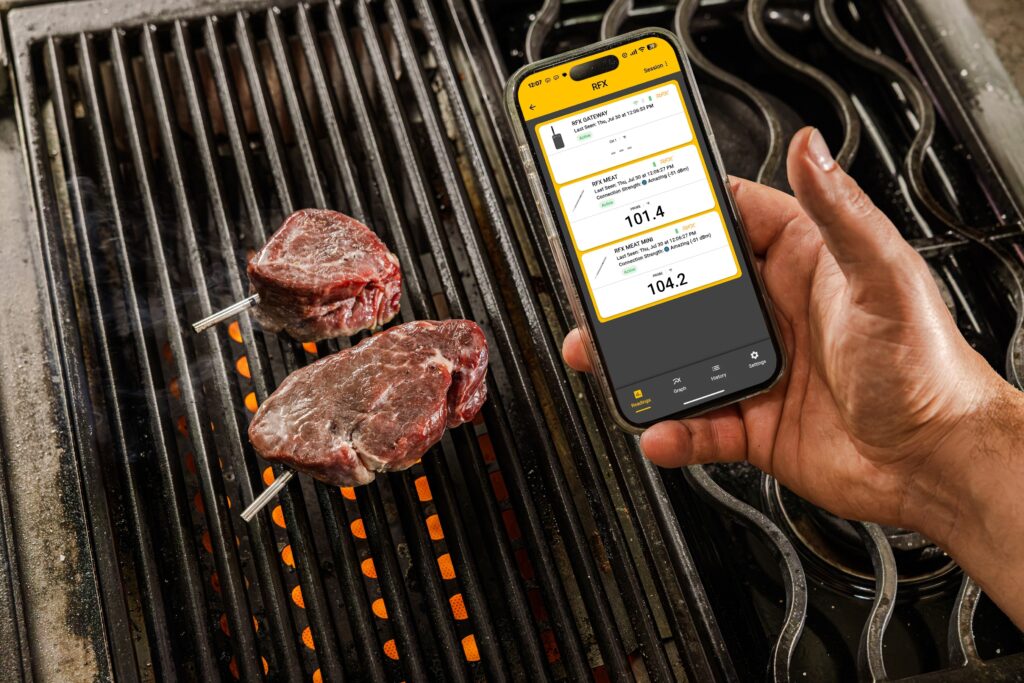
Wireless cooking probes are convenient until the probe itself is too long for the food. ThermoWorks is addressing that problem with the RFX Meat Mini, a shorter version of its cable-free RFX thermometer designed for chicken breasts, pork chops, filets, burgers, fish and other smaller portions.
The new probe launched on October 29, 2026, with a list price of $99. It is available now from ThermoWorks. The important catch is that this is not a complete system by itself: the Mini requires an RFX Gateway to pass its temperature readings to the ThermoWorks app. That makes it a straightforward add-on for existing RFX owners, but a more expensive purchase for someone starting from scratch.
What ThermoWorks changed
The RFX Meat Mini is 4.0 inches long, compared with 4.7 inches for the standard RFX Meat. Its minimum insertion depth drops from 3.15 inches to 2.36 inches, while the maximum insertion line is 2.6 inches. Those measurements matter because the probe’s sensors need to remain fully inside the food. A shorter required depth makes the Mini practical for cuts that could not safely accommodate the original probe.
ThermoWorks has not reduced the number of internal sensors. Four temperature sensors run along the probe, and the system reports the lowest reading so the cook can follow the coldest part of the food. An advanced view in the app can display all four readings. This does not eliminate the need to insert the probe correctly, but it gives the system more chances to detect the thermal center than a single-sensor design.
The exposed section is rated for cooking environments up to 1,000 degrees Fahrenheit. ThermoWorks also gives the Mini an IP69K water-resistance rating, and the company says it is dishwasher safe. Those are manufacturer specifications, not the result of our own testing.
Range is still the main RFX advantage
Instead of relying on a direct Bluetooth link between the probe and phone, RFX uses a sub-GHz radio connection at 433MHz between the probe and Gateway. ThermoWorks claims up to 1,500 feet of line-of-sight range and up to 560 feet through walls. Thick grill lids, smokers and household walls can weaken any wireless signal, so real-world range will depend on placement and construction.
The Gateway then sends readings over Wi-Fi to the ThermoWorks app, allowing remote monitoring beyond normal Bluetooth distance. When Wi-Fi is unavailable, the Gateway can connect to a phone over Bluetooth. One Gateway can support more than 50 probes, according to ThermoWorks, which is more capacity than most homes will ever need but may be useful for commercial kitchens or large events.
This arrangement is also the product’s biggest limitation. The Mini does not replace the Gateway, and buyers should not mistake the $99 probe price for the total price of a first RFX setup. ThermoWorks sells Starter Kits that include a Gateway and full-size probes, while its online kit builder lets shoppers add a Mini. The company was offering a 20 percent bundle discount at launch, but promotional pricing can change and should be checked before ordering.
Battery life is shorter, but still generous
The smaller body brings one clear compromise. ThermoWorks rates the RFX Meat Mini for up to 48 hours on a full charge, while the larger RFX Meat is rated for more than 65 hours. A 10-minute quick charge is said to provide up to 38 hours for the Mini, and a full charge takes about 20 minutes.
The included charging block uses one AAA battery. ThermoWorks says that battery can provide more than 175 full charges. Keeping the probe docked between cooks should make the lower runtime largely irrelevant for ordinary grilling, roasting and overnight smoking. Commercial users running back-to-back cooks are more likely to notice the difference.
Who the Mini is for
Existing RFX owners are the clearest audience. The same Gateway and app can handle the Mini alongside full-size RFX Meat probes, so a cook could monitor a brisket with the longer model and smaller portions with Minis at the same time. The shorter insertion requirement should also make the system easier to use with delicate fish, tofu or cheese, although each food still needs enough thickness to cover the marked insertion line.
New buyers face a more complicated decision. The RFX system offers long range, multiple sensors and a high heat rating, but its Gateway adds cost and another device that needs power and a suitable location. A simple instant-read thermometer is cheaper and may be enough for quick stovetop or grill checks. A leave-in wireless probe is most useful when someone wants continuous temperature alerts while stepping away from the oven, grill or smoker.
It is also worth remembering that a connected probe does not make cooking automatic. Safe target temperatures vary by food, preparation and local guidance, and carryover heat can continue raising the temperature after food leaves the heat source. The app can alert the user, but it cannot correct poor placement or account for every food-safety variable.
How it compares with the full-size RFX Meat
The Mini is not a replacement for the original. Both cost $99 at list price and share the same four-sensor design, Gateway connection, app and 1,000-degree external heat rating. The full-size probe is better suited to roasts, pork shoulders, whole birds and other thick cuts because it offers longer battery life and a deeper sensor section. The Mini trades some endurance for a shape that fits everyday portions.
That makes the choice mostly about food size rather than features. Households that cook both large and small cuts may reasonably want one of each. Buyers focused on chops, filets, chicken pieces and fish should find the Mini more versatile, while dedicated low-and-slow barbecue cooks may prefer the original probe’s extra runtime.
What to check before buying
- Gateway ownership: The RFX Meat Mini requires an RFX Gateway; the probe alone is not a complete connected system.
- Food thickness: The probe must be inserted beyond the 2.36-inch minimum line.
- Live pricing: The list price is $99, but bundles and seasonal discounts can change.
- Network setup: Wi-Fi is needed for anywhere monitoring, while nearby phone access can use Bluetooth through the Gateway.
- Use case: An instant-read thermometer may be a better value for short, hands-on cooks.
The launch fits a broader move toward specialized connected sensors in the kitchen and home. Like recent smart-home devices such as the Amazon Echo Time, the RFX Meat Mini is most compelling when its sensor and alerts solve a specific problem rather than simply adding an app.
Bottom line
The ThermoWorks RFX Meat Mini closes a real gap in the company’s wireless lineup. It brings the RFX system’s four sensors, long-range radio link and high-heat design to cuts that are too small for the original probe. For existing RFX users, it is an easy expansion. For newcomers, the $99 price needs to be considered alongside the required Gateway and the total cost of a starter setup.
Sources
Featured image credit: ThermoWorks.