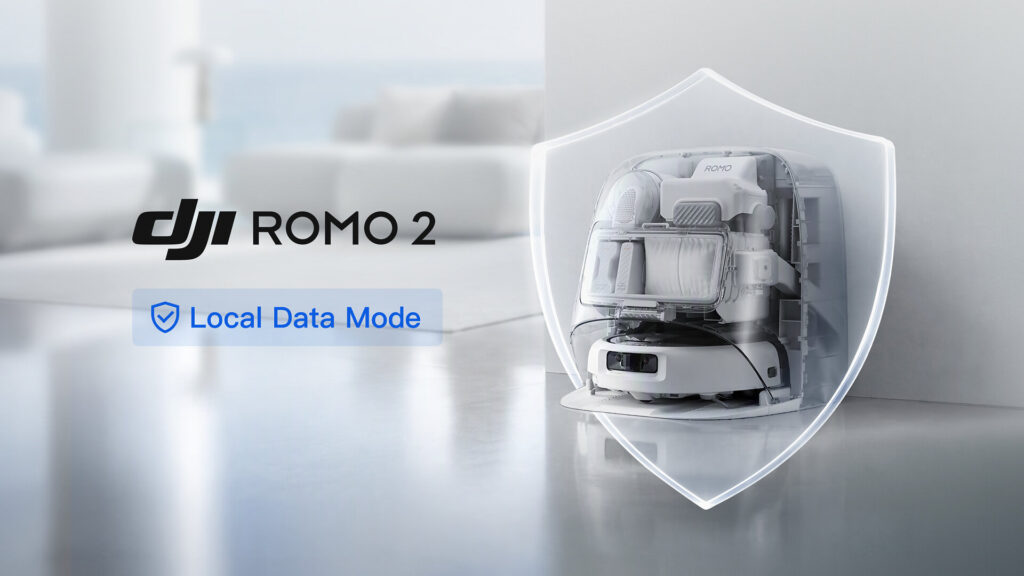
DJI has added a Local Data Mode to its ROMO 2 robot vacuums, giving owners a way to keep maps, navigation images and other cleaning data on the device instead of sending it to the cloud. The feature became available through a firmware update on October 29, and DJI says the vacuum can continue navigating, avoiding obstacles, starting customized cleaning cycles and returning to its dock while the mode is active.
That is a meaningful change for a category of gadget that moves through private rooms while using cameras, LiDAR and other sensors. It is not a completely internet-free experience, however. A ROMO 2 must connect online during initial setup to create its first map, and some connected conveniences may no longer work as expected once the app is disconnected from the internet.
What DJI’s Local Data Mode actually changes
Local Data Mode disconnects the DJI Home app from the internet after setup. According to DJI’s October 29 announcement, maps, images and other information used for navigation and obstacle avoidance are then stored and processed locally on the ROMO 2.
The practical benefit is that the vacuum’s basic intelligence does not depend on an active cloud connection. If the home internet goes down, the robot should still be able to recognize obstacles, follow its map and clean. Owners can also start or customize a cleaning job and send the robot back to its base station while remaining offline.
DJI calls this an industry first for smart-home products. That broad claim is difficult to verify across every connected appliance, so it is best read as the company’s description of the feature rather than an independently established record. What is clear is that a prominent robot-vacuum maker is making a local-only operating mode a headline feature rather than hiding privacy controls deep in a policy page.
The important catch: first setup still needs the internet
ROMO 2 does not arrive in a permanently offline state. DJI says the robot connects to the internet the first time it is powered on so it can create a map of the home. Local Data Mode can be enabled only after the vacuum is updated to firmware that supports it.
Owners activate the setting in the DJI Home app by opening Device Settings, choosing Security Settings and switching on Local Data Mode. That sequence means buyers still need an internet connection, a compatible phone and a DJI account or app setup before they can take the robot offline.
The announcement does not fully explain how future firmware updates will work in Local Data Mode, whether the device must be taken temporarily online to receive them, or which remote notifications disappear when the app cannot reach the vacuum through the cloud. Those details matter because security patches are especially important for a device with cameras and sensors inside the home.
What data stays on the robot
DJI specifically names maps, images and the data used for navigation and obstacle avoidance. The company says none of that information is uploaded to the cloud while ROMO 2 is offline. Users can also turn off the On-Site Photo feature, which controls whether pictures of detected obstacles appear in the app; DJI says disabling those photos does not stop obstacle detection or avoidance.
For owners who keep the robot online, DJI says data in transit is protected with end-to-end encryption. An optional auto-delete setting removes photos older than 14 days, while a factory reset is supposed to erase all stored information from the device.
Those controls address several common privacy concerns, but they do not make the robot invisible to every network in the home. Shoppers should distinguish between local processing, app connectivity, Matter integration and any router-level traffic. DJI has not published a detailed consumer-facing list of every packet or feature disabled by Local Data Mode.
Core cleaning is designed to keep working
The ROMO 2 range includes the transparent ROMO P2 and the more conventional-looking ROMO A2. Both use high-precision LiDAR and vision sensors to map rooms and spot obstacles. DJI claims the system can sense objects at millimeter scale, while a 123-degree swing arm reaches farther along walls and under floating furniture.
On carpets, the vacuum is rated for up to 36,000 Pa of suction. Retractable “robotic legs” are designed to cross a single threshold up to 4 cm high or a two-step obstacle up to 8.5 cm. The base station washes the mop with 80°C water, and DJI claims its design can provide up to 365 days of maintenance-free operation. Those are manufacturer specifications, not Gadget N Widget test results.
The new privacy mode is notable because DJI says those sensor-heavy functions still work locally. A less capable offline fallback would be much less useful: a robot that can only drive randomly or loses obstacle avoidance when disconnected would force buyers to choose between privacy and performance.
Pricing and availability remain region-dependent
DJI launched the ROMO 2 family globally in September. The official European launch prices were €1,199 for the ROMO A2 water-tank version and €1,299 for the transparent ROMO P2. A ROMO Clean More Combo started at €1,349. Store pricing and stock can vary by country, and current promotions may be lower than those recommended launch prices.
DJI has not announced a normal U.S. retail launch for the ROMO 2. That makes the privacy update immediately relevant mainly to buyers in markets where the vacuum is officially sold. Importing one can create warranty, app-region and replacement-part complications, so U.S. shoppers should not treat European availability as equivalent to domestic support.
Matter support adds convenience—and questions
Alongside Local Data Mode, DJI says all ROMO models now support Matter. That can let the vacuum appear in compatible Apple Home, Google Home, Amazon Alexa, SmartThings and Home Assistant setups, although available controls depend on the platform and controller.
Matter is useful for routines such as starting a cleaning job when everyone leaves home, but it introduces another layer to the privacy picture. A locally controlled Matter setup is not the same as using a cloud-dependent voice assistant. Owners who want the most private configuration will need to check how their chosen controller processes commands and whether the desired automation still works when external internet access is blocked.
This is the same tradeoff seen across modern smart-home gear: convenience grows as devices share more context, while privacy becomes harder to evaluate. GNW’s recent look at Amazon’s Alexa Photo Frame raised a related issue—software and account requirements can matter as much as the hardware price.
Certifications help, but they are not a guarantee
DJI says ROMO and the DJI Home app have been certified against the ETSI EN 303 645 consumer-IoT security standard, comply with EU RED EN 18031 requirements and earned UL Solutions’ Diamond IoT Security certification. The company also says a 2026 TÜV SÜD penetration test of the ROMO P2 and DJI Home app found no critical, high or medium-risk issues.
Those are useful signals because they involve defined standards and outside testing. They do not prove that a device can never be compromised, and certifications can become outdated as software changes. Local Data Mode is valuable precisely because reducing the amount of data leaving the home can limit exposure even when no connected product is perfectly secure.
Who should use Local Data Mode?
The strongest candidates are people uncomfortable with a mobile camera and mapping system sending information beyond their home, as well as users who live with unreliable internet. The mode also makes sense for households that do not need remote access and are willing to manage updates deliberately.
People who frequently start cleaning while away, rely on cloud notifications or use voice-assistant routines should first confirm which features remain available. It may be possible to create a balanced setup using local Matter controls, but the exact result depends on the home platform.
The practical significance
DJI is not making the ROMO 2 cheap, and Local Data Mode does not erase the need for an online first-run process. Still, the update moves a premium robot vacuum in a consumer-friendly direction. Buyers should be able to use core cleaning, navigation and obstacle avoidance without continuously uploading a map of their home.
The bigger question is whether competitors follow. Robot vacuums increasingly use cameras, microphones, AI recognition and detailed spatial maps. If local processing becomes a visible buying criterion rather than a niche request, companies will have more reason to design offline operation from the start.