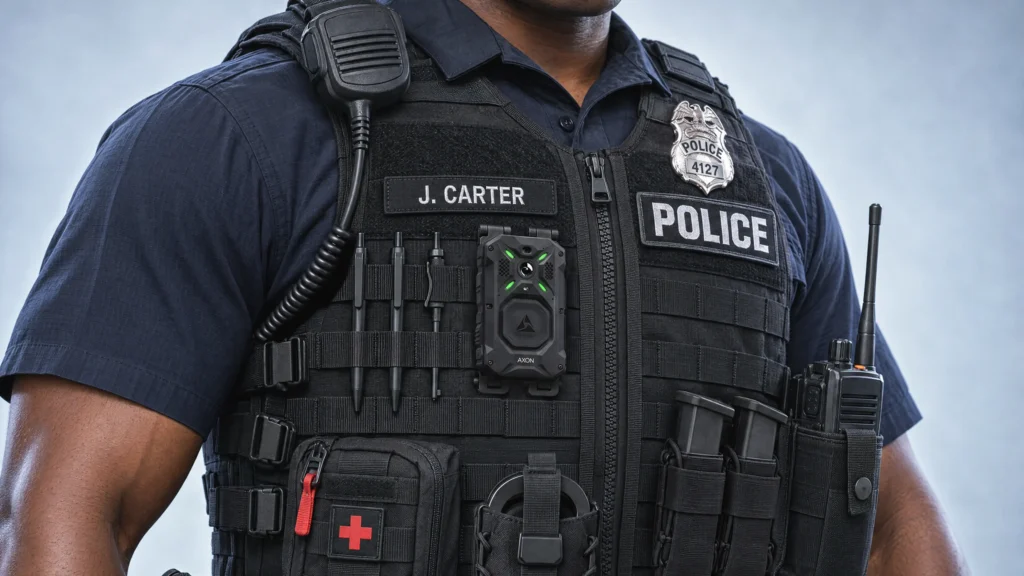
Axon has introduced its next generation of body-worn cameras, and the biggest change is not simply a sharper sensor. The new Axon Body 5 and Axon Body 5 Pro are designed to run more artificial-intelligence features at the scene, while improving video, connectivity, positioning and battery life.
The company announced the cameras on October 24, 2026. Both models can record at up to 4K, connect over 5G and Wi-Fi 7, and work with existing Axon Body 4 docks, mounts, cables and accessories. The Pro adds a second, close-focus camera for scanning driver’s licenses, extra memory and a six-speaker audio system intended to make translations and spoken answers easier to hear.
There are two important caveats: Axon has not announced pricing, and it says general-availability dates will be disclosed later. The product is aimed primarily at police departments and other organizations buying into Axon’s wider evidence, communications and AI ecosystem, rather than ordinary consumers.
What changed from Axon Body 4
According to Axon’s launch announcement, the Body 5 family has 25 times the AI processing capability of earlier Axon body cameras. That is a manufacturer comparison, and Axon has not published the processor model, benchmark method, memory capacity or power figures needed to evaluate it independently.
The more concrete upgrades are easier to understand. Axon says both cameras offer 20% longer battery life than Body 4, improved low-light video and more precise location reporting. The cameras can record at up to 4K when agencies need additional detail. Fast charging is said to restore 20% of the battery in 15 minutes, while an optional Battery Backpack can extend runtime for long shifts.
Axon is also preserving compatibility with Body 4 hardware. Existing docks, mounts, cables and the optional point-of-view camera module are supported, and the button layout remains familiar. That could reduce replacement costs and training time for departments already using the previous generation.
Body 5 Pro can scan a driver’s license
The standard Body 5 receives the core imaging, battery, location and connectivity upgrades. Body 5 Pro adds hardware intended for AI-assisted tasks in the field.
Its dedicated near-focus camera can capture a physical driver’s license and check its status along with active wants or warrants. Axon says the result can appear on the camera, allowing an officer to complete a routine check without returning to a patrol vehicle. Relevant information can also be sent into Axon Fusus, the company’s real-time operations platform.
The Pro model also has additional memory for running several AI tools at once. Six speakers—four more than the standard arrangement described in the launch materials—project audio toward the person in front of the camera. Axon positions that system as useful for real-time translation and spoken answers from Axon Assistant in traffic or crowd noise.
Those functions depend on the surrounding software, agency configuration and access to official databases. They should not be read as guarantees that every department or every deployment will receive the same capabilities.
5G and Wi-Fi 7 support live operations
Body 5 is designed as a connected computer as much as a recorder. Axon’s product page says both models support 5G and Wi-Fi 7 and can move to a better available Wi-Fi connection without interrupting an active livestream. If network coverage weakens, the system can lower video quality to preserve audio.
On supported 5G networks, network slicing can prioritize critical traffic when a cellular network is congested. Actual performance will vary with the carrier, coverage, agency network and service plan. Axon has not published a complete list of supported bands or regional certifications.
Location reporting also uses dual-band positioning for improved accuracy around tall buildings. The camera can increase its update frequency when it detects that an officer has started running or driving. As with other connected safety devices, better location data can help a response team, but it also makes data-retention rules and access controls especially important.
Axon Guardian brings live AI alerts
The new cameras support Axon Guardian, a group of AI features included in the company’s AI Era plan. One planned function, Escalation Detection, listens for signs that a recorded conversation may be becoming more confrontational. It can create an alert in Axon Fusus, where a person reviews the livestream and decides whether any response is appropriate.
A second function, Approach Alert, works with Axon Fleet 3 vehicle cameras. It can detect a door opening on a stopped vehicle and warn the officer through the patrol-car display and body camera.
Axon says Guardian keeps a human in the decision loop and leaves agencies in control of their data. Those safeguards matter, but the announcement does not provide accuracy rates, false-alert rates, supported languages, independent test results or detailed retention policies. Agencies evaluating the system will need those answers before treating the alerts as dependable operational signals.
This move is part of a wider shift toward processing AI close to where data is captured. GNW recently examined a similar trend in vehicles, where GM’s new central computer is intended to handle connected AI and future driver-assistance workloads. In both cases, more local computing can shorten response times, but the practical value depends on software quality, network reliability and clearly defined human oversight.
What departments and the public should ask
For agencies, backward-compatible accessories and better battery life may be the most immediately useful changes. Higher-resolution video can help document details, and more resilient streaming can make remote assistance more reliable. The Pro model’s license scanner could also reduce time spent moving between a person and a patrol car.
For the public, the central questions go beyond image quality. Body cameras create records of people who may never be charged with a crime, and live AI adds another layer of interpretation during an encounter. Departments should publish policies covering when AI features are active, who sees alerts, how errors are reviewed, how long data is kept and whether footage or derived information is used for purposes beyond the original incident.
Procurement officials should also separate included hardware features from subscription-dependent services. Guardian is tied to Axon’s AI Era plan, and features vary by configuration. Without public prices, it is not yet possible to compare the full ownership cost of Body 5, Body 5 Pro, cloud storage, connectivity, AI services and accessory replacement.
Price and availability are still unknown
Axon has not given a list price for either camera. That is not unusual for enterprise and public-sector equipment sold through contracts, but it prevents a direct value comparison with Body 4 today. General availability for Body 5 and Axon Guardian will be announced later, and the company warns that features and capabilities differ by configuration.
That makes the launch a technology preview as much as a ready-to-order product announcement. The confirmed hardware direction is clear: up to 4K recording, 20% better battery life, 5G, Wi-Fi 7, more precise positioning and reuse of Body 4 accessories. The more consequential claims—real-time escalation alerts, license scanning and AI assistance in the field—will need transparent testing and carefully written policies.
The practical takeaway
Axon Body 5 is a meaningful upgrade because it turns the body camera into a more capable edge-computing device without discarding the previous generation’s accessory ecosystem. The Pro model goes further by adding specialized hardware for close-up document capture and clearer two-way audio.
Still, the most important details are not settled. Buyers do not yet know the price or shipping date, and Axon has not released independent performance data for Guardian’s live alerts. Until those arrive, agencies should view the 25-times-AI figure as capacity for future software—not proof that every AI feature will be accurate, appropriate or worth enabling.
Featured image: Axon official product launch image.