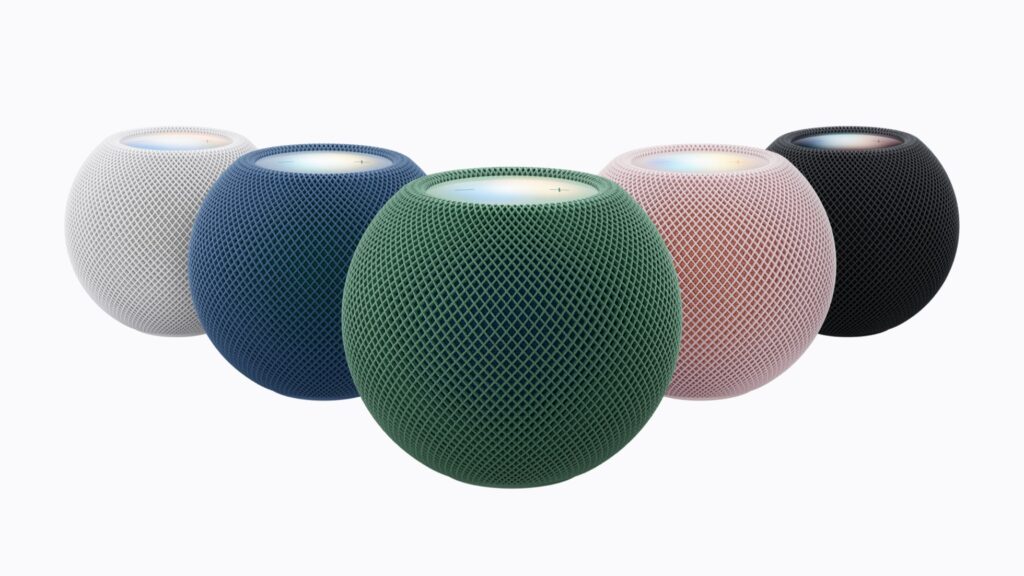
Apple’s second-generation HomePod mini will reach stores on October 30, six years after the original compact speaker arrived. The new model costs $149 in the U.S.—$50 more than its predecessor’s launch price—and adds an S10 chip, new audio features, a redesigned light surface, and a much deeper role in Apple’s smart-home plans.
The headline feature is Siri AI, but buyers should note the timing: Apple says the upgraded assistant will arrive through a future software update rather than being available on day one. That makes the HomePod mini 2 an unusual launch. The hardware is shipping now, while one of its biggest software reasons to upgrade is still coming later.
What changes with HomePod mini 2
The compact spherical design remains familiar, but Apple now offers five colors: white, blue, green, pink, and midnight. Inside, the new Apple S10 chip powers computational audio that analyzes music in real time to tune loudness, dynamic range, and acoustic performance. Apple describes the output as room-filling 360-degree sound, although that is a manufacturer claim and independent listening tests will be needed to judge how large the improvement is over the first generation.
A new feature called Sound Glow turns the top surface into a color-matched light display. It can pulse in time with music, borrow colors from album artwork, or play animations tied to ambient soundscapes such as rain. It is a visual flourish rather than a reason to replace a working speaker, but it makes the new model easier to distinguish from the original.
HomePod mini 2 can also serve as a Mac speaker over Wi-Fi. Apple says the feature works with a single speaker or a stereo pair, but it requires a Mac with Wi-Fi 6E or newer.
Siri AI is important—and delayed
Apple says Siri AI will support more natural back-and-forth conversations, current web knowledge, improved music discovery, and personal-context requests. With a compatible Apple Intelligence-enabled iPhone or iPad, the speaker will be able to act on information in apps—for example, finding a song mentioned in Messages, locating a recipe from an email, or creating a reminder connected to a calendar event.
The speaker can recognize up to six household members by voice. Apple says requests may be processed on the device or with its Private Cloud Compute system. Personal-context features require the home owner to have a compatible iPhone or iPad running current software with Siri AI enabled.
There are several practical limits. Siri AI is promised for a later free update, initially in English in the U.S., Australia, Canada, India, New Zealand, Singapore, South Africa, and the UK. Apple says it will not initially be available in the European Union. Some Apple Intelligence functions that use server-side models may also have daily limits, with expanded access planned as a paid option. Buyers should therefore treat Siri AI as a future capability, not a launch-day guarantee.
A bigger home-theater role
The new speaker can join Apple’s first four-speaker home-theater arrangement when used with the fourth-generation Apple TV 4K. Four compatible HomePod speakers must be set up in matching front and rear pairs. Apple says the system detects each speaker’s position and calibrates timing and volume for the room.
That flexibility comes at a cost. Four HomePod mini 2 units total $596 before adding the required Apple TV 4K. A report from Tom’s Guide also notes that the new speaker’s $149 price is $50 above the original model’s $99 launch price. Anyone interested mainly in stereo music or TV sound should compare the total with a conventional soundbar or a pair of powered speakers.
Smart-home features and safety caveats
HomePod mini 2 functions as a home hub for compatible accessories, allowing remote control and automations through Apple’s Home app. It can listen for smoke or carbon-monoxide alarms and send alerts to an iPhone, iPad, or Apple Watch. Apple explicitly warns that Sound Recognition should not be relied on in an emergency or other high-risk situation, so it is an extra notification layer rather than a replacement for certified alarms.
The speaker will also work with upcoming Apple Home Collection cameras and doorbells, including the ability to announce recognized visitors when HomeKit Secure Video and Face Recognition are enabled. Apple says the first Home Collection accessories will arrive in December, with more following in early 2027.
Price, release date, and who should consider it
HomePod mini 2 is available to preorder now for $149 and reaches stores on Friday, October 30, in the U.S. and more than 23 other countries and regions. It runs HomePod software 27.2.
The strongest case is for an Apple household that wants a compact speaker, a Home hub, and a path to a multi-speaker Apple TV setup. Existing HomePod mini owners have a harder decision. The new lighting, Mac-speaker support, and home-theater expansion are useful, but the most ambitious assistant upgrade will not be ready at launch.
Apple’s official announcement confirms the price, availability, compatibility rules, and Siri AI limitations. Until independent reviews compare sound quality and Apple supplies a firm Siri AI release date, the cautious approach is to buy for the features available on October 30—not for the ones still promised.