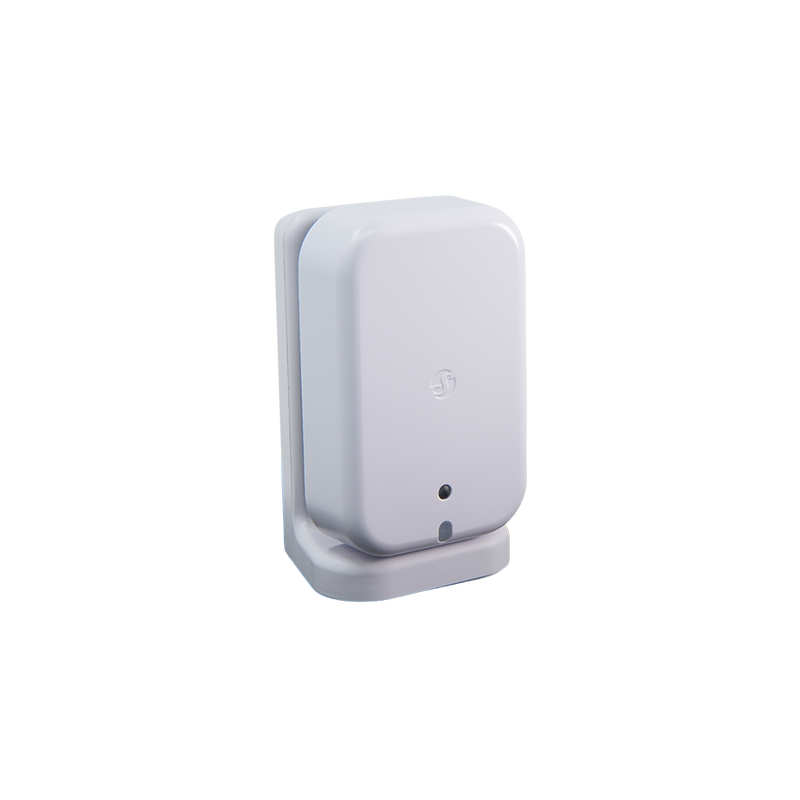
Shelly’s new Presence Gen4 is a $84.99 smart-home sensor designed to detect whether people are in a room without using a camera. Instead, it relies on 60GHz mmWave radar to recognize movement and continued presence, including someone sitting still at a desk or on a sofa.
The sensor is now listed as in stock through Shelly’s U.S. store. It can track up to 10 people at once, divide a room into as many as 10 detection zones and trigger automations for lighting, heating, cooling or other connected devices.
How it differs from a basic motion sensor
Conventional passive infrared motion sensors are good at noticing someone entering a room, but they can decide the room is empty when that person stops moving. Millimeter-wave radar can pick up much smaller motion, allowing the Presence Gen4 to maintain an occupied state while someone is reading, working or sleeping.
Shelly says the device can identify up to 10 separate people and display detected positions on a room map. Users can define zones, blind spots and room boundaries, then build different automations for each area. A light sensor reports three ambient conditions—dark, twilight and bright—so lighting rules can also respond to the room’s brightness.
Connectivity is unusually flexible
The Presence Gen4 supports Wi‑Fi 6, Bluetooth 5 LE, Zigbee 3.0 and Matter over Wi‑Fi. That gives buyers several ways to integrate it with a smart-home system instead of locking it to one hub or platform.
It can operate independently over Wi‑Fi through Shelly Smart Control or its local web interface. Shelly also lists integrations with platforms including Amazon Alexa, Google Home, Samsung SmartThings and Home Assistant. Advanced users can access MQTT, webhooks and scripting for local automations.
There is an important Matter detail: Shelly’s documentation says only one room zone appears by default in a Matter-compatible controller. Additional zones can be exposed as separate components, up to the 10-zone limit, but users may need extra configuration rather than seeing the full room map immediately after pairing.
Coverage, power and placement
Shelly rates the sensor for rooms up to roughly 8 by 8 meters, or 26 by 26 feet, when wall mounted. Its stated horizontal field of view is 140 degrees, while corner mounting reduces coverage to about 7 by 7 meters and 90 degrees.
The device can sit on a shelf or table, attach with adhesive tape or mount with screws. Shelly recommends installation at about 2 meters, or 6.5 feet, with a slight downward tilt. Walls and other solid obstacles block detection, and the sensor cannot see behind itself.
This is not a battery-powered sensor. It needs continuous 5V USB-C power and consumes a claimed 2.5 watts typically, with a 3.5-watt maximum. Shelly warns buyers to use a stable, dedicated power adapter rather than a multi-port fast charger whose voltage may fluctuate as other devices connect or disconnect.
Privacy advantages and limitations
Because the Presence Gen4 has no camera, it does not capture identifiable images of a room. That makes it a better fit for bedrooms, offices and other spaces where video monitoring would feel intrusive.
Camera-free does not mean data-free. The sensor still creates a live representation of occupancy and can store event history through connected software. Households should review cloud settings, account security and activity logs, particularly when using the device in sensitive spaces.
Radar also requires careful setup. Shelly provides options to adjust sensitivity, detection height and near-ground filtering so pets or robot vacuums do not trigger automations. Real-world reliability will depend on room layout, placement, reflections and those configuration choices. Shelly’s tracking claims are manufacturer specifications; we have not independently tested them.
Who should consider it?
The Presence Gen4 is most useful when a basic motion sensor turns lights off too quickly or cannot distinguish between different parts of a room. It could keep office lighting active while someone works quietly, control separate zones in an open-plan space or reduce heating and cooling in genuinely empty areas.
At $84.99, it costs more than many simple motion sensors. The value comes from multi-person tracking, zone-level automation and broad protocol support—not from basic entry detection. Buyers who only need a hallway light to turn on when someone walks past can spend less.