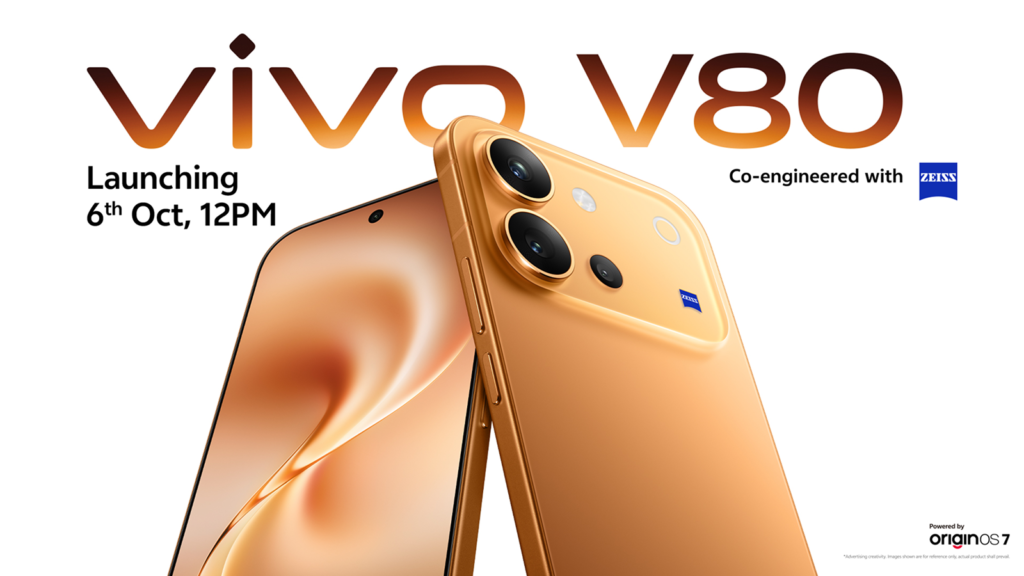
Vivo will formally launch the V80 in India at noon on October 6, bringing an unusually large 7,200mAh battery, a 144Hz OLED screen and a ZEISS-branded camera system to its midrange V series. The company has already published most of the hardware details, but it is holding back the price, sale date and full retail configuration list until the launch event.
That makes the V80 easier to evaluate than a typical pre-launch teaser. Its strengths are clear on paper, but so are several compromises—including USB 2.0 connectivity, no expandable storage and an 8-megapixel ultrawide camera.
Vivo V80 launch date and what remains unknown
Vivo India’s official announcement confirms an October 6 launch. The company’s promotional image specifies 12 p.m. India time.
Vivo has not yet announced the phone’s Indian price, the first sale date, bank offers or whether every color and storage option will be available on day one. Those details should arrive during the event. Any price circulating before then should be treated as an estimate rather than a confirmed figure.
The phone will be offered in Sunrise Anthem, Horizon Blue and Stellar Black. Vivo’s published specifications currently identify an 8GB RAM and 128GB storage version, but the company may announce additional configurations at launch.
A 7,200mAh battery is the headline feature
The V80 uses a 7,200mAh BlueVolt battery, which Vivo describes as the largest battery yet in a V-series phone sold in India. It supports 90W FlashCharge, and Vivo claims the phone can reach 50 percent in 30 minutes under its laboratory conditions and fast-charging mode.
Those are manufacturer claims, not independent test results. Charging speed varies with temperature, battery condition and whether the device is being used while charging. Vivo says the battery is rated at 7,015mAh even though its typical capacity is marketed as 7,200mAh, a normal distinction in phone specifications.
The large battery is especially notable because the phone is 7.69mm thick and weighs 203 grams. It is not unusually light, but it avoids the bulk expected from many battery-focused models.
The display targets smooth scrolling and outdoor use
On the front is a 6.59-inch AMOLED panel with a 2750 × 1260 resolution, up to a 144Hz refresh rate and a claimed 5,000-nit local peak brightness. The high refresh rate is supported only in selected apps, so users should not assume every game or interface will run at 144Hz.
Vivo also advertises an 1,800-nit high-brightness mode and the ability to dim to 1 nit for nighttime reading. The screen supports the P3 color gamut and uses an ultrasonic in-display fingerprint sensor.
The 5,000-nit figure describes a limited local peak rather than sustained full-screen brightness. Real-world visibility will depend on the content, automatic brightness behavior and heat conditions.
The camera system focuses on portraits and video
The rear camera array combines three lenses:
- a 50-megapixel main camera using Sony’s LYT-700V sensor with optical image stabilization;
- a 50-megapixel telephoto camera using Sony’s IMX882 sensor, 3x optical zoom and optical stabilization; and
- an 8-megapixel fixed-focus ultrawide camera with a 115-degree field of view.
The front camera is a 50-megapixel autofocus unit with a 92-degree field of view. Vivo says the rear system records 4K video at 60 frames per second and provides three cinematic color styles: Modern Movie, Vibrant and Pastel.
The telephoto camera is the more interesting part of the package. A stabilized 3x optical lens can be more useful for portraits, concerts and travel photography than the low-resolution auxiliary cameras commonly fitted to midrange phones. Vivo also promotes 10x portrait framing and up to 100x digital zoom, but image quality will inevitably fall as digital magnification increases.
The 8-megapixel ultrawide is the obvious weak link. It may be adequate for daylight group shots and landscapes, but its resolution and fixed focus suggest it will not match the two 50-megapixel cameras for detail or low-light performance.
Snapdragon 7 Gen 4 and OriginOS 7
Vivo’s official specification page lists Qualcomm’s Snapdragon 7 Gen 4 processor, built on a 4nm process, with LPDDR4X memory and UFS 3.1 storage. This is a midrange platform rather than a flagship Snapdragon chip, so buyers should wait for independent performance and thermal testing before judging sustained gaming capability.
The phone ships with OriginOS 7 based on Android 17. Vivo promises up to six years of extended security updates, counted from the product’s initial global launch. The wording is important: security support is not necessarily the same as six major Android-version upgrades, and availability can vary by market.
AI tools include Snap Note, which can turn a photo of a whiteboard or handwritten notes into an editable document, and an AI Creative Camera that adds lighting or stylized effects. Vivo warns that AI results can vary and that some functions depend on region, language and device settings.
Durability and connectivity details
The V80 carries IP68 and IP69 ratings under controlled laboratory testing. That covers dust resistance, immersion and high-pressure water jets, although Vivo says water resistance can decline over time and liquid damage is not covered by warranty.
Connectivity includes 5G, Wi-Fi on the 2.4GHz and 5GHz bands, Bluetooth 5.4, NFC, GPS, an infrared blaster and dual nano-SIM support. There is no microSD expansion, no 3.5mm headphone jack and no analog audio through a simple passive USB-C adapter. Owners need digital USB-C earphones or an adapter with its own DAC.
The USB-C port is limited to USB 2.0 speeds. That matters for creators moving large 4K video files to a computer, where wireless transfer or slower wired copies may become a bottleneck.
Who should consider the Vivo V80?
The V80 is aimed at buyers who prioritize battery endurance, portrait photography and a bright, fast display. Its 3x stabilized telephoto camera, 90W charging and IP68/IP69 rating make the specification sheet more balanced than many battery-first phones.
However, price will decide whether it is competitive. Buyers should also consider the modest ultrawide camera, USB 2.0 transfer speed, non-expandable storage and the difference between security updates and full operating-system upgrades.
The October 6 event should supply the missing price, sale date, storage variants and launch offers. Until those details are official—and independent reviews test the battery, cameras and thermal performance—the V80 looks promising, but not yet like an automatic recommendation.
Featured image: official Vivo India promotional artwork. Product appearance and launch information are supplied by the manufacturer.