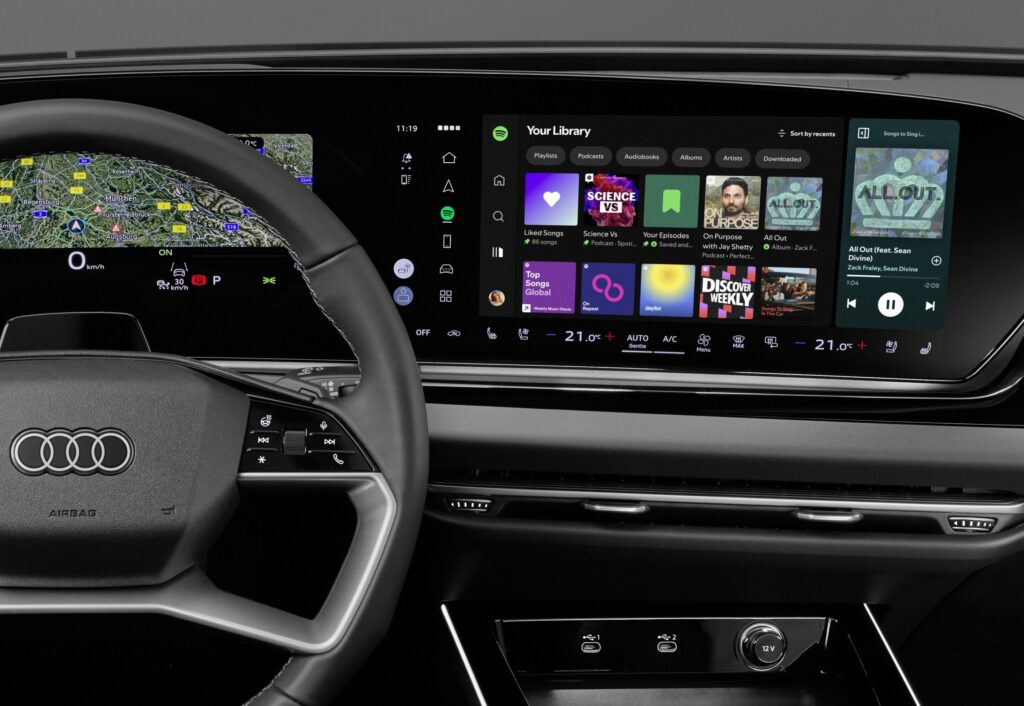
Spotify has launched a redesigned in-car app that runs directly on the infotainment system in selected Audi vehicles. Once it is installed and signed in, playback no longer depends on a phone connected through Bluetooth, a USB cable, Apple CarPlay or Android Auto.
The app became available on October 21, 2026, through the Audi Application Store. It works with Spotify Free and Premium accounts, although vehicle, software and market availability still matter. This is not a general update for every Audi on the road: the initial rollout targets newer models using Audi’s latest electric and combustion platforms.
Which Audi models support the new Spotify app?
At launch, Audi and Spotify list the electric A6 e-tron and Q6 e-tron, plus model-year-2026 versions of the A5, Q5 and A6. These vehicles use Audi’s Premium Platform Electric (PPE) or Premium Platform Combustion (PPC) architecture.
Audi says the app is launching across 47 markets. Availability can still vary by country, vehicle configuration and software version, so owners should check the Audi Application Store inside their own car rather than assuming that a matching model badge guarantees access. Spotify says Audi’s forthcoming Q7 and Q9 SUVs will receive the app at their market launches.
How is this different from CarPlay or Android Auto?
CarPlay and Android Auto normally project an app experience from a connected smartphone. Spotify’s new Audi app instead runs on the vehicle’s Android Automotive OS-based infotainment hardware. The car handles the interface, playback and integration with its screens, audio system and voice controls.
That distinction matters in daily use. A driver does not have to wait for a phone to pair, plug in a cable or keep Spotify running on the handset. After the initial setup, the app is ready when the vehicle starts. Spotify told The Verge that it created the interface itself instead of relying on the standardized templates used by its earlier Android Automotive integration.
This does not mean Spotify is abandoning CarPlay or Android Auto. Those phone-projection options remain useful, particularly in vehicles that cannot install the native app or when drivers prefer their phone’s familiar interface.
What drivers can use while the car is moving
The interface changes according to whether the vehicle is moving or parked. While driving, the center display emphasizes simplified navigation and hands-free operation. Drivers can control playback with “Hey Audi” voice commands and talk to Spotify DJ to influence what plays next.
Spotify and Audi restrict functions that could demand too much visual attention. Sign-in and settings are unavailable while the car is moving, and the main screen hides music videos, video podcasts and real-time lyrics. These limits are a practical reminder that a native app is not an invitation to treat the dashboard like a tablet while driving.
In cars fitted with a separate front-passenger screen, a passenger may still be able to browse, follow lyrics or watch supported video while the vehicle is moving. The precise experience depends on the vehicle’s display configuration.
Parked mode adds video, lyrics and richer browsing
When the Audi is parked—including while an EV is charging—the center MMI display unlocks the fuller interface. It can show full-screen music videos, video podcasts and synchronized lyrics, alongside expanded browsing controls.
Spotify Jam is also built into the experience. Passengers can scan an on-screen QR code with their phones, join a shared session and add tracks to the queue. That makes the native app more than a replacement for Bluetooth audio: it uses the car’s multiple displays and cabin controls in ways a basic streamed connection cannot.
Setup still requires an account—and a phone at first
The app is free to download from the Audi Application Store, but a Spotify account is required. Owners can use either the ad-supported Free tier or Premium. To sign in, the car presents a QR code that can be scanned with a phone or another personal device; users can also enter the displayed code at Spotify’s pairing website.
After sign-in, the phone does not need to remain paired or tethered for playback. However, Spotify notes that an Audi connect package may be required. Streaming also needs the vehicle to have an active data connection, and any related connectivity cost is separate from the Spotify app itself. Subscription prices and available functions may vary by market.
What this changes for Audi owners
For owners of a supported car, the biggest benefit is consistency. The app can launch with the vehicle, use the built-in microphone and controls, and avoid some of the delays or connection failures that can occur with wireless phone projection.
The tradeoff is that the experience is tied more closely to the vehicle’s software and connected-services ecosystem. Updates come through Audi’s app store, compatibility depends on Audi hardware and software, and streaming may rely on a vehicle data plan. Drivers who frequently switch cars may still find phone-based CarPlay or Android Auto more portable.
There is also no announced retrofit path for older Audi models. Owners of an earlier vehicle should not expect a normal software download to provide the same experience unless Audi explicitly adds their model and configuration.
Why this rollout matters beyond Audi
Audi is the first automaker to launch this version of Spotify’s native app, but Spotify says it plans to expand to additional global automotive partners over the coming year. Because the software is built for Android Automotive OS, Spotify can adapt the same foundation for other compatible vehicle platforms instead of creating a completely separate product for every brand.
That could make native media apps a more important competitor to phone projection. Automakers gain an experience integrated with their displays and controls, while Spotify gains more control over its interface. Consumers, meanwhile, get another option—but also another compatibility and connectivity question to consider when comparing vehicles.
What remains unknown
Neither company has published a complete model-by-model list covering every trim and market, and Audi warns that availability depends on equipment and software configuration. Real-world data use, long-term update support and expansion timing for other carmakers also remain unspecified.
For now, the practical test is simple: owners of a supported 2026 Audi should open the in-car Audi Application Store, look for the Spotify update and confirm any Audi connect requirements before relying on it. Everyone else can continue using Spotify through CarPlay, Android Auto, Bluetooth or a cable while the native rollout expands.