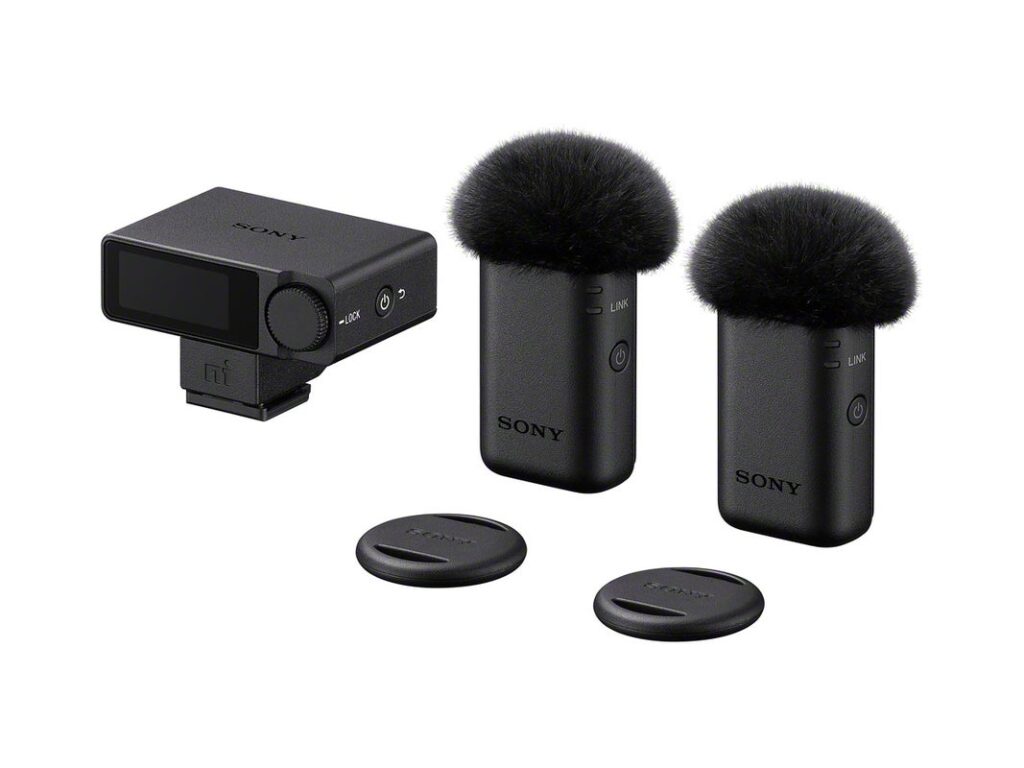
Sony is entering the premium two-person wireless microphone market with the ECM-W5, a $399.99 kit aimed at video creators who want fewer separate audio files to manage. Its headline feature is the ability to send 32-bit float audio through a compatible Sony camera’s Multi Interface Shoe and record that audio directly into the video file.
The kit includes two wireless transmitters and one receiver. Sony says it will be available in the United States and Canada in November 2026 for $399.99 USD or $569.99 CAD. Sony also plans to sell the receiver separately for $189.99 USD and each additional transmitter for $119.99 USD.
This is not a hands-on review. The specifications and performance figures below come from Sony, and several of the most interesting features require compatible Sony cameras or headphones.
Why direct 32-bit float recording matters
Wireless microphone systems commonly offer 32-bit float backup recording on the body-worn transmitter. The wider dynamic range gives editors more room to recover very quiet speech or loud peaks without constantly riding the gain control. The usual tradeoff is workflow: the backup remains a separate audio file that must be transferred and synchronized with the video.
Sony’s main pitch is that a compatible camera can receive the ECM-W5’s 32-bit float signal digitally through the Multi Interface Shoe and store it with the video. That can remove a synchronization step and reduce the risk of using the wrong take in an edit.
There are important limits. Sony specifies that 32-bit float recording operates at 48 kHz, while its higher-resolution 96 kHz mode records at 24-bit. Sony also warns that audio clipped at the microphone’s input stage cannot be restored later simply by lowering the level in editing software. And direct in-camera recording requires a compatible camera; buyers should check Sony’s compatibility list for their exact model before ordering.
Two transmitters, backups and longer-range claims
Each ECM-W5 transmitter has 64GB of built-in storage for backup recording. Sony estimates that capacity can hold up to 90 hours of 32-bit float audio at 48 kHz or up to 60 hours of 24-bit audio at 96 kHz. Actual usable storage will be lower after formatting.
The company claims a maximum wireless range of up to 500 meters when the microphone remains visible to the receiver. That is a line-of-sight laboratory-style figure, not a promise for a crowded conference hall or a city street. Walls, people, reflective surfaces and radio congestion can shorten the practical range.
Sony also says transmission is approximately three times more stable than its ECM-W3 under the company’s own measurement conditions. That is a manufacturer comparison rather than an independent test, so buyers should wait for consistent real-world testing before treating it as a guaranteed improvement.
Connections for cameras, phones and computers
The receiver mounts on compatible Sony cameras through the Multi Interface Shoe, which can carry digital audio and provide power. That reduces cable clutter and can link the receiver’s power state to the camera.
A supplied USB-C adapter extends the system to compatible phones and computers that support USB Audio Class 2.0. The transmitters also include a 3.5mm input for lavalier or other external microphones, which is useful when the clip-on unit itself would be too visible in a shot.
The system supports timecode for matching recordings across multiple cameras. It can also expand to as many as four in-camera audio channels, but a two-transmitter kit does not provide four speakers out of the box. Additional ECM-W5T transmitters are sold separately, and the exact camera configuration still matters.
Wireless headphone integration is useful but selective
Compatible Sony wireless headphones can monitor the ECM-W5 without a cable. Sony says selected models can also function as wireless microphone inputs, opening possibilities for quick voice recording or an extra audio source.
This is an ecosystem feature, not universal Bluetooth support. Compatibility varies among devices, and Sony directs buyers to a dedicated list of supported headphones. Creators using another camera or headphone brand should evaluate the ECM-W5 as a conventional USB-C or analog-capable microphone system rather than assume the deeper Sony integrations will work.
Battery life, durability and what is in the price
Sony rates the transmitters for up to 11 hours of operation. The hardware is described as dust- and moisture-resistant, but the company explicitly says it is not guaranteed to be completely dustproof or waterproof. Outdoor creators should still protect the transmitters from sustained rain and water exposure.
The $399.99 kit price includes the receiver and two transmitters. Sony’s announcement also shows windscreens and a charging case as part of the package presentation. Buyers comparing it with DJI, Rode or other systems should look beyond the number of transmitters and compare the included accessories, internal storage, timecode support, camera integration and the cost of expanding to more channels.
Who should consider the ECM-W5?
The strongest case is for a creator already using a compatible Sony camera. Direct in-camera 32-bit float recording, shoe power and linked controls can simplify interviews, events and small-team productions where there is little time to organize separate files.
Phone and computer users can still connect through USB-C, but they may be paying for camera-specific features they cannot use. Creators working across several camera brands should also confirm how much of the streamlined workflow survives outside Sony’s ecosystem.
The ECM-W5 is scheduled for November, and Sony’s U.S. store currently lists it at $399.99 but not yet in stock. Until it ships broadly, the most sensible buying step is to verify compatibility and wait for independent tests of wireless reliability, noise handling, battery endurance and the real benefit of its headphone integration.