Samsung Health is lowering one of the biggest barriers to its Sleep Coaching program. Instead of collecting seven nights of sleep data during a month, eligible users can now begin after recording just three nights within a seven-to-14-day window.
The October 2026 update also adds a clearer Sleep Balance chart, expands Running Coach for more experienced runners, brings Strava Routes into Samsung Health, and introduces a U.S. beta that can estimate a meal’s ingredients, calories and nutrition from a photo. The changes are rolling out progressively, so availability can vary by phone, wearable, app version and region.
Sleep Coaching now starts after three tracked nights
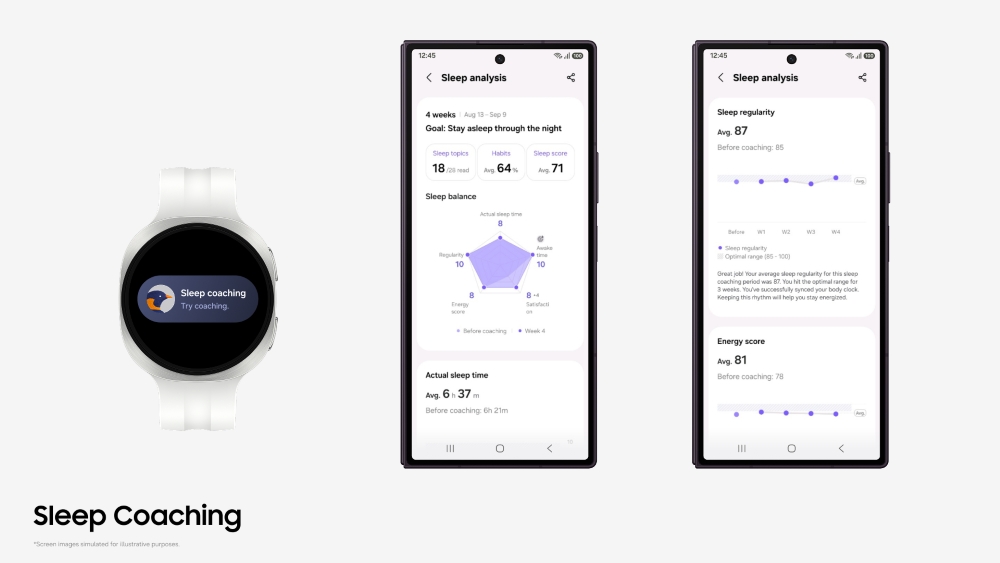
Samsung’s coaching program uses wearable data and a setup survey covering sleep regularity, nighttime interruptions, caffeine and alcohol intake, and the user’s own assessment of sleep quality. It then assigns a “Sleep Animal” profile and creates a personalized four-to-eight-week program.
The important change is the shorter setup period. Samsung previously required seven days of sleep data collected within a month. The new version needs at least three days recorded within the previous one to two weeks. That should make the feature easier to activate for people who do not wear a watch or ring every night.
After setup, the program supplies daily habit checklists, morning insights and weekly recommendations. Samsung says those recommendations adjust as sleep patterns and self-reported satisfaction change. Examples include avoiding screens during the hour before bed, limiting late caffeine and spending time outdoors after waking.
This is wellness guidance, not a medical diagnosis. Samsung explicitly says its Energy Score is for personal reference and is not intended for medical use. Anyone with persistent insomnia, breathing interruptions or other concerning symptoms should seek qualified medical advice rather than relying only on an app.
The new Sleep Balance graph combines five signals
A pentagon-shaped Sleep Balance graph is designed to make trends easier to scan. It combines five measurements:
- total sleep time;
- sleep regularity;
- time awake during the night;
- self-reported sleep satisfaction; and
- Samsung’s Energy Score.
The chart is potentially more useful than a single nightly score because it can show which part of a routine is changing. For example, someone may sleep for an adequate number of hours while still having irregular bedtimes or frequent wake periods. The value of the advice still depends on the quality and consistency of the data supplied by the wearable and the user.
Which devices support the updated sleep program?
According to Samsung’s U.S. announcement, Sleep Coaching requires Samsung Health version 6.24 or later, a Galaxy phone running Android 11 or later, and a supported wearable. Compatible trackers include the Galaxy Watch 4 series and newer watches, Galaxy Fit3 and later models, and Galaxy Ring.
Samsung is distributing the upgrade through app updates beginning in October. A compatible device may therefore meet the requirements before the new interface actually appears. Checking both the Galaxy Store and Google Play for Samsung Health updates is sensible, but repeatedly reinstalling the app will not force a staged server-side rollout.
Running Coach adds harder levels and Strava Routes
Running Coach grows from 10 to 12 training tiers. The two additional levels target intermediate and advanced runners who need higher benchmarks than the existing programs offered. Samsung continues to base a plan on either a 12-minute outdoor running test or historical running data.
The running feature has narrower compatibility than basic sleep coaching. Samsung says it requires outdoor running with GPS, a compatible Galaxy Watch using One UI 8 or later, an Android phone running Android 10 or later, and Samsung Health version 6.30.2 or above.
Strava users can now import saved routes for running, trail running and cycling into Samsung Health. This is route integration rather than a complete merger of the two services, and Strava availability is restricted in several countries. New shareable workout templates also let users export milestones, records and route highlights for social platforms.
U.S. users get Scan Meal and a Diet Score beta
The U.S. version of the announcement includes nutrition features that are not part of the global release in every market. Scan Meal uses a photo to estimate ingredients, calorie content and other nutritional details. Samsung is launching it as a beta for U.S. users age 19 or older on supported flagship phones, including the Galaxy S24 through S26 families and recent Galaxy Z Fold and Z Flip models.
The app can also produce a Diet Score across four broad ratings—Needs Attention, Fair, Good and Excellent—using information entered by the user. A separate eight-to-14-week curriculum supplies several weekly activities involving food knowledge, planning and habit changes.
These features have significant limitations. A photograph cannot reliably capture every ingredient, portion size or cooking method, so Scan Meal results should be treated as estimates. Samsung says Diet Score is for general wellness rather than diagnosis or treatment. The company also notes that beta terms can change and that Scan Meal could become a paid feature later with prior notice.
What Galaxy owners should do now
- Update Samsung Health on both phone and wearable. Feature requirements differ, and older app versions may not expose the new tools.
- Collect at least three complete nights. Wear the supported device consistently and ensure sleep records synchronize to the phone.
- Review permissions and privacy choices. Sleep surveys, meal photos and fitness routes can reveal sensitive personal patterns.
- Use trends, not one isolated score. A week-to-week view is more useful than reacting to a single poor night or questionable meal estimate.
- Check regional availability. The sleep and running updates are progressively rolling out, while Scan Meal is initially a U.S.-only beta.
The practical takeaway
The biggest improvement is not a new sensor; it is a lower activation threshold. Requiring only three tracked nights makes Samsung’s existing coaching program accessible sooner, while the Sleep Balance chart provides a more readable view of the factors behind a score.
The running upgrades and Strava support add real utility for Galaxy Watch owners, and Scan Meal could reduce the friction of food logging. Still, Samsung’s health outputs remain consumer wellness tools built on estimates and user input. They can help reveal patterns, but they should not be treated as medical conclusions or perfectly accurate nutrition records.
Source: Samsung Global Newsroom and Android Authority. Featured image: Samsung Electronics.