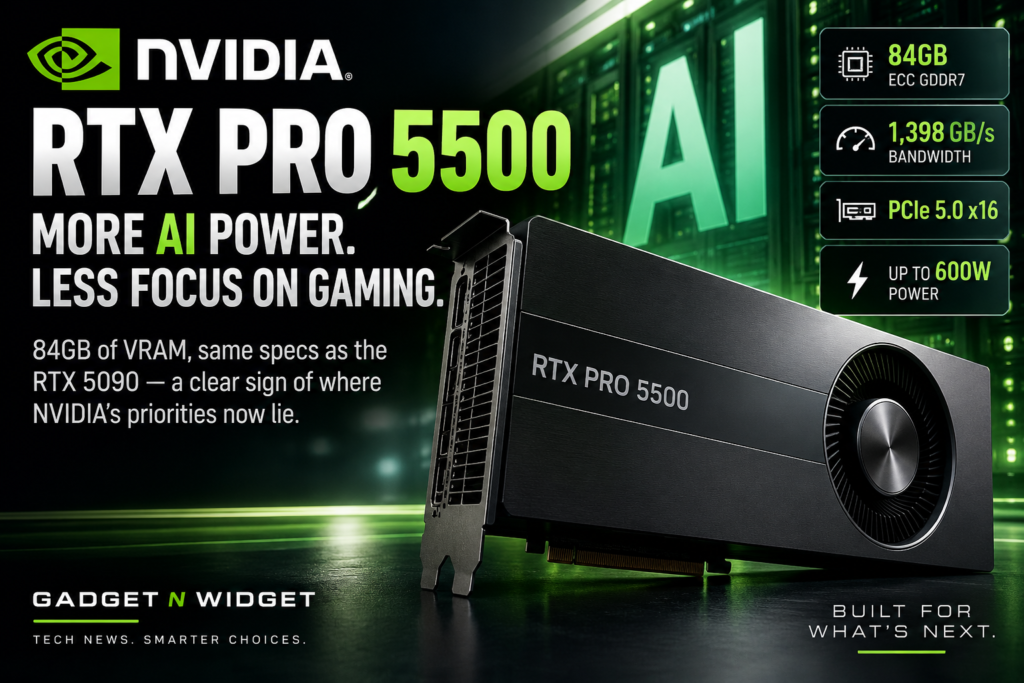
Nvidia has added a powerful new GPU to its Blackwell professional lineup: the RTX PRO 5500 Workstation Edition. At first glance, it looks surprisingly familiar. It uses the same GB202 architecture and has 21,760 CUDA cores — the same CUDA-core count as the GeForce RTX 5090. But Nvidia has made one enormous change: memory.
84GB of GDDR7 changes the story
The RTX PRO 5500 comes with 84GB of ECC GDDR7 VRAM. By comparison, the GeForce RTX 5090 has 32GB. That gives the professional card more than 2.6 times as much graphics memory.
That extra capacity matters especially for AI workloads. Large local AI models, complex simulations, huge datasets, professional 3D projects and high-resolution rendering can quickly consume GPU memory. A GPU may have plenty of processing power, but when a workload cannot fit comfortably in VRAM, memory becomes a major limitation.
RTX PRO 5500 vs RTX 5090
Both GPUs use Nvidia’s Blackwell GB202 silicon and both have 21,760 CUDA cores. The RTX PRO 5500, however, is designed as a professional workstation product rather than primarily as a gaming card.
- RTX PRO 5500: 21,760 CUDA cores, 84GB ECC GDDR7, roughly 1,398 GB/s memory bandwidth and up to 600W power.
- RTX 5090: 21,760 CUDA cores, 32GB GDDR7, roughly 1,790 GB/s memory bandwidth and 575W total board power.
So this is not simply an RTX 5090 with a new name. The much larger ECC memory pool and professional features make it better suited to demanding workstation and AI environments, even though the consumer card has higher raw memory bandwidth.
Built with AI workloads in mind
Nvidia says its RTX PRO Blackwell platform targets workloads including generative and agentic AI, simulation, graphics and other professional applications. The RTX PRO 5500 also supports Multi-Instance GPU technology, allowing its resources to be partitioned for separate workloads.
For people experimenting with large language models locally, 84GB of VRAM could be particularly interesting. More memory can allow larger models, larger context or heavier workloads to stay on the GPU instead of relying as heavily on slower system memory.
Gaming is no longer the whole GPU story
The RTX PRO 5500 is another sign of how rapidly the GPU market is changing. Flagship graphics processors are no longer valuable only because they can produce higher gaming frame rates. AI training and inference, professional visualization, simulation and content creation increasingly influence how high-end GPUs are designed and positioned.
That does not mean Nvidia is abandoning gaming. The RTX 5090 remains a gaming flagship. But the RTX PRO 5500 shows how the same underlying silicon can become a very different product when Nvidia gives it substantially more memory and targets professional AI workloads.
Price and availability
Nvidia lists the RTX PRO 5500 as coming soon, but an official retail price has not yet been announced. As a professional workstation GPU with 84GB of ECC memory, it should not be viewed as a normal RTX 5090 alternative for gamers.
Gadget N Widget take: The headline feature here is not simply performance — it is memory capacity. The RTX 5090 already demonstrated how powerful Blackwell can be, while the RTX PRO 5500 shows what essentially the same class of GPU can do when Nvidia gives professional and AI users a much larger VRAM pool.
Sources: Nvidia product information and reporting from Tom’s Hardware. This article was independently written by Gadget N Widget and does not reproduce the source article.