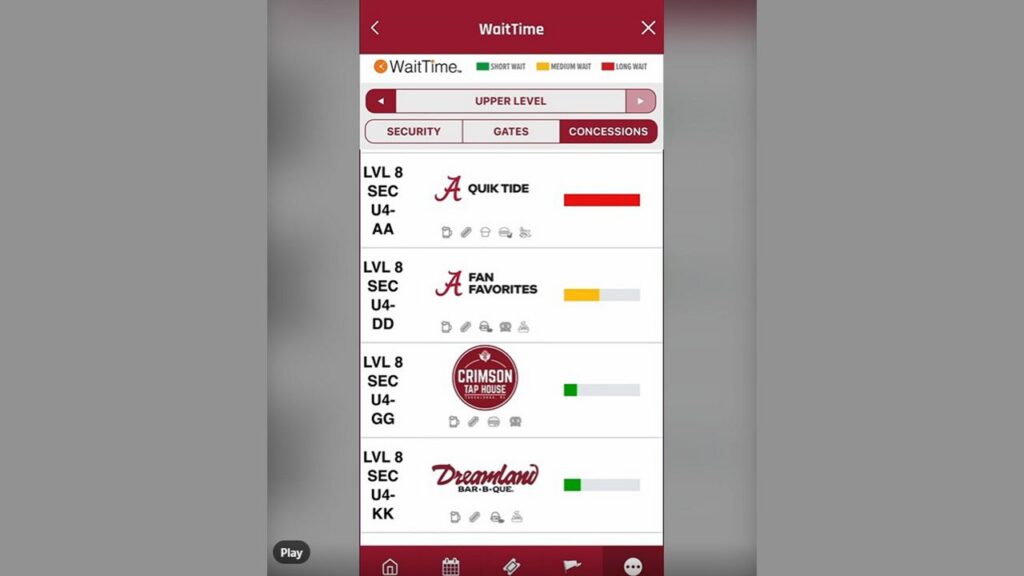
At the University of Alabama’s Bryant-Denny Stadium, an AI system is being used to help fans choose a shorter line before kickoff or during a game. Intel says the setup measures crowd movement at entrances and concession stands, gives operators live queue data, and shares red, yellow and green wait indicators in the Alabama Athletics app.
The case study, published by Intel on October 20, describes a real venue deployment rather than a newly announced consumer product. It illustrates how edge AI can be used for a practical task: process camera-derived information locally so stadium staff can react while a crowd is still moving.
How the stadium system works
Alabama Athletics partnered with WaitTime, a crowd-intelligence software company. Intel says strategically positioned overhead sensors use image pixels and movement patterns to estimate whether people are entering a line, passing through or gathering nearby. The system does not need to identify fans by name to calculate queue length and movement, according to the companies.
At the stadium, the live information appears on dashboards for staff and in the university’s fan app. The app uses simple color indicators to help visitors compare lines at gates and concessions. Stadium staff can use the same information to move personnel, adjust the flow of security checks and ticket scanning, and respond to congestion.
Intel reports that Alabama Athletics has more than 100 sensors across football entrances and concessions, with 20 more in the basketball arena. The university processes the workload on six Dell servers powered by 12 Intel Xeon processors. The exact Xeon models and the system’s purchase and operating costs were not disclosed. For a separate look at CPU software optimization across AMD and Intel systems, see our PyTorch optimization report.
Why process it at the edge?
Edge computing means analyzing data close to where it is collected—in this case, inside the venue—instead of sending raw camera feeds to a distant cloud service for every calculation. Intel says local processing reduces the delay between detecting congestion and acting on it, and that raw video stays inside the stadium.
That can be useful when minutes matter. If one entrance backs up, staff can shift resources or fans can choose another gate without waiting for a remote service to process the scene. Intel says the queue system helped Alabama identify bottlenecks and change where security checks and ticket scanning take place.
What fans and operators may gain
Intel says long entrance waits, once the top complaint in the university’s postgame surveys, no longer rank among its top 10 issues. The system has also helped the venue identify concession delays. For the 2026 season, Alabama converted 19 stands to grab-and-go kiosks after reviewing recurring wait patterns; Intel says those kiosks can process transactions up to four times faster than traditional cashier lines.
Those figures come from Intel’s account of the deployment, not an independent comparative study. Results will vary with venue layout, sensor placement, staffing, app adoption and how quickly operators respond. The public write-up does not provide baseline wait times, a measured average reduction, independent accuracy testing or a detailed cost-benefit analysis.
Privacy claims need context
Intel and WaitTime describe the analysis as anonymous and say the venue processes the visual data locally. That is different from saying no cameras are used: overhead sensors observe crowds so software can estimate movement and queue conditions. Visitors who want to understand the full privacy picture should look for the venue’s own notice covering camera placement, retention, access to data and whether any information leaves the local system.
The case study does not publish a full technical privacy assessment, sensor specifications or independent audit. So the safest reading is that the vendor says it uses aggregate movement data and local processing—not that the system has been independently proven to capture or retain no identifiable information.
Could this come to other venues?
WaitTime says its software is already used at more than 25 sports, convention and shopping venues. A stadium with thousands of visitors has obvious reasons to monitor queues, but this is not something a fan can buy or install. Adoption requires venue hardware, network and server capacity, software, an app or display system, and staff procedures for acting on the data.
For visitors, the most visible change is simple: check the venue app, compare the wait indicators, and follow posted directions. For operators, the larger promise is turning crowd patterns into better staffing and layout decisions. The Alabama example shows the potential, while leaving the economics and independent performance measurements open.
Sources: Intel Newsroom, October 20, 2026; WaitTime.
Featured image: Alabama Athletics fan-app wait-time dashboard at Bryant-Denny Stadium; image courtesy of Intel Corp.