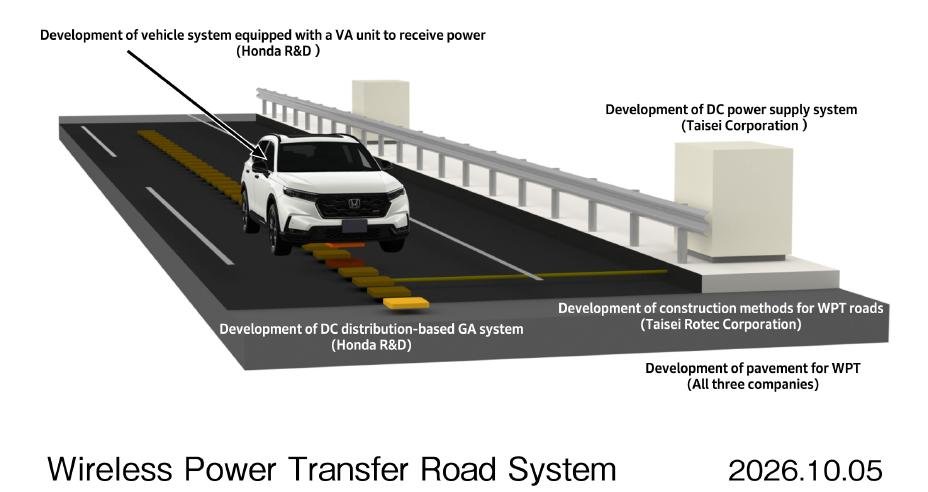
Honda has outlined a road-embedded charging system designed to send power to electric vehicles while they are moving. The project is aimed first at logistics fleets and other heavy commercial vehicles, not at giving today’s passenger EVs a cable-free charging upgrade.
The company announced the underlying technology on October 5, 2026, alongside construction partners Taisei Corporation and Taisei Rotec Corporation. A public-road demonstration is planned in Japan during fiscal 2027 or later, so the system remains an engineering program rather than a product drivers can buy or use today.
What Honda has developed
The project uses magnetic coupling. Transmitter units, which Honda calls ground assemblies, are embedded in a lane and connected to a roadside DC power supply. A receiver mounted underneath the vehicle collects energy as the vehicle passes over the active section.
Honda is responsible for the road transmitters and the vehicle-side receiver. Taisei Corporation is developing the power-supply system, while Taisei Rotec is working on methods for installing the hardware in pavement. The partners say the design is being developed with retrofits to existing roads in mind, using road milling and embedding techniques rather than requiring an entirely new kind of highway.
That division of work matters because dynamic wireless charging is not only an automotive problem. It also has to survive road construction, water, heat, vibration, repairs and years of heavy traffic while connecting safely to the electrical grid.
The 150 kW figure is a target, not a finished specification
Honda says later testing will verify output of up to 150 kW for large commercial vehicles and confirm reliable operation at highway speeds. That is an important distinction: 150 kW is the intended validation target for the program, not a commercially available charging rate or a claim that every equipped vehicle will continuously receive that power.
The road hardware is being designed for routes carrying vehicles with a gross weight of roughly 20 metric tons. Durability testing will simulate one million wheel-load passes using a 49-kilonewton load per wheel. Engineers will also examine power-transfer performance and ways to limit electromagnetic leakage.
Honda has not disclosed energy-transfer efficiency, the length of road needed to deliver a useful charge, installation cost per kilometer, maintenance cost or the share of rated power that a moving vehicle would receive under real traffic conditions. Those missing numbers will determine whether the technology can compete with large stationary chargers.
Where and when public testing is planned
Before the highway demonstration, the companies plan to build a test road at Taisei’s T-FIELD/TAMRA research site in late 2026. Public-road testing is then expected on the Tateyama Expressway in Chiba Prefecture under NEXCO East’s Tateyama Project, beginning in Japanese fiscal 2027 or later. Fiscal 2027 starts on April 1, 2027.
The trial is expected to focus on logistics and transportation vehicles. That is a sensible starting point: trucks and buses often follow predictable routes, stop on tight schedules and carry large batteries that add weight and cost. Charging along a frequently used corridor could reduce long stationary charging stops, and in some carefully designed operations it might eventually allow a smaller battery.
Why DC distribution could make the road easier to build
Honda’s concept sends DC power along the road to integrated transmitter units. The company says this can simplify wiring and make later upgrades easier. It also describes the ground unit as combining an inverter and charging coil in one module; Honda says it was the first publicly disclosed dynamic wireless power-transfer unit with that integrated design as of the end of September 2026.
That claim comes from Honda and should be read narrowly. Other companies and research groups have demonstrated roads that transfer power to moving vehicles, but Honda is specifically claiming a first for the disclosed integration of the inverter and coil inside the road unit.
A modular design could help crews replace failed sections without rebuilding an entire charging lane. Still, any embedded system faces a difficult serviceability tradeoff: putting electronics under pavement protects them from direct contact but makes access more disruptive than servicing a conventional charger beside the road.
What would have to happen before ordinary EVs could use it
The test program leaves several major questions unanswered:
- Compatibility: Honda has not announced an industry standard or said whether receivers from other manufacturers could use the system.
- Economics: There is no pricing for road installation, vehicle hardware or electricity delivery.
- Efficiency: Power lost between the road and a moving receiver will influence operating cost and grid demand.
- Safety and regulation: Electromagnetic emissions, foreign objects, weather, crash damage and maintenance procedures all need validation.
- Infrastructure: A useful corridor needs grid capacity, control equipment and enough energized pavement to deliver meaningful energy.
Passenger vehicles would also need a compatible underbody receiver, power electronics and software. There is no announced retrofit kit, production Honda model, consumer price or sales date. In other words, current EV owners should not delay a purchase while waiting for this road technology.
Why the experiment is still worth watching
Dynamic charging is most compelling where vehicles repeat the same route all day. A freight corridor, dedicated bus lane, port or depot approach can concentrate expensive infrastructure where it receives frequent use. That is more realistic than electrifying every lane of a national highway network.
If Honda and its partners can prove durability, safe high-speed operation and acceptable efficiency, the project could give fleet operators another way to balance battery size, cargo capacity and charging downtime. If installation and maintenance remain too expensive, high-power depot and roadside chargers will continue to be the simpler option.
For now, the announcement is best understood as a roadmap for a real-world engineering trial. The notable news is not that Honda has solved charging roads, but that it has named the partners, road program, durability target and future 150 kW validation goal needed to move the idea closer to a public highway.
Sources
- Honda Global: development of in-motion wireless charging technology
- Reuters: Honda plans highway test for wireless charging of moving trucks
- NEXCO East: Tateyama Project information
Featured image: Honda Motor Co.