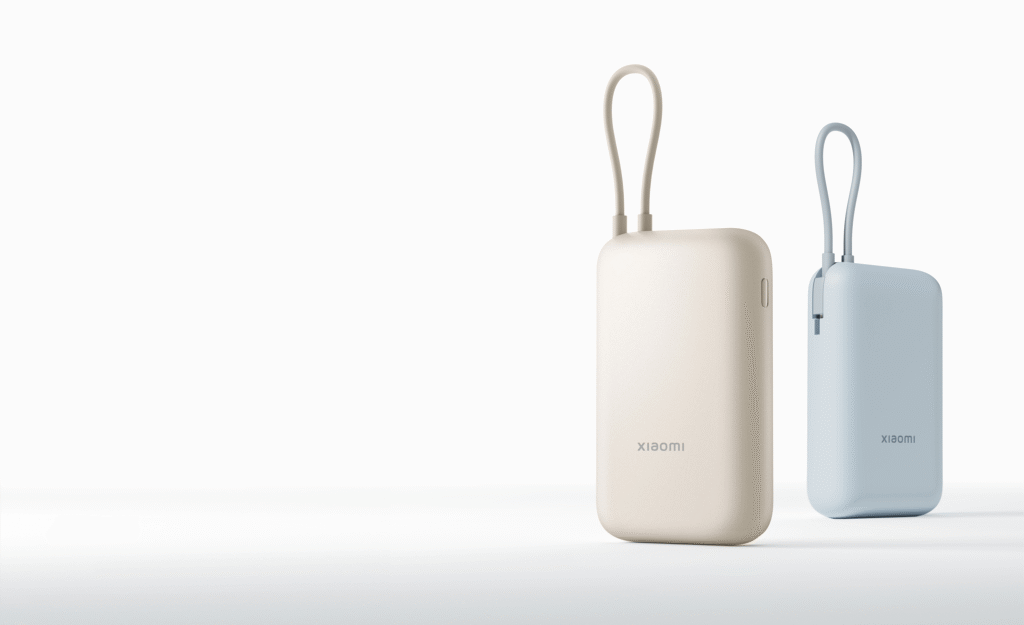
Xiaomi has added a refreshed Power Bank 10000 (Integrated Cable) to its global product catalog. The compact battery keeps the same practical formula—10,000mAh capacity, a built-in USB-C cable and up to 22.5W charging—but the 2027 revision is being positioned around upgraded cell safety rather than a major speed increase.
The international listing confirms the core specifications and two colors, but Xiaomi has not announced a global price or a country-by-country release date. That makes this an early product listing rather than a device shoppers can assume is available everywhere today.
One cable and two extra ports
The most useful part of the design is the integrated USB-C cable. It can charge another device and can also be used as an input to refill the power bank, reducing the number of loose cables needed in a travel bag.
Alongside that cable, the body has a separate USB-C port and one USB-A port. Xiaomi says all three outputs can operate simultaneously and that each can deliver up to 22.5W when used alone. Total output will be shared when several devices are connected, so users should not expect three gadgets to charge at 22.5W at the same time.
The power bank measures a reported 105.2 × 65.2 × 26.9mm and weighs 231.5g. That is small enough for a bag or a loose jacket pocket, though it is noticeably heavier and thicker than a basic phone.
Charging speed is useful, not cutting-edge
Xiaomi’s official product page lists a maximum output of 22.5W and two-way USB-C fast charging. The company says the pack can recharge itself in about 2.75 hours when paired with a compatible 22.5W-or-faster QC charger.
For Apple devices, Xiaomi advertises up to 20W charging and says an iPhone 14 can reach 57% in 30 minutes, although that test requires a separately purchased USB-C-to-Lightning cable. Owners of an iPhone 15 or newer can use the attached USB-C cable instead.
At 22.5W, this model is better suited to phones, earbuds, fitness bands and a Nintendo Switch than to laptops. Competing compact power banks now reach 30W, 45W or more, so charging speed is not the reason to choose Xiaomi’s refresh. Convenience and expected affordability are the stronger arguments.
What 10,000mAh means in practice
Xiaomi claims the power bank can charge a Xiaomi 13 about 1.7 times, an iPhone 14 twice or a Nintendo Switch about 1.1 times under its laboratory conditions. Real results depend on cable losses, conversion efficiency, battery temperature and whether the connected device is being used while it charges.
The product’s nominal cell capacity is 10,000mAh, but Xiaomi lists a rated output capacity of 5,500mAh at 5V/3A. That difference is normal for power banks: the headline capacity is measured at the lower internal battery-cell voltage, while USB output is delivered at a higher voltage and loses some energy during conversion.
For comparison shopping, watt-hours and rated output capacity are often more useful than the large milliamp-hour number printed on the package. Xiaomi says this model falls below the 100Wh limit commonly used in international airline rules, although travelers still need to follow their airline’s specific carry-on requirements.
The update focuses on battery safety
Notebookcheck’s September 26 report identifies this as a 2027 refresh with upgraded battery protections. It says the new version passed needle-penetration and compression testing as well as a 135°C hot-box test without exploding. Those results are manufacturer claims and have not been independently tested here.
Xiaomi’s global page lists nine layers of protection covering high temperature, short circuits, input and output overcurrent, overvoltage, overcharging and over-discharging. The internal control chip also detects connected devices and adjusts current automatically.
A low-current mode is available for small accessories that may not draw enough power to keep an ordinary battery pack active. Double-pressing the battery-check button enables the mode for earbuds, smart bands and similar products.
Important limits and unanswered questions
The integrated cable is convenient, but it is also a fixed part that will receive repeated bending and pulling. Xiaomi does not state on the global page whether the cable can be replaced if it is damaged. The separate USB-C port means the power bank should remain usable with another cable, but the defining convenience feature would be lost.
There is no wireless charging, display or high-output laptop mode. Battery status is shown through a simpler indicator rather than a percentage screen. The maximum 22.5W figure also applies only in the right single-port conditions and with a compatible device and protocol.
Most importantly, Xiaomi has not published pricing or confirmed which countries will sell the 2027 revision. The older version has been listed in the UK for £22.99, but that is context rather than a confirmed price for the refreshed model. US availability is also unconfirmed; Xiaomi’s US store currently lists other power banks, not this new global version.
Who this power bank is for
The new Power Bank 10000 makes the most sense for travelers and commuters who value an attached cable more than the fastest possible charging. Its three-output design can cover a phone, earbuds and another small accessory, while the 10,000mAh class remains manageable for daily carry.
Buyers who need to charge a USB-C laptop or refill a phone as quickly as possible should look at higher-wattage alternatives. Everyone else should wait for local pricing: at an aggressive price, the upgraded safety focus and integrated cable could make this a practical everyday pack, but Xiaomi has not yet supplied enough availability information to judge its value.
Image: Xiaomi.