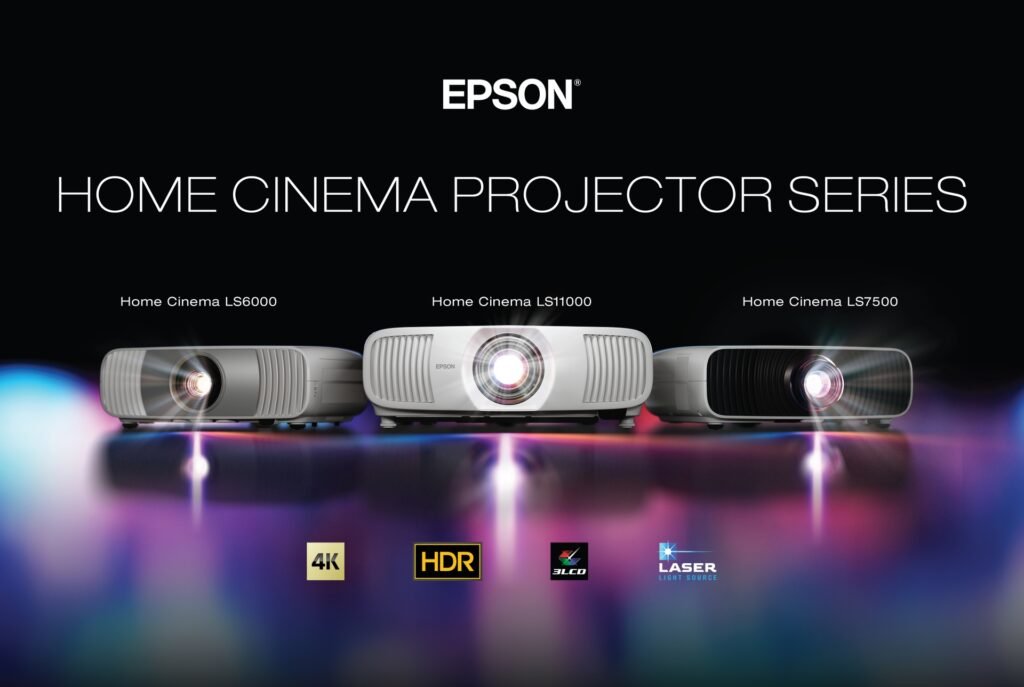
Epson has expanded its US Home Cinema range with three laser projectors aimed at movies, sports and current-generation console gaming. The new Home Cinema LS5000, LS6000 and LS7500 start at $1,999.99 and share 4K HDR processing, dual HDMI inputs, 120Hz support and a claimed input lag below 20 milliseconds.
The lineup is scheduled to reach Epson’s online store and selected US retailers in late September. The main buying decisions are brightness, price and placement: the LS5000 is the least expensive, the LS6000 makes a large jump in light output for $200 more, and the LS7500 adds a shorter-throw lens for rooms where a conventional projector would sit too far from the screen.
Prices and the important differences
| Model | US price | Brightness | Lens |
|---|---|---|---|
| Epson Home Cinema LS5000 | $1,999.99 | 2,500 color and white lumens | Standard Epson Cinema lens |
| Epson Home Cinema LS6000 | $2,199.99 | 3,400 color and white lumens | Standard Epson Cinema lens |
| Epson Home Cinema LS7500 | $2,699.99 | 3,500 color and white lumens | Shorter-throw Epson Cinema lens |
The LS6000 looks like the value-focused step-up model on paper. It costs $200 more than the LS5000 but increases Epson’s brightness rating from 2,500 to 3,400 lumens. The LS7500 adds only another 100 lumens; most of its $500 premium over the LS6000 pays for the lens and the extra installation flexibility it provides.
Epson says the LS7500 can sit as much as three feet closer to the wall than a conventional model while still producing an image up to 300 inches. It is a short-throw projector, not an ultra-short-throw unit designed to sit directly below the screen, so buyers still need to calculate the required distance for their intended image size.
All three support 4K HDR at up to 120Hz
The three projectors use laser light sources and three-chip 3LCD imaging engines. Epson rates color brightness and white brightness equally on each model, with the measurements based on IDMS and ISO standards respectively.
Each projector accepts 4K HDR content at up to 120Hz through its two HDMI ports. Auto Low Latency Mode is included, and Epson claims input lag below 20ms. That combination makes the range relevant to PlayStation 5, Xbox Series and gaming-PC owners who want a very large display without being limited to 60Hz.
One HDMI port supports eARC for sending sound to a compatible receiver or soundbar. Bluetooth 6.0 can also stream two-channel audio from an HDMI source to wireless headphones, which could be useful for late-night viewing. Epson lists manual lens shift of plus or minus 21% horizontally and plus or minus 59% vertically across the range.
“4K” uses pixel-shifting technology
Epson says its 4K Display Technology creates an 8.29-million-pixel image on the screen. The company’s own footnote explains that this is resolution-enhancement technology that shifts pixels to produce the stated on-screen image, rather than a native 4K imaging panel.
That distinction does not automatically determine picture quality, but it matters when comparing specifications with native-4K projectors. None of the three has been independently tested here, so real sharpness, black level, fan noise and HDR performance remain to be established by reviews.
The projectors process 10-bit color and support HDR10 and HLG. Epson also includes automatic HDR scene correction. Dolby Vision is not listed in the company’s announcement or product specifications, so buyers with a Dolby Vision-heavy movie library should expect the source device to fall back to a supported HDR format.
Contrast claims and screen sizes
The LS5000 and LS6000 product pages list dynamic contrast ratios of 800,000:1. The LS7500 is rated at 1,000,000:1. Dynamic contrast figures are manufacturer measurements and do not directly describe the native contrast a viewer will see in a given room.
All three support 16:9 television and 21:9 cinematic aspect ratios and are specified for images up to 300 inches. A screen that large will demand careful control of ambient light, and the LS5000’s lower brightness makes room conditions especially important. Buyers should also remember that a projector’s usable brightness can change with picture mode, throw distance and calibration.
What is not built in
These are home-theater projectors rather than all-in-one smart projectors. Epson’s specifications emphasize HDMI, USB, RJ-45 and Bluetooth connectivity but do not list an integrated streaming platform or built-in speaker system. A streaming box, game console, disc player or receiver will therefore be part of most installations, along with separate audio.
That approach suits an enthusiast setup, but it makes the actual cost higher than the projector price alone. A suitable screen, ceiling mount or shelf, long HDMI cable and sound system can add substantially to the budget.
Availability and warranty
Epson announced the LS5000, LS6000 and LS7500 on September 22 and says all three will be available in the United States in late September. Each carries a two-year limited warranty that includes full-unit replacement and free technical support.
The trio sits below Epson’s $4,499.99 Home Cinema LS11000. For shoppers starting near $2,000, the choice is straightforward on paper: the LS5000 minimizes cost, the LS6000 buys considerably more brightness for a modest premium, and the LS7500 is primarily for people who need its shorter throw. Independent measurements will still be important before deciding which one delivers the best picture for the money.
Image: Epson.