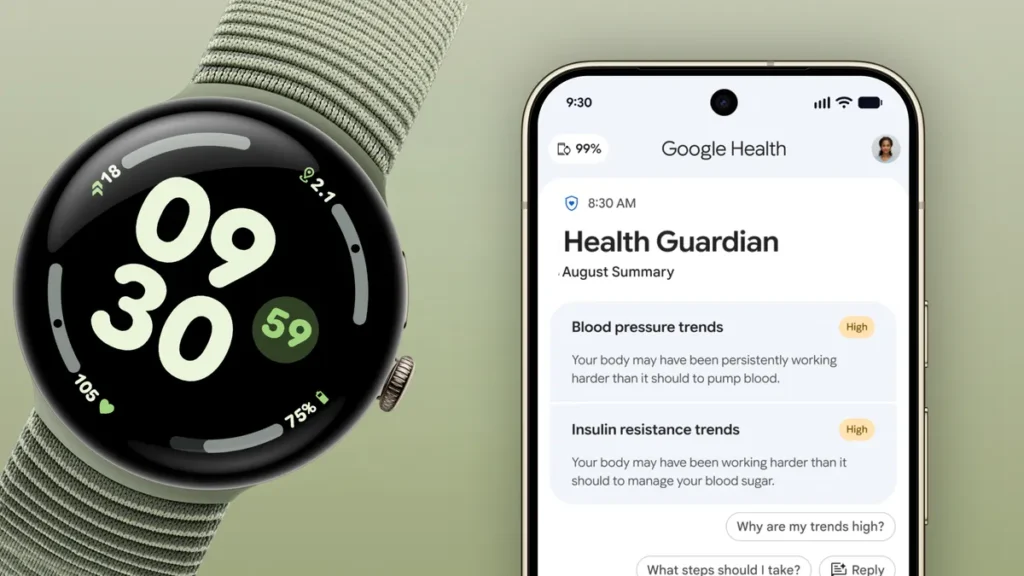
Google is rolling out three new long-term wellness reports to Pixel Watch 3, Pixel Watch 4 and Pixel Watch 5 owners. Starting this week, users can set up blood pressure trends, insulin resistance trends and sleep breathing quality in the Google Health app. Google says the tools are included at no extra charge on those three watch generations, with the first monthly trend reports due in early October.
The timing matters because Google announced the Health Guardian suite alongside the Pixel Watch 5 in August, but the headline features were not ready when the watch launched. The September 24 rollout turns those promises into something owners can actually configure—while also placing strict limits on what the results should be used for.
What Pixel Watch owners are getting
Unlike a traditional blood pressure cuff or a glucose meter, these features do not produce on-demand clinical readings. Google’s rollout announcement describes them as background tools that look for patterns across days and weeks.
- Blood pressure trends use pulse and motion patterns gathered over time to estimate whether a user’s cardiovascular trend is persistently higher. Google says the system does not need a cuff or manual calibration.
- Insulin resistance trends analyze multi-week physiological data to flag changes associated with metabolic health. The watch does not measure blood glucose, and the feature is not a diabetes test.
- Sleep breathing quality estimates how much of each night was spent with optimal breathing, then rolls those nightly results into a longer-term assessment.
The first two reports arrive on the first day of each month, provided the watch has collected enough data. Google requires at least seven days of data in a month for an insulin resistance report and at least five consecutive days within a week for a blood pressure trend. That minimum explains why people enabling the features now will not receive an instant result.
Pixel Watch 3 owners are included
The free rollout covers the Pixel Watch 3, 4 and 5. That is useful news for owners of the two older generations: they do not need to buy the latest model or add Google Health Premium just to receive these three trend reports.
Fitbit Air follows a different model. Google says Air owners will get blood pressure and insulin resistance trends later in 2026 through a Google Health Premium subscription. The company has not given a more specific date in its rollout notice.
Availability still varies by country and device. Google also uses different names in some regions: blood pressure trends may appear as “Vascular Stress” or “Vascular Stress Trends” in Japan and Mexico, while insulin resistance trends may be called “Metabolic Stress Trend” there.
These reports are not medical diagnoses
The most important limitation is in Google’s own fine print. Blood pressure trends are not a replacement for an arm-cuff monitor, do not screen for hypertension and cannot be used to adjust medication. Insulin resistance trends do not diagnose diabetes or monitor glucose. Sleep breathing quality does not screen for sleep apnea.
Google classifies all three as general-wellness and informational features. They do not provide real-time clinical readings, and the company says they should not be used by pregnant people. Anyone who sees a concerning change should confirm it with an appropriate home device or discuss it with a healthcare professional instead of changing treatment based on the watch.
That distinction is easy to miss because “blood pressure” and “insulin resistance” sound like conventional medical measurements. In practice, Health Guardian is closer to an early-warning dashboard: it may show that a longer-term pattern deserves attention, but it does not tell a user their current systolic pressure or blood glucose level.
How the system works in the background
Google’s earlier technical overview says the blood pressure feature passively studies pulse and motion patterns, while the insulin resistance feature draws on multiple weeks of wearable data. Both depend on machine-learning models trained to find subtle changes in sensor signals.
The company says its blood pressure system is based on a foundation model called WavesFM, trained on heart and movement data and evaluated with clinical reference measurements. Its insulin resistance model was validated against standard blood tests. Those are manufacturer claims, not independent testing of the consumer rollout, and real-world usefulness will depend on consistent wear, sensor quality and how clearly the Google Health app explains uncertain results.
The watches collect the underlying signals quietly, but users still need to opt in and complete setup in the Google Health app. Internet access is required for the app experience. Google Health Coach can help interpret the reports, although that conversational coaching layer requires a separate Google Health Premium subscription.
A separate emergency feature has narrower availability
Health Guardian also includes breathing emergency detection, but it should not be confused with sleep breathing quality. The emergency feature is limited to Pixel Watch 4 and 5 users in selected European countries. It is designed to prompt an emergency call after detecting a persistent, critical drop in blood oxygen and a lack of response from the wearer.
Google says the feature carries a CE mark in the European Union but has not been cleared or evaluated by the U.S. Food and Drug Administration. It may miss emergencies, and calling depends on a charged device and adequate connectivity. None of those restrictions applies in the same way to the three monthly wellness reports, which are the focus of this week’s broader rollout.
Why this update matters
Most smartwatches are good at showing today’s heart rate, last night’s sleep or a completed workout. Google is trying to make the same sensors useful over much longer periods, where a slow change can matter more than any single reading.
For Pixel Watch 3 and 4 owners, the practical benefit is that the biggest Health Guardian additions are arriving as a software feature rather than a hardware upgrade. The tradeoff is patience and caution: users need enough wear time to generate a report, and the result is a trend to investigate—not a diagnosis to act on by itself.
Image: Google.