Blue Planet III is making an unusual creative choice for a prestige nature series: some of its less-perfect footage is staying in the final cut.
The BBC production’s team says visible plankton, murky water, boats and buoys can help viewers recognize that the remarkable animal behavior on screen was captured in the real ocean—not generated by artificial intelligence. The decision lands at a moment when synthetic video is becoming more convincing and audiences have more reason to question imagery that looks impossibly clean.
What Blue Planet III is changing
Earlier installments of the franchise were celebrated for exceptionally polished underwater photography. That standard has not disappeared, but executive producer Elizabeth White told The Guardian that shots once rejected because of suspended plankton or poor water conditions may now make the cut. The production may also leave a distant boat or buoy in the frame instead of composing around it.
That does not mean the series is intentionally making the ocean look bad. It means the production is allowing more of the conditions that naturally accompany underwater filming to remain visible. Those details act like texture: they remind the viewer that a camera and crew were operating in an unpredictable physical environment.
BBC specialist factual commissioning head Jack Bootle was even more direct at a press screening, saying no generative AI was used in the series—not a single frame. That is an important distinction. The creative choice is not a disclosure system for a mixture of real and synthetic scenes; it is an attempt to make entirely photographed material feel credibly real.
New cameras still play a major role
Keeping rough edges does not mean Blue Planet III is stepping away from advanced production technology. The four-year shoot covered five oceans and used several specialized tools designed around difficult animal behavior.
Among them is an underwater “stonefish” CCTV camera used to record dolphins plugging holes in coral with sea sponges so they can trap fish. The team also developed a small dome camera for following an octopus, used deep-sea camera extensions, and equipped divers with leg-mounted scooters to create more fluid first-person movement. Lasers were used to help film animals in the deep ocean.
The result is a useful contrast: cutting-edge cameras expand what can be observed, while imperfect water and background details help establish that the observation happened in the real world. The technology is there to reach the scene, not to replace it.
What viewers will see
The official BBC Earth page describes the series as a return to the franchise 25 years after the original. Its episode listing includes tropical seas, the open ocean, seasonal seas and polar waters, with each listed installment running 50 minutes.
Reported sequences include fish communicating across species, roughly 200,000 crabs forming a feeding line, and sea urchins carrying shells like sun hats. The series also addresses warmer oceans, plastic pollution and persistent chemicals, rather than treating the natural world only as spectacle.
Sir David Attenborough returns as narrator. According to the production team, the 100-year-old broadcaster remained involved in the scripts and continued responding closely to new footage.
When and where Blue Planet III will be available
Blue Planet III is scheduled to begin on BBC One and BBC iPlayer in the United Kingdom on Sunday, November 1, 2026. The official BBC Earth site currently offers a first-look trailer and episode information, but access and release timing can vary by country. Viewers outside the UK should check their local BBC Earth or distribution listing rather than assume the iPlayer date applies everywhere.
There is no separate hardware purchase or technical requirement attached to the series. Picture quality will depend on the broadcaster, app, subscription arrangement and display used in each market. The BBC has not framed the cloudier images as a lower-resolution version; the visible imperfections are part of the captured environment and editorial approach.
Why the “rough edges” strategy matters
AI-watermarking and content-credential systems try to carry provenance through metadata. Those approaches can be useful, but viewers do not always see that information, and it can disappear when a video is clipped or reposted. Blue Planet III is testing a second layer of trust that works inside the picture itself.
The strategy has limits. Murky water is not proof that a video is authentic, because an AI system could imitate it. Clean footage is not suspicious by default, either. A production’s sourcing, editorial standards and explicit disclosure still matter more than any one visual cue.
Even so, the choice reflects a broader change in visual culture. For years, cameras, displays and editing workflows competed to remove noise and distraction. As synthetic video improves, some creators may decide that the evidence of real-world friction—weather, particles, awkward framing and all—has new value.
For viewers, the practical takeaway is simple: spectacular footage should not need to look sterile to be worth watching. In this case, the plankton in the frame may be part of the story.
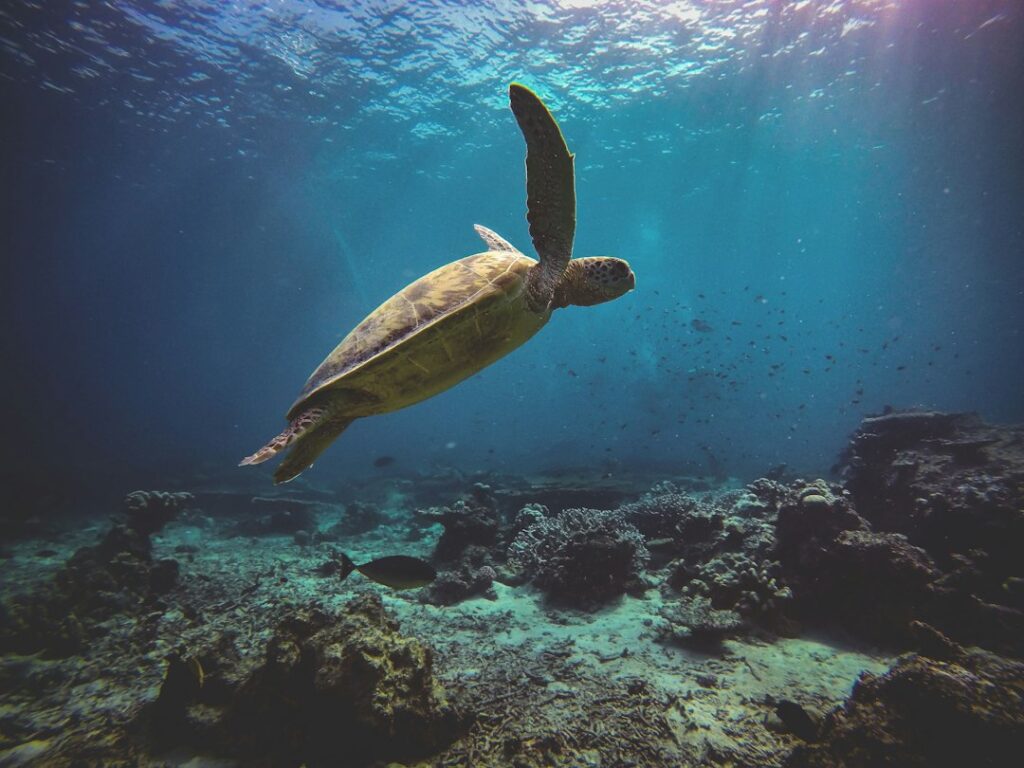
Featured image: sea turtle in the ocean, photographed by Jesse Schoff on Unsplash. The image is illustrative and is not a frame from Blue Planet III.