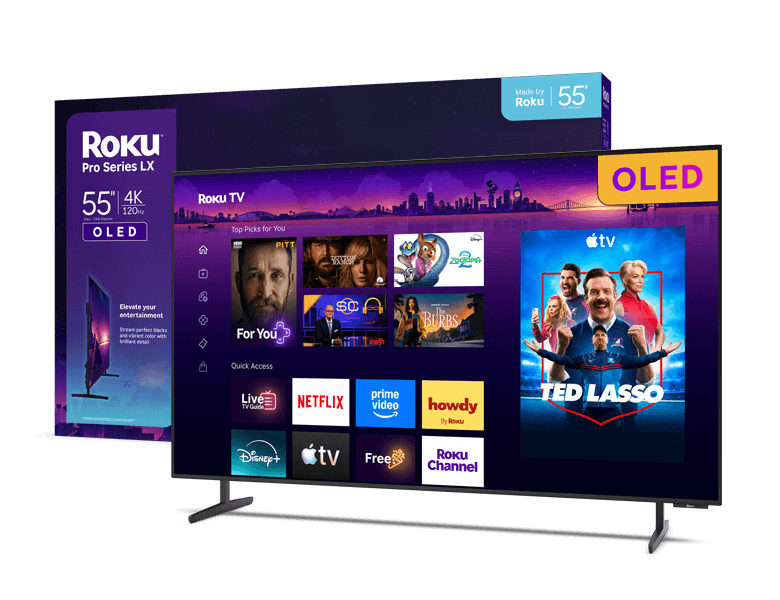
Roku’s higher-end Pro Series LX OLED televisions are now available in the United States, giving the company a more ambitious option for buyers who want Roku OS without settling for an entry-level panel. The lineup comes in 55- and 65-inch sizes, priced at $1,299.99 and $1,599.99 respectively.
The LX models sit above Roku’s standard Pro Series OLED sets. Both families use 4K self-lit OLED panels, but Roku positions the LX as its brightest OLED option with a wider color range, faster variable refresh rate and upgraded connectivity. The new televisions are being sold through Amazon, with Roku’s official product page linking directly to the retailer.
Roku Pro Series LX prices and sizes
There are two configurations:
- 55-inch Roku Pro Series LX OLED: $1,299.99, model 55RCD5
- 65-inch Roku Pro Series LX OLED: $1,599.99, model 65RCD5
That creates a meaningful premium over the regular Roku Pro Series OLED. Roku lists the standard 55-inch set at $999.99 and the 65-inch version at $1,199.99, so choosing LX adds $300 or $400 depending on screen size.
The range stops at 65 inches. Buyers looking for a 77-inch OLED or a larger home-theater screen will need to consider another product line. Roku also has not announced a smaller 42- or 48-inch LX model for a desk or compact gaming setup.
What the LX upgrade adds
The most visible upgrade is Roku’s claim of its brightest OLED picture and widest color range. Because OLED pixels generate their own light and can switch off individually, the technology can produce deep black levels without the blooming that can appear around bright objects on some LCD televisions.
The display supports Dolby Vision, HDR10+ and HLG. Roku Smart Picture Max automatically adjusts picture settings for the content on screen, although buyers who prefer manual calibration can still change the available picture controls.
Connectivity also improves. The LX uses Wi-Fi 6 instead of the Wi-Fi 5 connection in the standard Pro Series OLED, and wired Ethernet remains available. Roku lists four HDMI 2.1 inputs in total, with one supporting eARC, plus USB-C, USB-A, an antenna input and optical audio output.
144Hz VRR targets gamers
The Roku Pro Series LX supports a variable refresh rate of up to 144Hz. That can be useful with a compatible gaming PC because the television can synchronize its refresh rate with the system’s changing frame output, reducing visible tearing. Console games that support 4K at 120 frames per second can use the set’s HDMI 2.1 capability, while 144Hz is most relevant to suitable PC hardware.
Roku also includes AMD FreeSync Premium, automatic low-latency mode and an automatic game mode. These features are designed to reduce lag and smooth motion, but Roku has not published detailed input-lag measurements on the product page. Real performance will depend on the connected device, resolution and picture mode.
The remote and smart-TV experience
Each LX television includes the second-generation Roku Voice Remote Pro. It has backlit buttons, a rechargeable battery, hands-free and push-to-talk voice control, a customizable shortcut and a lost-remote finder. A charging cable is included in the box.
Roku OS provides access to major paid streaming services and Roku’s free live-TV channels. The televisions also support Apple AirPlay, Apple Home, Alexa, Google Home and Roku Smart Home integrations. Bluetooth Headphone Mode lets one viewer listen privately with compatible headphones.
Dolby Atmos support is included, but a format logo does not guarantee room-filling sound from the television’s built-in speakers. A soundbar or receiver may still be worthwhile for buyers building a serious home-theater system. eARC is available for passing high-quality audio to compatible equipment.
Who should consider the Pro Series LX?
The LX is aimed at buyers who value the simple Roku interface but also want a premium OLED panel and stronger gaming support. The 144Hz VRR ceiling, Wi-Fi 6 and rechargeable remote are the clearest reasons to choose it over the regular Pro Series OLED.
The value question is less straightforward for movie-first viewers. The standard Pro Series already offers 4K OLED, a 120Hz refresh rate, Dolby Vision, HDR10+, Dolby Atmos and HDMI 2.1 for less money. If 144Hz PC gaming and the brighter-panel claim are not priorities, the cheaper model may cover the same essential uses.
Roku has not provided independent brightness measurements, detailed color-volume figures or long-term image-retention data for the LX. Those gaps matter when comparing it with established OLED lines from LG, Samsung and Sony. Buyers should also check current street prices because televisions frequently sell below list price.
The practical takeaway
The Pro Series LX moves Roku further into the premium-TV market while keeping the company’s familiar software at the center. Its specifications are competitive on paper: 4K OLED, up to 144Hz VRR, broad HDR support, four HDMI 2.1 ports and Wi-Fi 6.
At $1,299.99 for 55 inches and $1,599.99 for 65 inches, however, the LX is not positioned as a budget Roku TV. Its best fit is a buyer who specifically wants Roku OS and plans to use the faster gaming features. Everyone else should compare the regular Pro Series OLED and similarly priced competitors before paying the LX premium.